Changning

Things to do in Changning

Search attractions or local attractions & tours
Search

Explore top experiences

Top 10 attractions in Changning

View all Attractions
Yulong Snow Mountain
2026 Asia 100 - Best Things to Do

Yulong Snow Mountain

9.1
4.4/5
20.8k reviews

Yulong Snow Mountain is one of Lijiang's famous attractions and a sacred mountain in the hearts of the Naxi people. It consists of 13 undulating peaks that resemble a dancing silver dragon, which is how it got its name. Within the attraction, visitors can take a cable car directly up the mountain to easily admire the magnificence of the high-altitude glacier, which is a highlight for many visitors coming here. Snow mountain overview Yulong Snow Mountain is renowned for being "dangerous, wondrous, beautiful, and elegant." From the foot to the summit, there are multiple tiers of views ranging from subtropical to temperate to frigid zones. At the foot of the mountain lies Ganhaizi, a vast pasture where gentians and azaleas bloom across the meadows in spring and summer. From here, the peaks of Yulong are clearly visible in the distance. Yunshanping, at an elevation of over 3,200 m, is a sacred place in the hearts of Naxi youth. It is a tranquil meadow surrounded by ancient towering trees and dense vines, creating a serene environment. Below the thirteen peaks of Yulong are 13 modern maritime glaciers, which from afar appear like a waterfall hanging overFanzi DouBelow, under the sunlight, it glistens with silver light. Tourists can take the large cableway to an altitude of 4506 m, and then follow the mountain boardwalk to view the glacier and the majestic main peak up close. Large cableway The attraction's popular cable car transports visitors from the lower station at Ganhaizi to the Glacier Park at an elevation of 4,506 m. After getting off the cable car, you can follow the wooden boardwalk laid out on the glacier all the way to the highest point at an elevation of 4,680 m, where you can experience the charm of the snow-capped mountains and glaciers up close. In case of strong winds, the cable car may be suspended; please keep an eye on official messages for details. Spruce meadow cableway The lower station of the cableway is located at the foot of the snow mountain by the Baishui River, and can be reached by taking the attraction's eco-friendly bus. Riding the Yunshanping cableway takes you to Yunshanping at an elevation of 3,240 m, a great spot to view the peaks of Yulong Snow Mountain from afar. Yak Meadow cableway Maoniuping is a large meadow located on another side of Yulong Snow Mountain, about 15 km from Yunshanping. Climbing up to Maoniuping, you can view Yulong Snow Mountain from another angle.

China · Yulong
Shangri-La Tiger Leaping Gorge
No. 8 of Best Things to Do in Yunnan

Shangri-La Tiger Leaping Gorge

8.3
4.6/5
6.5k reviews

Shangri-La Tiger Leaping Gorge is one of the world's deepest gorges,Located in the east of Tiger Leaping Gorge town, Shangri-La county, it is divided into three sections: Upper, Middle, and Lower Tiger Leaping, with a total length of approx. 20 km. The Jinsha River rushes here, flanked by the Jade Dragon and Haba snow mountains. At its narrowest, the river is only 20 to 30 m wide, and combined with the massive drop, the water surges with tremendous force. Beyond its magnificent natural scenery, Shangri-La Tiger Leaping Gorge is also a world-renowned hiking destination, attracting a steady stream of outdoor enthusiasts every year. Only after passing through Middle Tiger Leaping and descending to the riverbank can you truly appreciate the grand and majestic momentum of Shangri-La Tiger Leaping Gorge. Shangri-La Tiger Leaping Gorge is renowned for its steepness, danger, grandeur, and magnificence. Among them, Upper Tiger Leaping is famous for the "gorge mouth" and the "Shangri-La Tiger Leaping Gorge Scenic Area - Tiger Leaping Stone"; Middle Tiger Leaping is perilous due to "Starry Sky" and "A Sliver of Sky"; while Lower Tiger Leaping is beautiful for "a calm lake emerging from the high gorge" and "Daju scenery." Upper Tiger Leaping Gorge Upper Tiger Leaping is the upper section of Shangri-La Tiger Leaping Gorge and the narrowest part of the entire Shangri-La Tiger Leaping Gorge. Near the viewing platform, the width is only less than 30 m, and a triangular boulder stands prominently in the middle of the river, splitting the torrent into two and sending up snow-white spray and waves of roaring sound. Legend has it that a fierce tiger once leaped from the Jade Dragon Snow Mountain side to the Haba Snow Mountain side using this boulder in the middle of the river, hence the name of the stone: Shangri-La Tiger Leaping Gorge Scenic Area - Tiger Leaping Stone. Upper Tiger Leaping was developed earlier, and a plank road has been built so you can descend from the roadside to the riverbank; a fast walker can get there in 20 minutes. Because the path is simple and easy, the distance is relatively short, and the difficulty is low, some people jokingly call Upper Tiger Leaping the "senior activity center." Middle Tiger Leaping Gorge Middle Tiger Leaping is below Upper Tiger Leaping, about 8 km from the Shangri-La Upper Tiger Leaping Scenic Area - Viewing Platform. The mouth of Middle Tiger Leaping Gorge in Shangri-La, Yunnan is slightly wider, and the river surface is relatively open, but there are many dangerous shoals. The river water threads through the reef area, and under the sunlight, it sparkles, like stars shining across the sky, hence the name: Starry Sky. Winding down along "Teacher Zhang's Trail," the path is narrow and rugged, and it takes about 40 minutes to reach the riverbank. By the river, jagged rocks stand, and the surging water splashes up a mist of spray, where you can see gorgeous rainbows. Lower Tiger Leaping Gorge Continuing along the road from Middle Tiger Leaping, you pass the "Slippery Rock Slab," where loose mountain rock causes frequent falling stones, and suddenly the view opens up: the river surface widens and the current grows gentle, as if a massive reservoir has appeared within the gorge—this is Lower Tiger Leaping. In the distance, fields stretch in a patchwork and cooking smoke curls upward; you have already reached Daju Township in Lijiang.

China · Shangri-La
The Chongsheng Temple And The Three-Pagoda Culture Tourist Area
No. 1 of Global Traveller-Picked Attractions in Dali City

The Chongsheng Temple And The Three-Pagoda Culture Tourist Area

8.1
4.7/5
13.9k reviews

The Chongsheng Temple And The Three-Pagoda Culture Tourist Area is located 1.5 km north of Dali Ancient Town, serving as the royal temple during the Dali Kingdom period. With Erhai Lake to the east and Cangshan Mountain's Yinglue Peak to the west, the scenery here is exceptionally beautiful. The three pagodas were originally part of Chongsheng Temple. While the temple seen today is a reconstruction, the pagodas remain as millennia-old relics and a major highlight for visitors. The tour route begins at the attraction's main gate, where the three pagodas immediately come into view atop the central axis staircase. The large central pagoda, called Qianxun Pagoda, stands majestically with two smaller pagodas to its north and south, forming a grand tripartite layout. The three pagodas resemble the Small Wild Goose Pagoda in Xi'an. The perfect spot to photograph them is the "Three Pagodas Reflection Pool" in the Three Pagodas Reflection Park located diagonally behind them, where travelers can capture the pagodas and their reflections in the water. Many travelers take photos here as souvenirs. Walking around the pagodas and following the central axis inward, visitors can view Nanzhao and Dali Kingdom artifacts excavated during the pagodas' restoration at the cultural relics exhibition hall, admire the 16-ton Nanzhao Jianji Bell in the bell tower, see the Rain Copper Guanyin in the Rain Copper Guanyin Hall, and finally arrive at the Chongsheng Temple. The current Chongsheng Temple was rebuilt in 2005, boasting a grand scale that reflects the imperial monastery's grandeur during the Nanzhao and Dali periods. The temple houses over 10,000 dragon designs of various types, making it the temple with the most dragon depictions in China. Additionally, it features one of the country's largest cowhide drums, measuring 3.1 m in diameter and made from a single piece of cowhide, which is worth seeing.

China · Dali City
Pu'Er Sun River Forest Park
No. 4 of Family-friendly Attractions in Yunnan

Pu'Er Sun River Forest Park

8.2
4.7/5
2.8k reviews

Pu'er Sun River Forest Park, located in the southeast of Simao District, Pu'er City, Yunnan Province, it is a forest park that integrates natural scenery, biodiversity and ecological protection. Pu'er Sun River Forest Park is not only a paradise for animals and plants, but also a great place for tourists to explore nature, observe wild animals up close and enjoy summer fun. The forest coverage rate in the park is extremely high, reaching97.45%, which is one of the largest and most complete subtropical monsoon evergreen broad-leaved forests in China. The vegetation here is rich in variety. In this dense forest, ancient trees are towering, vigorous and upright, and vines are entwined, forming a vivid natural picture. Here is aparadise for wild animals, withmore than 800 kindsof wild animals living in the park, visitors here have the opportunity to observe the life status of these rare animals at close range, and feel the fun of harmonious coexistence with nature. There are a number ofecological hiking trailsin the park.Under the guidance of forest experiencers, tourists can go deep into the forest, explore the ecology, and feel the mystery and magnificence of nature. At the same time, there are also rich and colorful cultural activities in the park, such asethnic festival activities, tea and coffee culture, dyeing, out-of-print woodcut experience, etc., you can experience the local ethnic and cultural characteristics. Welcom toPu'er Sun River National Forest Park!

China · Pu'er
Heshun Ancient Town
No. 6 of Night Attractions in Yunnan

Heshun Ancient Town

8.1
4.4/5
6.5k reviews

Heshun Ancient Town is located southwest of Tengchong city, a borderland ancient town with over 600 years of history. Originally settled by military households guarding the frontier, the village was named "Heshun" (meaning "river follows") due to a small river encircling it. Later, locals refined the name to its current form, inspired by the phrase "scholars harmonious, people compliant." As Yunnan's renowned hometown of overseas Chinese and a key caravan hub on the Southwest Silk Road, generations of ancestors traveled to Myanmar for trade—their descendants now spread across more than ten countries and regions. Here, traditional central plains family values, borderland customs, and Western influences brought back from Southeast Asia blend seamlessly in the alleyways, making the entire town resemble an open-air museum of Sino-Western architectural fusion. The ancient town rises gradually along the mountain facing the flatland, with ancestral halls, memorial archways, and old residences from the Ming and Qing dynasties spreading across the slopes. Clan ancestral halls like the Cun and Liu family halls line the alleys—the Liu ancestral hall stands by a stream, housing a teahouse where visitors can sit and enjoy hot tea brewed with Longtan spring water and chestnut charcoal fire. The curved building dwelling museum gets its name from structures following the winding lanes, featuring three courtyards with ingenious East-meets-West designs; the TV series "Beijing Love Story" filmed scenes here. Crossing Shuanghong Bridge leads to a hillside library founded in the late 1920s by overseas Chinese from Myanmar, still serving locals with its 100,000-volume collection today. Ai Siqi's former residence, the Jade King's house, Zhongtian Temple, Wenchang Palace, and the Sino-Myanmar Anti-Japanese War Museum each hold unique histories worth exploring in depth. A clear stream winds around the village, with weeping willows brushing the banks. Along the river stand several laundry pavilions built successively since the Guangxu era of the Qing dynasty—a thoughtful gesture from men traveling abroad to their families back home, providing shelter for women washing clothes by the river. This earned them the poetic name "wifeloving pavilions." Watching locals pound laundry and chat by these pavilions offers a deeper taste of the ancient town's daily life than hurried checkins. The lanes of Heshun gather shops preserving old crafts like shadow puppetry, rattan weaving, and traditional papermaking, perfect for a leisurely stroll. Heshun takes its food seriously: the local specialty "Dajiu Jia" (literally "life-saving dish") is actually stir-fried rice cakes, thinly sliced and cooked with eggs, ham, and pickled vegetables—oily, fragrant, and named after a legend involving an exiled emperor. The pine pollen cakes from old street-side shops, made with pine pollen and red beans, are delicately sweet and soft. Sweet "Tounao," slow-cooked earthen pot stews, and the traditional banquet "Sandishui" served only for guests are all worth saving room for. The ancient town is sizable—too big to explore in one day—so consider staying at an inn converted from an old residence, many of which retain their original two- or three-courtyard layouts. Wake up naturally, enjoy a bowl of Dajiu Jia at the town entrance, then bask in the sun by the riverside laundry pavilion, adjusting to the rhythm of Heshun life.

China · Tengchong
Erhai Lake
No. 4 of Night Attractions in Yunnan

Erhai Lake

8.1
4.6/5
8.2k reviews

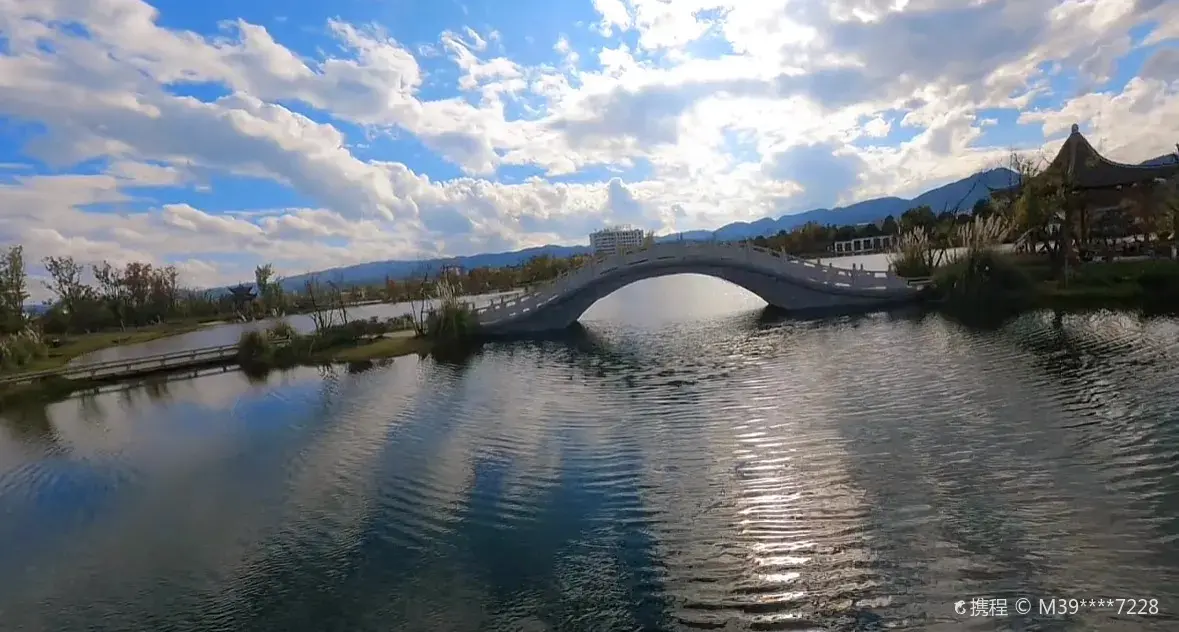
Erhai Lake lies quietly at the foot of the Cangshan Mountains and east of Dali Ancient Town, serving as Yunnan's second-largest plateau freshwater lake after Dianchi Lake. Stretching narrowly over 40 km from north to south, its silhouette resembles both a human ear and a crescent moon. The Bai people traditionally call large lakes "seas," and with its vast expanse and sea-like waves when winds rise, it earned this romantic name. The nineteen peaks of Cangshan stand like a screen to the west, reflecting the lake's shimmering waters—a scenery long praised as "silver Cangshan and jade Erhai." This is also the setting for the "Erhai moon," one of Dali's famed "wind, flower, snow, and moon" four scenic wonders. The classic way to explore Erhai Lake is riding or hiking along the lakeside ecological corridor, where you can stop anytime along the 100 km shoreline: Longkan Dock on the western shore features boardwalks extending into the water and rows of dawn redwoods, making it a popular sunrise spot. Further north, Panxi S-bend's waterfront trail curves gracefully along the lake, with a solitary tree in the water and pastoral shores serving as iconic photo backdrops. Taking a cruise offers distant views of Little Putuo Island and a chance to visit Nanzhao Folk Island, often accompanied by Bai ethnic tea ceremonies and dances. Jinsuo Island in the southern lake has been home to Bai fishermen for generations, preserving both village charm and Benzhu faith traditions. During the summer Torch Festival, lakeside villagers toss pine resin powder, creating fiery sparks, while the legend-linked Shuahai Festival—honoring Lady Bojie and Duan Chicheng's serpent-slaying tale—keeps Bai bravery alive by the lakeshore. To slow down, head to Shuanglang Ancient Town by the lake and pick a waterfront café to spend half a day. At dawn, wait for the sunrise on the western shore; in the evening, watch the sunset paint the Cangshan Mountains golden-red from the eastern shore—riding along the lakeshore, cruising back to gaze at the mountains from the lake center, or simply sitting by the water—these experiences perfectly piece together different facets of Erhai Lake.

China · Dali City
Changning Today's weatherOvercast 11-23℃
Changning weather for the next 2 days11/9: 4-15℃, 11/10: 7-12℃

Free things to do in Changning

What travellers say about Changning

user-avatar
Anonymous user7 November 2026
5.0
This accommodation was fantastic! It features a scenic elevator, bright and airy rooms, and an overall comfortable atmosphere. The owner was incredibly welcoming and attentive, offering round-trip transportation and afternoon tea. It was a hassle-free stay, the environment was clean, and it was great value for money. Highly recommended!

Yulong Snow Mountain

user-avatar
_TI***du5 November 2026
5.0
I change for a walk to zhonghe cable car from middle of the ximatan cable car after I had completed view the top of cangshan (top of ximantan cable car- got very good view of cangshan). The view is very good during the walk, and the road is quite good and the journey is quite smooth. Only litter up hill and down hill. In short it is a very relaxing and smooth walk, can be better with some titbit.

Cangshan Mountain

user-avatar
Anonymous user2 November 2026
4.0
Entering the park directly with the QR code is convenient. Autumn is a very pleasant time to visit Atami. The walk from the entrance to the Big Boiling Pot is shaded by trees, so it's not too sunny. Soaking your feet and eating some onsen eggs is quite nice! 👍

Rehai Scenic Area

user-avatar
_CF***6923 October 2026
5.0
I visited more than 10 years ago, and this return trip is still just as impressive. Now there are escalators, which are much more convenient than before and more friendly to those with limited mobility or the elderly, but there is an additional charge.

Shangri-La Tiger Leaping Gorge

user-avatar
布鲁斯云豹6 November 2026
5.0
The Three Pagodas of Chongsheng Temple are ancient and solemn, offering stunning photo opportunities against the backdrop of Cangshan Mountain and Erhai Lake. The scenic area is vast, with the temple complex built into the mountainside; the entire walk takes about three hours, so comfortable shoes are recommended. The Three Pagodas of Chongsheng Temple hold immense historical and cultural significance. Originally built during the Nanzhao Kingdom period of the Tang Dynasty, the main pagoda, Qianxun Pagoda, exhibits typical Tang Dynasty style, while the north and south smaller pagodas were added during the Dali Kingdom period of the Song Dynasty. This was once the royal temple of the Nanzhao and Dali Kingdoms; nine of the 22 kings of the Dali Kingdom became monks here, demonstrating its status as a "Buddhist capital." The three pagodas have withstood over a thousand years and more than 30 strong earthquakes, and were listed as one of the first batch of national key cultural relics protection units in 1961. During repairs in 1978, more than 680 precious artifacts from the Nanzhao and Dali Kingdoms were unearthed at the top of the pagodas, including exquisite gold-winged birds, providing crucial physical evidence for the study of ancient Yunnan history. Definitely worth a thorough visit!

The Chongsheng Temple And The Three-Pagoda Culture Tourist Area

user-avatar
M98***0026 October 2026
5.0
The pristine rainforest is home to many adorable animals that roam freely. A shuttle bus takes you up the mountain, and the entire hike is just over 2 kilometers long. You walk along one path to the shuttle bus stop on the way down, without backtracking. You can enjoy the scenery as you go, and overall it's not too tiring – a pretty good experience!

Pu'Er Sun River Forest Park

user-avatar
心中有佛的强哥4 November 2026
5.0
Heshun Ancient Town, located on the ancient Tea Horse Road, is a caravan stop with a romantic atmosphere. Strolling through the alleys under the blue sky and white clouds, or sitting in a coffee shop or teahouse to relax and unwind, is incredibly comfortable.

Heshun Ancient Town
user-avatar
Oo一天世界oO11 September 2026
5.0
On my second trip to Dali, I stayed for three days. On the first day, I stayed at Erhai Park, facing north to enjoy the view of Erhai Lake. On the second day, I stayed at Shuanglang Ancient Town, facing west to see the Cangshan Mountain and Erhai Lake together. On the third day, I cycled from west to east along the Erhai Ecological Corridor to enjoy the view of Erhai Lake. I also went to Yunxiang Mountain Road for extreme mountain biking, Shuanglang, Xizhou Ancient Town, Dali Ancient City, etc. Every angle offered a different perspective of Erhai Lake. The scenery in Dali is truly beautiful.

Erhai Lake

Trip Moments in Changning

Popular cities near Changning

Frequently asked questions

How can I contact Trip.com customer support?

Get help anytime, anywhere within 30 secondsContact customer support

Change and cancellation policies vary by attractions and tours. Please check the product details page for more information.

Ticket prices may vary between weekdays and weekends, as well as during peak and off-peak seasons. When booking with Trip.com, you can also use Trip Coins to get extra savings. For more tips on booking discounted tickets, please visit Trip.com for the latest information.