Things to do in Yijun
Explore top experiences
Top 10 attractions in Yijun


The Mausoleum of Yellow Emperor
The Mausoleum of the Yellow Emperor is located on Qiao Mountain in Huangling County near Yan'an. The Yellow Emperor is regarded as the ancestor of Chinese civilization. The mausoleum is surrounded by ancient evergreen trees which have been protected for generations. In addition to the mausoleum, the site is also home to the Xuanyuan Temple, which is named after the Yellow Emperor's personal name Xuanyuan. It was constructed during the Han dynasty and is surrounded by a number of ancient evergreen trees, one of which is believed to have been planted by the Emperor himself 5,000 years ago.Huangling · 25.1km from Yijun

Emperor Qinshihuang's Mausoleum Site Museum
Emperor Qinshihuang's Mausoleum Site Museum, also known as the Terracotta Army, is located about 1.5 kilometers east of the Mausoleum of the First Qin Emperor and forms part of the extensive necropolis. There were more than a thousand terracotta soldiers unearthed here, each with a different facial expression. Standing before the massive underground army, you will feel the extraordinary might of the Qin Emperor that enabled him to unify six warring states two thousand years ago. The Qin Emperor Ying Zheng began building the mausoleum for himself at the age of 13. Nearly 720000 men and 38 years were required to complete this vast project.China · Xi'an

Huangdi Mausoleum Xuanyuan Temple
Xuanyuan Temple, also known as the Yellow Emperor Temple, was built in the Han Dynasty. The Xuanyuan Temple is built on the mountains and beside the water, facing the south and the Xuanyuan Temple. The Hall of the First Ancestors of Humanities was built in the Ming Dynasty, with seven rooms wide and three rooms deep. On the forehead of the door hangs the four characters of "The First Ancestor of Humanity" inscribed by Mr. Cheng Qian when he sacrificed to the mausoleum in 1938. On the east side of Xuanyuan Temple is the Stele Gallery, which stores more than 50 ancient and modern stone tablets. The most famous one in the Xuanyuan Temple is the Yellow Emperor's Hand Planting Cypress, which is located 2 meters on the left side of the Xuanyuan Temple gate. According to legend, it was planted by Xuanyuan Huangdi himself. It is more than 5,000 years old and is the oldest cypress in the world. The cypress tree is more than 20 meters high and 11 meters in diameter at breast height. The worship hall was newly built in 2004. In the middle of the eaves of the main hall hangs three big characters "Xuanyuan Hall" in the official script written by the famous calligrapher Huang Miaozi. The front of the main hall is paved with granite, and there are "Three Mountains and Five Sacred Mountains" stones on display. Around the square are 9 pairs of bronze ox tripods with a height of 2 meters.Huangling · 25.1km from Yijun

Shaanxi History Museum
Historical background: The Shaanxi History Museum is located to the northwest of the Giant Wild Goose Pagoda and is one of Xi'an's signature attractions. Planning for the museum began in 1977, the foundation stone was laid in November 1986, and it was officially completed and opened on June 20, 1991, when it was named the Shaanxi History Museum. In 2016, it was selected by the Chinese Cultural Relics Society and the Architectural Society of China for inclusion in the "Architectural Heritage of China in the 20th Century." Museum features: It is a large modern museum, and its completion marked a new milestone in the development of China's museum industry. This building complex features Tang-style architecture with a "central hall and four corner towers," arranged in an orderly hierarchy with varied heights, presenting a solemn grandeur that integrates national tradition, local characteristics, and the spirit of the era. The museum covers an area of 65,000 square meters and houses over 1.7 million cultural relics, ranging from simple stone tools used in the earliest stages of ancient humans to various artifacts from social life before 1840, spanning more than one million years. The cultural relics are not only numerous and diverse in type, but also of high quality and broad value. The collection is a dazzling array of treasures. It is an art palace showcasing Shaanxi's history and culture and ancient Chinese civilization, and is known as the "pearl of the ancient capital and treasure house of China." The museum houses many treasures, including bronzes from the Shang and Zhou dynasties, pottery figurines from various dynasties, gold and silverware from the Han and Tang dynasties, and murals from Tang tombs, most of which are treasures from the prosperous periods of the Han and Tang dynasties, and among them are fine pieces that the state prohibits from being taken out of the country. Treasures in the collection: There are three exhibition halls in the center of the museum. The first exhibition hall displays cultural relics from the prehistoric civilization of the Lantian Man 1.15 million years ago to the Qin Dynasty; the second exhibition hall displays cultural relics from the Han Dynasty and the Wei, Jin, Southern and Northern Dynasties; the third exhibition hall mainly features cultural relics from the prosperous Tang Dynasty. Each exhibition hall has its own treasure. Special exhibition halls are located on both the east and west sides of the central hall. The west side houses the "Special Exhibition of Tang Dynasty Treasures (Treasures gallery, artifacts unearthed from Hejiacun)", and many fine gold and silverware pieces from the High Tang period have been moved here for display. The east side houses the "Exhibition of Tang Dynasty Mural Treasures," which displays a number of authentic Tang tomb murals. Yu Ding The Yu ding is placed in the first exhibition hall at the museum entrance, and can be regarded as the treasure of the first exhibition hall. What is placed here is a replica; the genuine artifact is kept in storage. Inscription on the outer wall: The inscription reads "Under the vast heaven, there is no land that is not the king's; within the shores of the land, there is no one who is not the king's subject," reflecting the land ownership system of the Western Zhou period. The inner wall of the Yu Ding bears a four-line inscription of 28 characters, the gist of which is: in the early eighth month of a certain year, Wang Jiang took back the land originally granted to Shi Lu and regranted it to Yu, whereupon Yu had this ding cast to commemorate the event. Empress's jade seal: One of the treasures worth seeing in Exhibition Hall 2 is this jade seal of a Han dynasty empress, displayed on its own. The seal is made entirely of Hetian mutton-fat jade from Xinjiang, and is carved on top with a chi tiger, symbolizing royal power. Tri-colored glazed pottery figurine of a camel carrying musicians: This world-famous tri-colored glazed pottery figurine of a camel carrying musicians is located in the third exhibition hall of the museum, and its overall appearance and colors are well preserved. Seven men are seated on the camel's back, holding different musical instruments. Among them, the figurine holding clappers has its ear inclined and its attention focused, as if intoxicated by the beautiful music. In the middle, a woman is performing, and the camel has its mouth wide open, gazing upward toward the sky, as if also joining its master in singing loudly. Gold-inlaid agate cup with animal-head design: This artifact, located in the special exhibition "Special Exhibition of Tang Dynasty Treasures," is one of the first sixty-four national treasures listed by the National Cultural Heritage Administration that are permanently prohibited from being exhibited abroad. In addition, there are a black-glazed oil-spot bowl, a celadon-glazed ewer with a handle and bottom-fill design, a gilt silver bamboo-joint bronze incense burner,Gold bowl with mandarin duck and lotus petal designAnd many other treasures.China · Xi'an

Yuhua Palace
Yuhua Palace Attraction is located in Yuhua Town, northwest of Tongchuan City. It was built in the seventh year of Wude (624 AD) of Emperor Gaozu of Tang Dynasty. It was once a summer palace in the west. After Emperor Gaozong of Tang Dynasty ascended the throne, Yuhua Palace was changed into a temple. In the fourth year of Xianqing (659 AD), the world-famous Master Xuanzang moved to Yuhua Temple with his disciples to translate Buddhist scriptures, and lived in Yuhua Temple for four years. In the first year of Linde (664 AD), he passed away in Suchengyuan of Yuhua Temple. Today, the palace and temple buildings of that year no longer exist, because it is surrounded by mountains and lush vegetation, and has become a summer resort for Residents in the Souvenir . The Yuhua Palace Attraction is lush with trees, and waterfalls and springs can be seen everywhere. There are also many pools and streams in the mountains with clear water quality. It is a good place for Residents in the Souvenir to visit the mountains. The scenery here varies throughout the year. In spring, wild flowers are everywhere in the mountains and fields. In summer, the temperature here is also high, and the thick shade of branches and leaves blocks the sunlight. In autumn, the mountains are full of red leaves. Every winter, an ice and snow festival is held here, where tourists can ski and skate. In the cold season of January and February, there will be exquisite ice sculptures in the Attraction for tourists to enjoy. There are hotels and farmhouses in the Attraction to provide accommodation and Dining services for tourists. In addition to appreciating the beauty of nature, tourists can also visit the Xuanzang Memorial Hall in the Attraction. This is a special museum for Master Xuanzang in recent years. The museum exhibits some cultural relics and Buddhist items unearthed from the Yuhua Palace. The Suchengyuan site in the Attraction is the site of the Sucheng Hall of the Yuhua Palace in the Tang Dynasty. It was renamed Suchengyuan during the Yuhua Temple period. It was also the place where Master Xuanzang stayed, reasoned about Buddhism, and passed away.Tongchuan · 19.9km from Yijun

Xi'an City Wall
Xi'an City Wall is a landmark of this ancient city. The city walls that we see now were built in the early years of the Ming dynasty and they are now more than 600 years old. The walls were built on the foundations of the imperial city of the Tang Dynasty and they are formed together with a series of defensive installments such as moats and turrets. At present, Xi'an City Wall can be accessed by many city gates. Visitors can choose the nearest one to them. The South Gate is the visitor entrance of Xi'an City and is also the city gate with more tourists. Cycling on the ancient walls is a good experience. Riding on the wall overlooking the ancient capital of the thirteenth dynasty, you will have a feeling of travelling through time.China · Xi'an

Huaqing Palace
Huaqing Palace attraction is located 30 km east of Xi'an, adjacent to the Terracotta Warriors. Renowned for its timeless hot spring resources and numerous historical events, it has become an iconic cultural tourism attraction of Tang Dynasty palaces in China. Palace scenic spots Huaqing Palace boasts a long history, serving as an imperial retreat for emperors from the Zhou, Qin, Han, Sui, and Tang dynasties. The palace features cultural zones like the Tang Imperial Hot Spring Relics Museum, the Xi'an Incident site—Five-Room Hall, Nine Dragon Lake and Lotus Lake scenic areas, and the Tang Pear Garden Museum. Notable architectural complexes include Feishuang Hall, Wanshou Hall, Changsheng Hall, Huanyuan Garden, and Yuwang Hall. The stele of "hot spring ode" Mount Li hot springs, developed early and favored by emperors throughout history, enjoy the reputation of being "the imperial hot springs under heaven." As far back as the Yangshao culture period 6,000 years ago, the ancient Jiangzhai people began utilizing these springs. With their profound cultural heritage spanning millennia, Mount Li hot springs represent an indispensable part of Chinese historical culture. The stele of hot spring ode in the attraction stands 154 cm tall, 72 cm wide, and 19 cm thick, featuring a coiled dragon design and a trapezoidal base. Engraved by Yuan Chang, the governor of Yongzhou during the Northern Wei Dynasty, the inscription reads, "The hot spring is nature's prescription and the primordial healer of the universe. People from all nations and those suffering from ailments come with provisions to seek relief in its waters." This stele is the earliest surviving written artifact at Huaqing Palace. Tang Imperial Hot Spring Relics Museum This is the site of the bathing pool described in the "Song of Everlasting Sorrow" where Yang Guifei emerged from her bath. After the An Lushan Rebellion, little remained of the original structure. In 1982, while constructing the "Guifei Pavilion," the Lintong County Government accidentally discovered the ruins of a Tang Dynasty bathing pool. After excavation and restoration, the Huaqing Palace imperial hot spring ruins museum was established. This small yet exquisitely designed pool measures 3.6 meters east-west and 2.9 meters north-south, with an oval-like shape. The pool walls are entirely built with bluestone slabs, featuring a two-tiered terrace structure composed of 18 arched stone sections. Inside the pool lies a dedicated bathing stone for Yang Guifei, engraved with the character "Yang." At the center of the pool bottom is a 10 cm diameter water inlet. A white marble lotus pedestal was unearthed here, connecting to both a showerhead above and ceramic water pipes below that linked to the main water source. Due to natural pressure, hot spring water would spray outward through the lotus showerhead, creating a mist effect remarkably similar to modern showers. Adjacent to the Guifei Pool to the east lies Emperor Xuanzong's exclusive imperial hot spring. During the Tang Dynasty, the Nine Dragon Hall stood above this pool, featuring nine white jade-carved dragons spouting water outside. This pool's surface resembles a realistic lotus shape, hence its alternate name "Lotus Pool." Xi'an incident site The five-room hall at the Xi'an incident site in Huaqing Palace is where the Xi'an incident took place. To this day, the glass windows and walls of the five-room hall still bear bullet marks from the fierce battle during the military remonstrance. The desks, chairs, beds, sofas, tea sets, stoves, carpets, telephones, and other office items in each room are replicated and arranged according to their original appearance. Historical events: Beacon fire to deceive the feudal lords In 779 BC, King You of Zhou obtained the beautiful Bao Si, yet she never smiled. To solve this, the king conspired with the treacherous minister Guo Shifu and lit the beacon fires at the Huaqing Palace attraction. The feudal lords across the land saw the signals.Beacon fireHe quickly led his troops to rescue the king, but King You told the feudal lords, "I lit the beacon fires just to make my queen laugh," upon which Bao Si burst into laughter. The feudal lords arrived valiantly but left resentfully. Seeing King You's incompetence and the people's discontent, the Quanrong tribe seized the opportunity to launch an attack. As the enemy troops approached the mountain, King You urgently raised the beacon fires.Beacon fireHe mobilized troops, but none of the feudal lords came to his rescue. King You fled with Bao Si toMount LiHe was later killed by the Quanrong tribe, leaving behind historical anecdotes such as "a smile worth a thousand gold," "losing the kingdom for a smile," and "playing with beacon fires to deceive the feudal lords." And this beacon tower at Huaqing Palace attraction towers at an altitude of 913.6 m.Mount LiThe beacon tower at Huaqing Palace attraction on the first peak of Xixiu Ridge. Su Dongpo composing poetry at Mount Li During the Jiayou era of the Northern Song Dynasty, the Lishan hot springs, meticulously restored by Liu Ziyong and others, became breathtakingly beautiful, attracting crowds of visitors who composed poems and essays to express their nostalgia. Among the countless poetic works, the emerging literary giant Su Shi stood out with his masterpieces like "Lady of Guo's night outing" and "Lishan" during his visit to the hot springs. Xi'an incident The Xi'an incident, also known as the "double-twelfth incident". Zhang Xueliang and Yang Hucheng launched a mutiny at Huaqing Palace, detaining the then chairman of the Military Commission of the National Government. Performance items You can watch a large-scale dance drama at the attraction. ▲ The Song of Everlasting Sorrow is China's first large-scale live historical dance drama created by Shaanxi Tourism Group. Based on Bai Juyi's timeless poem of the same name, it fully utilizes the attraction's resources and employs high-tech stage lighting to combine historical storytelling with live performances, recreating the love story of Emperor Li Longji and Yang Guifei at Huaqing Palace over 1,300 years ago. ▲There is also the historical adaptation "12-12 Xi'an Incident," which vividly and authentically recreates the lesser-known details of the "Xi'an Incident."China · Xi'an

Mount Hua
Mount Hua, formerly known as "Xiyue", is one of the five famous mountains in China. It is located in Huayin City, Shaanxi Province. Huashan is also known as "Taihuashan". It is the birthplace of Chinese civilization. The "Hua" in "Zhonghua" and "Huaxia" comes from Huashan. The words "strange and dangerous" are the essence of Huashan's scenery. "Since ancient times, there has been only one road to Huashan" describes the steepness of Huashan. The Attraction has many thrilling attractions such as Changkong Plank Road, Kitesurfing, Qianchi Chuang, Baichi Gorge, Laojun Ligou, etc., which are carved out on the steep cliffs. Those who visit them in person will be amazed. Huashan Attraction covers a vast area, including the Main Peak Attraction, Xiyue Temple Attraction, Xianyu Attraction, etc. The Main Peak Attraction is the core Attraction of Huashan, including "Huashan One Road" and the five main peaks in the southeast, northwest, and center. Huashan in most people's minds refers to the Main Peak Attraction. Five main peaks The East Peak is about 2,100 meters above sea level and is named for its location in the east. There is a platform on the top of the peak, which is high and dangerous with a wide view. It is a good place to watch the sunrise. It is called Chaoyang Terrace, and the East Peak is also called Chaoyang Peak. The East Peak consists of four peaks, one main peak and three s-ervant peaks. The peak where Chaoyang Terrace is located is higher, the Yunv Peak is in the west, the Shilou Peak is in the east, and the Botai is in the south. There are more than dozens of landscapes on the East Peak. There is a natural stone pattern on the cliff on the side of the East Shilou Peak, which looks like a giant palm print. This is the Huayue Immortal Palm, which is listed as the first of the eight scenic spots in Guanzhong. The story of the giant spirit opening the mountain and guiding the river originated from this. The West Peak is about 2,000 meters above sea level. Because there is a huge rock on the top of the peak that looks like a lotus petal, ancient literati often called it Lotus Peak or Hibiscus Peak. Xu Xiake wrote in his "Diary of Traveling to Mount Taihua": "There is a rock rising on the peak, and there are stone pieces covering it, like a lotus flower." This stone must be referring to it. There are many landscapes on the West Peak, including Cuiyun Palace, Lotus Cave, Giant Spirit Foot, Axe-Split Stone, Sheshen Cliff, etc., and there are many beautiful myths and legends. Among them, the well-known story of Chenxiang splitting the mountain to save his mother is circulated here. The South Peak is over 2,100 meters above sea level and is the highest peak of Huashan. The ancients called it the "Head of Huashan". On one side of the South Peak is a thousand-foot cliff, standing straight like a knife, and below is a deep ravine, which is separated from Sangong Mountain and Sanfeng Mountain. The South Peak consists of one peak and two peaks. The east side is called Songhui Peak, and the west side is Luoyan Peak. The origin of the name of Luoyan Peak is said to be because the migrating wild geese often land here to rest. The North Peak is about 1,600 meters above sea level, with cliffs on all sides, covered with clouds above and connected to the earth veins below. It stands tall and unique, and is also called Yuntai Peak because it looks like a cloud platform. Li Bai of the Tang Dynasty wrote in his poem "A Song of the Cloud Platform of Mount Xiyue to Complimentary Danqiuzi": "Three peaks stand as if about to collapse, and the green cliffs and red valleys are high. The golden essence of the White Emperor mobilizes his vitality, and the stones become lotus flowers and the clouds become platforms." The famous story of "Taking Huashan by Strategy" took place here. There are many landscapes on the mountain, including the Zhenwu Hall, Jiaogong Stone Chamber, Changchun Stone Chamber, and the place where Laojun hung the plow. The Middle Peak is the only way to the other four peaks. It is located in the middle of the East, West and South Peaks. The forests on the peak are lush and green, and the environment is quiet. There is a Taoist temple named Yunu Temple on the top of the peak. It is said that it was the place where Qin Mu Gong's daughter Nong Yu cultivated herself in the Spring and Autumn Period, so it is also called Yunu Peak. Main landscape: There are more than 210 famous Attraction in Huashan. From ancient times to the present, countless literati and poets have left various classic poems here. Skywalk The Changkong Plank Road is located on the east side of the Huashan South Peak. It was built by the master of the Huashan School, Taoist He Zhizhen of the Yuan Dynasty, who wanted to get away from the world and practice Taoism. He built it by inlaying stone piles on the cliffs and paving wooden boards. At the end of the plank road, you can see the "Hezu Cave" where Master He practiced self-cultivation. The road builders chiseled stone holes on the cliffs, wedged stone piles into the holes, and laid wooden boards about 40 cm wide between the stone piles. Visitors must stick to the cliff wall, pull the iron chain with their hands, step on the wooden boards, and move forward slowly sideways. Xiyue Temple Xiyue Temple, also known as Huayue Temple, is a temple where emperors of all dynasties worshipped and offered sacrifices to Shaohao, the Great Emperor of Xiyue. It was first built during the Yuanguang period of Emperor Wu of the Han Dynasty (134-129 BC) at the entrance of Huangshengu (now Huangfuyu) at the foot of Huashan Mountain. It was moved to its current location during the reign of Emperor Huan of the Eastern Han Dynasty (147-167 AD) and renamed today. It was rebuilt many times during the Tang, Song, Ming and Qing dynasties. Canglong Ridge The steps on Canglong Ridge are only 2 feet wide, with deep ravines on both sides, as steep as a knife. The height difference between the ridge and the top is about 500 meters, and the slope is more than 45 degrees. Looking at the green pines and white clouds in the distance and hearing the sound of the wind is dizzying. Jinsuoguan Jinsuoguan is one of the five passes of Huashan Mountain. It is built on a stone archway at the entrance of the three peaks. It is the throat of the Wuyun Peak to the four peaks of East, West, South and Center. There is no way to pass after the pass, so it is also called Tongtianmen. Taoists believe that Huashan is the fairyland of gods. Only after passing Tongtianmen can you enter the fairyland. Therefore, there is a folk song that "after passing Jinsuoguan, there is another world". There has been only one road to Mount Huashan since ancient times "There has been only one road to Mount Hua since ancient times" refers to the "Huashan Valley" hiking trail, which includes various scenic spots along the Huashan hiking trail since ancient times. When connected together, it is what is commonly referred to as "There has been only one road to Mount Hua since ancient times." How to visit Huashan has two mountain gates (entrances): East Gate and West Gate (also known as Huashan Gate). Take the cable car up the mountain and go to the East Gate; if you climb the mountain on foot, enter from the West Gate. Huashan currently has two cable cars, the East and West Lines, which reach the North Peak and the West Peak respectively (please plan the climbing route in advance before purchasing the ticket and purchase the corresponding ticket type, and you cannot change it midway.). Route 1: Hiking route There has been only one road on Mount Huashan since ancient times. It is an ancient mountaineering road with a total length of 12.5 kilometers and 9,567 steps. It takes about 4 hours to hike from Yuquanyuan, through Wuli Pass, Shaluoping (night climbing), Qianchi Chuang, Baichi Gorge, etc. to the North Peak, and then start the tour from the North Peak. Route 2: "Up West and Down West", a mountaineering route suitable for the Seniors and tourists with children This route goes up the West Peak Cableway of Mount Huashan and down the West Peak Cableway, that is, going up from the west and down from the west. The whole route takes a relatively short time, about 4 hours, and is also more energy-saving, making it more friendly to the Seniors and tourists with children. Route 3: "Up West and Down North", a one-day mountaineering route chosen by 80% of tourists This route goes up by cable car from the West Peak of Mount Huashan and down by cable car from the North Peak, that is, going up from the west and down from the north. The entire route is a classic one-day tour route, which takes about 6 hours. You can visit all the attractions without backtracking. Most tourists choose this route because this road almost goes straight down, which is easier and faster than the uphill road. Route 4: "North up and north down", a time-saving, economical and panoramic mountaineering route This route goes up by cable car at the North Peak of Huashan and down by cable car at the North Peak, that is, going up from the north and down from the north. The whole route is a relatively low-cost cable car mountaineering route. If your sightseeing time is limited, you can choose this route and visit the North Peak, which has the Memorial Pavilion, Ear-Crushing Cliff, Canglong Ridge, Huashan Sword Contest Monument, panoramic Huashan and other attractions.China · Huayin
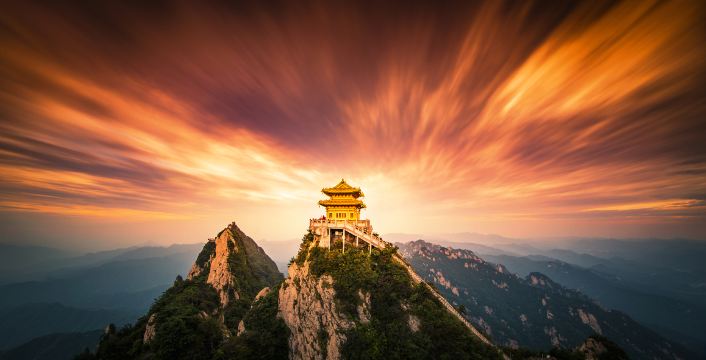
Laojun Mountain Scenic Spot
It is said that Laojun Attraction is the place where Li Er (Laozi), the founder of Taoism, practiced in seclusion. During the Northern Wei Dynasty, a temple was built in the mountain to commemorate it. Later, it was named "the famous mountain in the world" and has always been popular. The mountain is lush with trees and picturesque, and mountain springs can be seen everywhere. In the golden autumn, this is the best choice for viewing red leaves in the Souvenir areas. After the rain, Laojun Mountain is surrounded by clouds and mist in each peak, like a fairyland in the sky. The Attraction area is huge and is mainly divided into the main Laojun Mountain Attraction in the center, the Dream Valley Attraction in the west, and the Zhaigou Attraction Area in the east. Generally, tourists will spend a day to visit the main Laojun Mountain Attraction, which is also the most developed area of the entire Attraction. If you go to the top of the mountain, you will also have the opportunity to see the beautiful sea of clouds, sunrise, and sunset. The main Attraction of Laojun Mountain includes Zhongtianmen, Jinding, Laojun Temple, Nantianmen, Yuhuangding and Mazongling. Since its construction in the Northern Wei Dynasty, Laojun Temple has been the center of worship for pilgrims from the Central Plains; the Taoist temple on Yuhuangding enshrines the Jade Emperor and is also a good place to view the scenery in the mountain; Jinding and Mazongling are good places to watch the sunrise and the sea of clouds. Recommended itinerary: Day Trips Most tourists choose to spend a day to visit the main Attraction of Laojun Mountain. Lingguan Hall - the statue of Laojun at the foot of the mountain - Lincu Hall - Zhongtianmen - tree-lined trail - Lying Yunsong - Bodhisattva Hall - Laojun Temple, Jinding - Yuhuangding, and then return along the original route. Tourists can choose to walk the whole way or take a "walk + cable car" tour of Laojun Mountain according to their own conditions. There is the Zhongling Cableway of the Attraction between the Lingguan Temple at the foot of the mountain and the Zhongtian Gate on the mountainside. Take the Zhongling Cableway and then walk from Zhongtian Gate to the top of the mountain, Yuhuang Peak. The road from Zhongtian Gate to the top of the mountain is not very steep and can usually be completed in about an hour. Two-day tour If you have enough time, you can spend two days to visit Laojun Mountain. The general route is: D1: Visit the main Attraction of Laojun Mountain and stay in the mountain that night. D2: From the top of Laojun Mountain, choose to go down the mountain to the Dream Valley in the west or the Zhaigou Attraction in the east, and arrive at the west gate and east gate of the Attraction respectively. In the main Attraction of Laojun Mountain, you can stay near Zhongtianmen on the mountainside and Laojun Temple on the top of the mountain. There are hotels near Zhongtianmen with better accommodation conditions, while the accommodation conditions Souvenir Laojun Temple are relatively poor. If you plan to go to the top of the mountain to watch the sunrise the next morning, you can stay Souvenir Laojun Temple. Compared with the Zhaigou Attraction in the east, the mountain roads in Dream Chasing Valley are smoother, and tourists can choose one of them to go down the mountain according to their preferences. There are many places in the Attraction that can provide Dining services for tourists, but the signboards on some sections of the road in the Attraction are not yet very complete, so tourists need to pay more attention when visiting.China · Luanchuan

Xi'an Museum
Xi'an Museum is a modern comprehensive museum built upon the cultural relic protection site—the ruins of the Tang Dynasty Jianfu Temple and its iconic structure, the Small Wild Goose Pagoda. It integrates cultural relic collection and protection, academic research, exhibition and display, social education, and garden leisure. Its core area is the location of the original Tang Dynasty royal temple, Jianfu Temple, while the precious and striking historical relic existing within the temple—the Small Wild Goose Pagoda—has become the museum's unique landmark and soul. Therefore, the Jianfu Temple ruins and the Small Wild Goose Pagoda are not only the foundation and core carrier for the establishment of Xi'an Museum, but also important outdoor historical exhibition areas and focal points for visitors. The main building of the museum is located on the north side of the ancient temple ruins. The three elements (ancient temple ruins, ancient pagoda, and modern museum building) are organically integrated, jointly forming a unique cultural space that combines "museum, pagoda, temple, and garden," vividly showcasing the historical context of Xi'an from ancient times to the present. Xi'an Museum officially opened to the public on May 18, 2007. Its establishment aims to comprehensively showcase the glorious history and splendid culture of Xi'an (ancient Chang'an) as the capital of thirteen dynasties, filling the gap of a comprehensive museum of Xi'an's urban history. Collection highlights: The museum houses over 100,000 precious cultural relics from various historical periods of Xi'an. The collection spans from prehistoric times to the Ming and Qing dynasties, with particular emphasis on artifacts from the prosperous dynasties of Zhou, Qin, Han, and Tang, including bronze ware, jade articles, gold and silverware, ceramics, murals, stone steles, epitaphs, and Buddhist statues, systematically reflecting the political, economic, cultural, social life, and foreign exchanges of the ancient capital Chang'an. Main exhibition: The permanent exhibition "Ancient capital Xi'an" takes the urban development history of Xi'an as the main thread, showcasing the evolution and achievements of Xi'an as a capital (Zhou Fenghao, Qin Xianyang, Han Chang'an, Sui-Tang Chang'an) and a prefectural city (Song, Yuan, Ming, and Qing dynasties) through a large number of precious cultural relics, models, charts, and multimedia means. Unique environment: The museum's greatest feature lies in its surroundings. Travelers can not only visit modern exhibition halls but also stroll through the expansive heritage park encompassing the Small Wild Goose Pagoda, the ancient architectural complex of Jianfu Temple (including structures like the Ming dynasty bell tower housing a Jin dynasty ancient bell), an ancient stone sculpture art exhibition area, and garden views—experiencing the charm of the millennia-old capital at its historical site. The view of "morning bells at the Wild Goose Pagoda" is particularly renowned. Functional positioning: The museum is not only an important center for cultural relic collection, research, and display, but also an urban cultural park where citizens can relax, entertain, and immerse themselves in history and culture, undertaking significant social education and cultural exchange functions.China · Xi'an
Yijun Today's weatherClear 2-16℃
Yijun weather for the next 2 days10/30: 4-18℃, 10/31: 7-15℃
Free things to do in Yijun


What travellers say about Yijun

大洋咆哮者14 October 2026
4.0
The scenic area was larger than I expected. I went on the seventh day of the National Day holiday, and surprisingly, it wasn't too crowded, considering it's in a county town. But as descendants of the Yellow Emperor, having come all the way to Yan'an, I figured I should at least see it. The scenic area is half modern architecture and half historical sites, especially the several thousand-year-old cypress trees and some inscriptions by famous figures. The two Yellow Emperor Temples, one ancient and one modern, each have their own unique characteristics and are definitely worth seeing. However, there's one thing I really want to complain about: Didi (a ride-hailing app) is completely banned in Huangling County. You have to hail a taxi on the roadside, and the only ones you can find are very old-fashioned taxis—old and smelly. The drivers don't use meters and even share rides. But I don't want to complain about any of that because it's practically impossible to hail a taxi. It's impossible to find a car near the hotel or the scenic area entrance. I waited for over ten minutes before finally getting one, and I almost missed my train. You can't be picky. People say Didi disrupts market order, but in my opinion, it's precisely because there's no market competition that the travel experience in Huangling is so terrible. This problem really needs to be addressed.
The Mausoleum of Yellow Emperor

TonyMorton28 October 2026
5.0
We woke at 7 for a 730 Didi taxi pickup from our hotel in Bell Tower. 50 minutes later we arrived and joined the queue - we were among the first 100 people to get in and see Pit 1 which was as dramatic as we imagined. Everything went smoothly. We then went to Pit 3 and finally pit 2. And then the museum. We worked out the free shuttle bus to Loch Gardens where we walked to the Bronze Chariots. Somewhat surprised at the small size of this exhibit. And we walked to the plinth that represents the Mausoleum - not understanding at first the vast forest pyramid upon which the mausoleum stood - best to go further away to see this. All in all an enjoyable 4 hours before easily getting a Didi taxi and avoiding the touts and taxi drivers trying to screw us on piece. 91CNY to get back. All good. We had bought snacks with us into the place with no problem.
Emperor Qinshihuang's Mausoleum Site Museum

M57***2725 April 2025
4.0
The Xuanyuan Temple and the Priest Hall are nice and spacious. However, the overall design of the scenic area is unreasonable, the local management service awareness is limited, the ticket price is too expensive, and the staff try their best to sell incense, which is contrary to the respect for the ancestors of the Chinese nation.
Huangdi Mausoleum Xuanyuan Temple

Anonymous user28 October 2026
5.0
The Shaanxi History Museum is unique in China; reservations are virtually impossible without advance booking. To finally see it again, I decided to pay for more time, but I still didn't expect so many visitors on a weekday afternoon. Without the guide's explanations, I probably would have gotten lost in the crowds. The guide was very professional, knowledgeable, and humorous, making what could have been a rather dry visit an excellent experience. Thank you so much!
Shaanxi History Museum

M29***122 August 2026
4.0
Yuhua Palace was first built in 624 AD (the seventh year of the Wude era of the Tang Dynasty) as Renzhi Palace. It was expanded and renamed in 647 AD (the twenty-first year of the Zhenguan era). In 651 AD (the second year of the Yonghui era), the palace was converted into a temple. It was one of the four major summer palaces of the Tang Dynasty and the place where Xuanzang spent his later years translating Buddhist scriptures and passed away.
Yuhua Palace

_We***6328 October 2026
5.0
You can rent bicycles for a loop, but you have to return them at Wenchang Gate. So you'll need to rent them at Yongning Gate. There are also vlogs available for download (29 yuan) that you can scan a QR code to watch. A total rip-off.
Xi'an City Wall

_TI***ob29 October 2026
5.0
Had a great visual experience with this show. Light operation was great. Effects wonderful. Even if you not in Chinese history of this period (1936), you will be stunned with show details. The hard moment is to get to this show 1. The time of performance is different and you have to ask it at the theatre pavilion. 2. Pavilion is rather hard to find from east gate (but easy if you first visit mountain and are descending from it. 3. It is better to buy ticket at place, because I had a problem with my reservation (trip com does not buy your ticket, some supplier buy and the voucher may be incorrect)
Huaqing Palace
Anonymous user28 October 2026
5.0
This was the attraction with the longest queues during my trip to Xi'an. The 20-minute cable car ride was a bit scary. We only visited West Peak with our group of elderly people; we'll try to visit Zhenta Peak another time.
Mount Hua

辞casst29 October 2026
5.0
Just got back from my visit, and I'm writing this review while it's still fresh in my mind. This trip was with friends, and overall the experience was great. Some of the old buildings in the scenic area are very well-preserved and make for excellent photo opportunities 📸. It was a bit crowded on the weekend, though, and we spent quite a while queuing. I recommend going early to avoid peak times for a better experience. Overall, it's worth a visit; every snapshot is picturesque ✨.
Laojun Mountain Scenic Spot
Anonymous user28 October 2026
5.0
Booked the free ticket to get into Xian Museum few days in advance. The museum is not very huge but the museum was located inside the big park that has the famous small wild goose pagoda which is very nice. The park itself was also very cosy and beautiful to walk around in the chilly weather. Plenty of the seats to rest and enjoy the park. Recommended to book in advance.
Xi'an Museum
Trip Moments in Yijun


