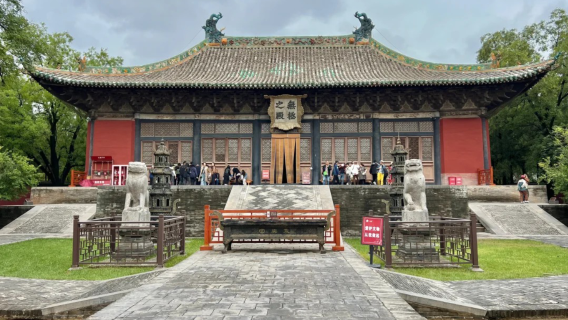
▲ Yongle Palace was built during China's Yuan Dynasty and has endured over 600 years of vicissitudes. Renowned for its exquisite murals, its magnificent architecture and mural art continue to be admired and revered by artists from both Eastern and Western cultures, earning it the title of "World Super Art".


▲ The Temple of Prince Guangren is the earliest surviving evidence of the Tang Dynasty's dragon king worship tradition. The temple preserves two significant stone inscriptions: the "Guangren Wang Longquan Inscription" from the 3rd year of Yuanhe era (808 AD) and the square stele "Longquan Inscription" from the 6th year of Dahe era (832 AD). These artifacts hold important reference value for studying ancient water conservancy projects and the construction period of the Five Dragon Temple.


▲ Pujiu Temple is the setting of The Romance of the West Chamber, witnessing the love story between Cui Yingying and Zhang Sheng. The "Pear Blossom Courtyard" where Cui Yingying's family resided and the "Study Courtyard" where Zhang Sheng moved after breaking the siege are interspersed within the temple. Behind the temple lies a dynamic garden with undulating terrain. The garden features perilously steep artificial rock formations and the Twin Oriole Pavilions with upturned eaves. A winding Magpie Bridge spans the lotus pond, connecting pavilions and blending with the lakeside scenery. Yingying's "Moon-Worshiping Terrace" is nestled among pine trees, cypresses, and bamboo groves. The publication of The Romance of the West Chamber brought fame to Pujiu Temple, hailed as "unparalleled among Buddhist temples," and its relic pagoda was renamed "Yingying Pagoda," gaining widespread renown. Beneath the west chamber awaiting the moon, the door half-opens to the breeze. Flower shadows sway beyond the wall, as if the beloved approaches.


▲ "The sun along the mountain bows; the Yellow River seawards flows. You will enjoy a grander sight if you climb to a greater height." This timeless masterpiece by Wang Zhihuan has made Guanque Tower renowned far and wide. Located on the east bank of the Yellow River, west of the ancient Puzhou City in Yongji, Shanxi Province, this famous tower carries profound historical and cultural significance, attracting countless visitors to explore its charm. Guanque Tower was originally built during the Northern Zhou Dynasty by General Yuwen Hu as a military watchtower. It earned its name from the storks that frequently perched on it. By the Tang and Song Dynasties, with social stability and cultural prosperity, the tower's majestic stature and breathtaking scenery drew literati and poets who left behind many celebrated poems. Among them, Wang Zhihuan's "On the Stork Tower" further cemented its fame.


▲ A national treasure of China, the Yellow River Iron Bull and the Pujindu Ruins Museum, as a key national cultural heritage site, is like a treasure box of time and space, filled with endless historical stories. The attraction offers a rich array of planning, ensuring that whether you're a history enthusiast or a leisure visitor, you'll find something to enjoy here. The museum not only displays a collection of iron artifacts, including the Tang Dynasty Kaiyuan Iron Bulls, but also unearthed relics such as Ming Dynasty embankments, allowing you to take in all the sights at once! The 2,268-square-meter ruins restoration platform is truly remarkable—standing on it, the bustling scene of the ancient ferry seems to come alive before your eyes, vibrant and lively. Highlights to watch for: Tang Dynasty Iron Bulls: A total of four, each weighing between 26-45 tons, these are true "strongmen." They are divided into two groups, north and south, arranged in pairs facing west, "lying" obediently. The craftsmanship of the iron bulls is exquisitely detailed beyond words.


▲ The Xiezhou Guandi Temple was initially built during the Sui Dynasty, gradually expanding from a ancestral hall in Guan Yu's hometown. Guan Yu, a renowned general from the late Han Dynasty, was posthumously honored and eventually revered as the "Military Sage," paralleling Confucius as the "Twin Sages of Civil and Military Virtues." His loyalty, bravery, and righteousness won widespread admiration, earning imperial endorsement across dynasties. The Xiezhou Guandi Temple underwent multiple expansions and renovations. Major expansions began during Emperor Zhenzong's Dazhong Xiangfu era in the Song Dynasty, with subsequent additions and restorations during the Jin, Yuan, Ming, and Qing Dynasties—over 30 times during the Ming and Qing alone—shaping its current layout. Layout: The temple unfolds along a north-south central axis, comprising the Oath Garden, main temple complex, and Imperial Garden, following the "court in front, residence behind" imperial design with a rigorous layout resembling royal palaces. The main temple complex features glazed dragon screens, the Duan Gate, and the Wu Gate aligned along the axis, while the Chongning Hall and Chunqiu Tower stand majestically, exuding solemn grandeur.
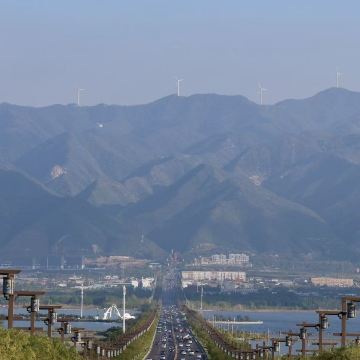

▲ Yuncheng Salt Lake, historically known as Hedong Salt Pond, is located in Yanhu District, Yuncheng City, Shanxi Province, China. It is one of the world's three major sodium sulfate inland salt lakes, alongside Russia's Lake Kuchuk in Siberia and the Great Salt Lake in Utah, USA. Not only is it the earliest exploited salt lake in China (with over 4,600 years of salt mining history), but it also served as a core driving force in the origin of Chinese civilization—the capitals of the legendary emperors Yao, Shun, and Yu were all within 150 km of the lake, and its salt taxes long supported national finances. After the implementation of the "Returning Salt to Lake" project in 2020, the lake transitioned from an industrial production base to a composite ecological and cultural attraction integrating ecological conservation, cultural heritage, and wellness tourism, earning it the nickname "China's Dead Sea."