# 60 minutes, understanding the millennium heartbeat of a city
## Fun exploration of Kuanzhai | official study tour of Kuanzhai Alley
**No Shaocheng, no Chengdu.**
In 311 BC, Qin prime minister Zhang Yi built the city of Chengdu, adding a small city to the west of the main city, historically known as the "Lesser City"—this marked the beginning of Chengdu's urban layout and the prelude to the millennia-old story of Kuanzhai Alley.
Over 2,300 years of time's flow, Shaocheng witnessed its initial construction in the pre-Qin era, destruction during the Jin dynasty, and reconstruction in the Sui dynasty, until its reappearance as the "Manchu city" in the Qing dynasty. In the 57th year of Kangxi's reign (1718), Sichuan governor Nian Gengyao petitioned to station banner troops, building 732 official residences and 4,800 soldier quarters on Shaocheng's former site, forming the unique **fishbone-shaped street layout** of today's Kuanzhai Alley.
Back then, the wide alley was called "Xingren Hutong," and the narrow alley was named "Taiping Hutong"—the garrison of the Bordered Red Banner, where the martial years of the Eight Banners' descendants were imprinted in every gray brick.
In the 1980s, Kuanzhai Alley was included in the "Chengdu historical and cultural city protection plan". In 2003, a preservation-oriented renovation adhering to the principle of "repairing the old as old" was launched—"keeping brick walls, gateheads, and ancient trees intact while preserving the fishbone-shaped texture of the old alleys". Forty-five courtyards were restored, and over seventy percent of the old buildings were reinforced. Kuanzhai Alley became the **last remnant** of old Chengdu's "millennium Shaocheng" layout and century-old authentic architecture.
Today, it is one of the relatively well-preserved Qing Dynasty ancient streets remaining in Chengdu, along with Daci Temple and Wenshu Monastery, collectively known as the three major historical and cultural city conservation blocks of Chengdu.
**[1. The storefront has a secret code]**
In Kuan Alley, there is a courtyard gate with a crescent-shaped arch made of specially crafted blue bricks. Above the archway is embedded a traditional Chinese stone plaque with the characters "Kai Lu" carved in seal script. It is said that the reversed inscription of "Kai Lu" on the stone plaque reflects the overseas-inspired reformist ideas of the homeowner from a century ago. Above the arch, an elaborate oval pattern made of fine bricks symbolizes lofty aspirations and safeguarding the peace of the area.
Every brick and tile tells a story. An old wall embedded with a red sandstone hitching post—a living fossil of the Manchu-Mongol Eight Banners' life here—evokes images of spirited horses tied to it, their manes fluttering and hooves clattering in bygone days.
**[Part two·The art of carving]**
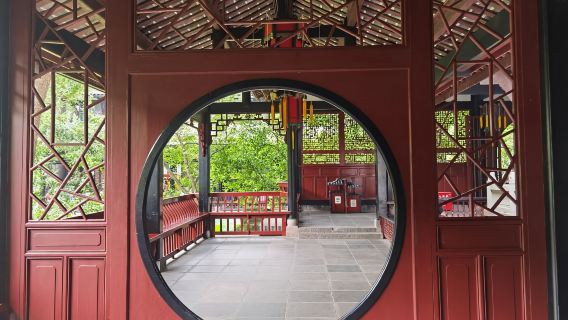
The architecture of Kuanzhai Alley is a **unique fusion** of northern hutong culture and Sichuan courtyard culture. On both sides of the courtyard gates, stone lions and potted flowers stand in picturesque disorder, each with distinct forms. Wooden railings, carved diagonal braces, and hanging ornaments—every detail serves as a textbook example of traditional Chinese architectural aesthetics.
There are also "small western-style buildings" that blend Chinese and Western elements—Roman columns and Western-style arched doors and windows paired with Chinese wood carvings, bearing witness to Chengdu's openness and inclusiveness during the late Qing Dynasty and early Republic of China.
**[Three·The brick wall remembers]**
In Jing Alley, there is a 400 m-long "Brick" cultural view wall—China's first museum using bricks as its medium. Old bricks from different historical periods are stacked to form platforms, city walls, screens, paths, steles, and gates, narrating the vicissitudes of Chengdu over millennia.
On the old walls, scenes like "narrow alley glances," "street-side bird fights," "courtyard card games," and "half-alley meal scraping" — these utterly ordinary life moments form the vivid images and memories of old Chengdu.
**Our study tour is not just a cursory glance.**
Architects, cultural scholars, urban culture experts, and intangible cultural heritage inheritors jointly participate in course design, enabling youth to intuitively experience cultural charm through familiar surroundings and deepen their identity by "touching the culture around them."
Find matching doors, identify carvings, decode door symbols—**learn while playing, play while learning**.
**Play anytime, flexible grouping, covering all age groups.**
Professional guide throughout the tour, bringing children into historical scenes, making culture tangible, perceptible, and warm.
**
**
Kuanzhai Alley·study tour available anytime
**Includes guide | Quick group formation | Flexible time slots**