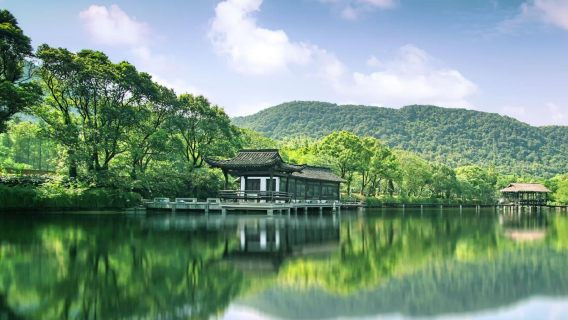
[Lu Xun Native Place Attraction] The Lu Xun Native Place in Shaoxing covers an area of 50 hectares, featuring numerous cultural relics related to Lu Xun, including the Former Residence of Lu Xun in Shaoxing, Baicao Garden, Sanwei Study Hall, Lu Xun Ancestral Residence, Tugu Temple, Changqing Temple, Lu Xun's Cultural Garden, and the Shaoxing Lu Xun Memorial Hall. As a prime example of preserving and continuing the traditional style of Shaoxing's ancient city, it has been developed into an ecological "cultural relic forest," showcasing the integrity of Shaoxing's ancient city preservation. It is hailed as a model for the protection of former residences of Chinese celebrities.

 [Baicao Garden] Covering an area of approximately 2,000 square meters, Baicao Garden was where Lu Xun played during his childhood. Although there are no clear boundaries within the garden, it is divided into a large section and a small section. The smaller section, located in the north, occupies a relatively modest area and extends northwestward, accounting for about one-quarter of the larger section. It has a gate leading to the Dongxianhuan River, where a riverside dock was built, allowing fertilizer boats to moor and transport the Zhou family's grass ash and manure. The larger section, situated in the south, covers a more extensive area. On its western side stands a 44-meter-long, roughly 1-meter-high earthen wall, serving as the boundary with the Liang family's rear garden to the west. At the southern end of the earthen wall, near the corner of Lu Xun's family's back door, lies a boundary stone inscribed with the characters "Liang Boundary." This marker and the "short earthen wall," which Lu Xun described as "endlessly fascinating," remain preserved to this day.
 [Sanwei Study Hall]Sanwei Study Hall was a renowned private school in Shaoxing during the late Qing Dynasty and served as Lu Xun's place of study from ages 12 to 17, located at No. 11 Duchangfangkou. The tutor, Shou Jingwu (also known as Jinghu in his later years), was an upright, simple, and erudite man. His character and scholarly spirit left an unforgettable impression on Lu Xun. Shou Jingwu taught here for 60 years, and from the building structure to the interior furnishings and even the surrounding environment, it has largely retained its original appearance. The Sanwei Study Hall is a small three-bay flower hall that originally served as the Shou family's study. It faces west with its back to the east, borders a small river to the north, and stands opposite the Lu Xun Ancestral Residence across the river.

Shen's Garden, located at No. 318 Lu Xun Middle Road, Yuecheng District, Shaoxing City, Zhejiang Province, east of Lu Xun Native Place, was originally the private garden of the Shen family during the Song Dynasty, hence the name "Shen's Garden." The garden consists of three main areas: the Historic Site Zone, the East Garden, and the South Garden (Lu You Memorial Hall and Lianli Garden). It features distinctive views such as the Solitary Crane Pavilion, Half-Wall Pavilion, Double Osmanthus Hall, Eight Chants Tower, Song Well Pavilion, Plum Inquiry Pavilion, Qin Terrace, and Guangsi Study. These form ten scenic spots: "Broken Cloud Elegy," "Poetic Love," "Spring Ripple Startled Swan," "Remnant Wall Regret," "Solitary Crane's Lament," "Lotus Reflecting Sunlight," "Willow of Palace Wall Sorrow," "Treading Snow to Inquire Plum," "Fragrance of Poetry and Books," and "Magpie Bridge Romance."