This is not a traditional walking tour. The Anti Tour Medellín explores the city through what was demolished, silenced, or deliberately forgotten. Medellín is a city in constant transformation, and unlike other Latin American capitals, it chose to erase much of its colonial past in the name of progress. This tour asks a simple but uncomfortable question: what was lost along the way?
We begin in La Alpujarra, the political and administrative core of the city, at the Monumento a la Raza, a powerful symbol of identity and power. Nearby, the old train station reminds us how industrialization reshaped Medellín—and set the stage for the destruction of its historic center.
We continue to Parque de las Luces, once a vibrant market square, now a forest of light poles illuminating a history that no longer exists. Around it, buildings like the Carré and Vásquez, the EPM Library, and other modern structures reveal the tension between memory and redevelopment.
The walk leads into El Hueco, a chaotic commercial district where informal trade, music, and crowds expose the pulse of everyday Medellín. Here, fragments of old buildings coexist with anonymous modern constructions, reflecting a city built without pause—or reflection.
At the Palacio Nacional, a former judicial palace turned shopping center, we confront the transformation of power and space. Just steps away, the Church of La Veracruz, one of the last colonial survivors, stands as a quiet act of resistance against relentless modernization.
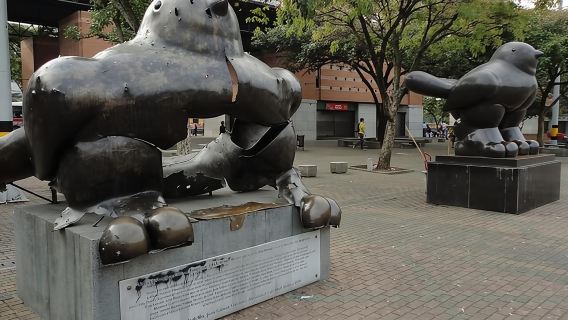
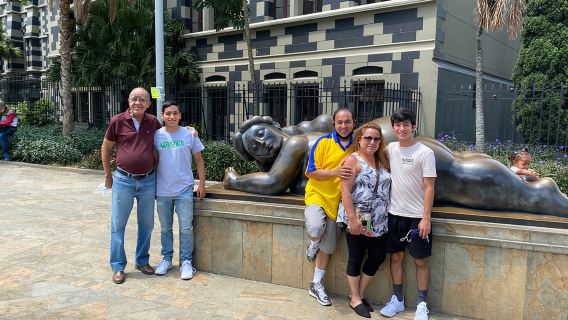
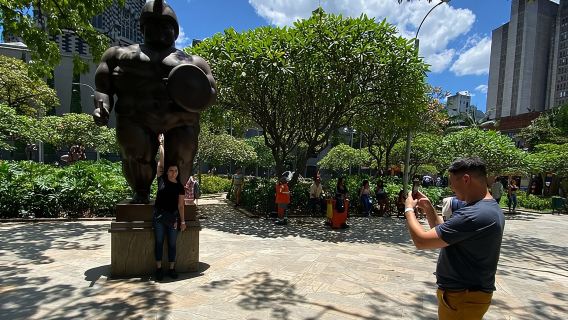
In Plaza Botero, art becomes political. Surrounded by Botero's sculptures and the imposing Palacio de la Cultura Rafael Uribe Uribe, we explore how culture has been used to rebrand and redefine the city's identity.
From the Coltejer Building, a symbol of industrial ambition, to Junín Street, once the heart of elegant urban life, we trace how economic progress slowly displaced Medellín's collective memory.
The tour ends on La Playa Avenue, a remaining trace of the city's aristocratic past, where theaters, old mansions, and the Casa de la Memoria Museum invite reflection on violence, loss, and resilience.
This Anti Tour is not about celebrating the city—it's about understanding it.


View all 15 photos
Anti tour Medellin
4.7/5
Good(3 reviews)
From
PKR 0.00
Sold out
Highlights
Discover the city's history and how it has been built on the ruins of its past
Meet ex-combatants and victims of Colombia's armed conflict
Stories you won't hear anywhere else

Itinerary
Product details
Explore the untold side of Medellín through stories of conflict, resilience, and transformation. Understand why the city has no historic center and how memory and change shape its streets.
Show less
What's included
Exploration of historic buildings and modern structures
Guided tour of Medellín's old city center
Insights into Medellín's transformation and history
Ticket memoria museum
Viche tasting
Visit to La Alpujarra, Parque de las Luces, El Hueco, and Plaza de Botero
Transportation to and from the activity
Eligibility
Adult: Age 1 to 99
Change & cancellation policies
If a cancellation request is submitted before 00:00, 1 day(s) prior to the date of use, no cancellation fee will be charged.
If a cancellation request is submitted after 00:00 1 day(s) before the date of use, a fee of 100% will be charged.
If a discount is applied, the cancellation fee will be calculated based on the original price before the discount and will not exceed the amount paid.
Partial refund is not available.
Important note
Wear comfortable walking shoes
Bring a hat and sunscreen for protection against the sun
Consider bringing water and snacks
Be prepared for varying weather conditions
Camera is recommended for capturing the sights
Not suitable for:
Wheelchair users
Good to know:
Be prepared for varying weather conditions
Bring a hat and sunscreen for protection against the sun
Camera is recommended for capturing the sights
Consider bringing water and snacks
Wear comfortable walking shoes
You may also like

Day tours
Medellin: Full Day Guided City Highlights Tour
5.0/5
(40 reviews)Duration: 7.5 hrs | English
Depart from Medellin
5% off
PKR 16,461.01
FromPKR 15,637.95
Day tours
Walking Tour, Cable Car & Fruit Tasting
Duration: 4 hrs | English
Depart from Medellin
5% off
PKR 12,815.79
FromPKR 12,175.00

Day tours
Medellin Historic Walking Tour
4.8/5
(44 reviews)Duration: 3.5 hrs | English
Depart from Medellin
5% off
PKR 4,006.79
FromPKR 3,806.45
Day tours
City Tour Medellin
5.0/5
(138 reviews)Duration: 270 mins | English
Depart from Medellin
FromPKR 44,763.36

Day tours
Medellin: Mémoire et Transformation - Une Visite Authentique
Duration: 3–4 hrs | English
Depart from Medellin
FromPKR 9,791.99
Day tours
Walking tour downtown Medellín
5.0/5
(32 reviews)Duration: 3–4 hrs | English
Depart from Medellin
FromPKR 9,791.99

Day tours
Museo Pablo Escobar
4.9/5
(7.7k reviews) | 2 bookedDuration: 45–90 mins | English
Depart from Medellin
FromPKR 14,548.10
Day tours
MEDELLIN: ENGLISH TOUR GUATAPE + OLD PEÑOL + MALECON + BOAT RUMBERO
Duration: 12 hrs | English
Depart from Medellin
5% off
PKR 13,420.59
FromPKR 12,749.56

Day tours
Pablo Escobar Tour And Comuna 13
4.9/5
(50 reviews)Duration: 4 hrs | English
Depart from Medellin
FromPKR 34,971.38

Day tours
Pablo and Comuna 13 with Cable Car
4.9/5
(373 reviews)Duration: 5 hrs | English
Depart from Medellin
FromPKR 42,027.20
FAQ
Popular Day tours in Medellin
Can I change or cancel my booking?
Please confirm the details on the product details page, as cancellation and change policies depend on the specific product
How can I get discounts?
We suggest keeping an eye on price changes, as prices can vary between working days and weekends as well as during peak and off-peak seasons. We also recommend using Trip Coins and Trip discounts for your purchases. For the latest discounts, visit Trip.com.
Trip.com Picks
Popular Products
Popular Activities
Guangzhou Spa & MassageSri Lanka SIM CardPhu Quoc Island SIM CardHainan SIM CardNaples Day ToursChina Bus TicketsChongqing Spa & MassageVietnam SIM CardShanghai Day ToursLaos SIM Card
Private Forbidden City Tour with English Speaking GuideBus Shared Tranfer From Huanglongjiuzhai Railway Station to Jiuzhaigou|Tikect is availableTerracotta Army TicketsPrivate tour from Lijiang: Jade Dragon Snow Mountain + Glacier Park Cableway + Blue Moon Valley Gulong Gorge Skywalk Glass Bridge and Waterfall View Private Tour2026 Wisteria Story - Ashikaga Flower Park + Ibaraki Nemophila Fields 1-day Tour Including Admission Ticket 89 Show Pattaya TicketPattaya 6996 ShowThe Wake Up Club Adult Show Ticket Phuket Mutianyu Great Wall With English Speaking Driver Service