



▲ Line 14 of the Shanghai subway fully covers the city's core cultural tourism hubs, directly connecting three major landmarks - Jing'an Temple, Yu Garden and Lujiazui (Oriental Pearl Radio & Television Tower) - saving the duration of transfers and enabling efficient "one-stop-one-view" sightseeing. Time optimization: Visit Jing'an Temple in the morning, explore and dine at Yu Garden at noon, ascend Shanghai Tower in the evening, and enjoy a night cruise on the Huangpu River. The entire itinerary relies on subway + walking to avoid transportation congestion. Eco-friendly summer retreat advantage: Enjoy the cool river breeze on summer nights, escape the high temperatures on land, and immerse yourself in the city's night views on a cruise.

▲ The ancient Jingan Temple, with a history spanning millennia, offers a Zen experience amidst Shanghai's bustling commercial district. Just steps from the subway station leads you to shopping centers, allowing visitors to experience the unique contrast of "urban vibrancy outside, temple tranquility within." Located at 1686 West Nanjing Road in Shanghai, Jingan Temple stands as a celebrated ancient Buddhist temple in the Jiangnan region. Its halls welcome pilgrims and tourists daily.

▲ The temple houses a vast collection of Buddhist artifacts, including the "Yunhan Zhaohui Pavilion" stele inscribed by Emperor Guangzong of Song (Zhao Dun) when he was crown prince, a large bell cast in the second year of the Hongwu era (1369) during the Ming Dynasty, and calligraphy and paintings by renowned historical figures. These include Su Shi's scroll of the Heart Sutra, long scrolls of calligraphy by Wen Zhengming, Chen Jiru, Zhang Ruitu, Yi Bingshou, and others, as well as paintings by the Eight Eccentrics of Yangzhou, Wu Changshuo, Zhang Daqian, and multiple Buddhist paintings by Wang Yiting. The collection also features numerous stone carvings, bronze-cast, gilded, white porcelain, and lacquered gold Buddha statues dating from the Han-Wei period to the Qing Dynasty. Additionally, it preserves the "Pinjia Jingshe Collated Buddhist Canon," a facsimile edition of the Song Dynasty's "Qisha Canon" (full title: "Pingjiang Prefecture Qisha Yansheng Monastery Buddhist Canon"), and Japan's "Taishō Tripiṭaka" (full title: "Taishō Shinshū Daizōkyō").
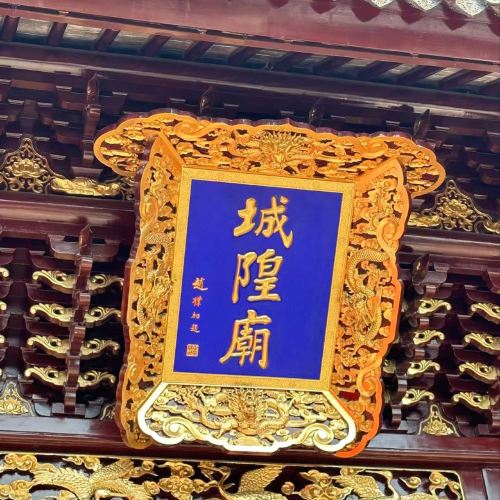

▲ Theme depth: A single day covers four dimensions - "religious culture, Jiangnan gardens, urban finance, and river ecology" - meeting the composite needs of historical exploration, nature sightseeing, and urban leisure. Near Yu Garden, the City God Temple is a local Taoist religious site.


▲ Xintiandi Shikumen architectural complex (near South Huangpi Road Station) blends the revolutionary history of the First National Congress of the Communist Party of China with trendy entertainment, where traditional alleyways meet designer boutiques to create a new ecosystem of Shanghai-style culture.

▲ The Yu Garden and City God Temple area gathers a variety of local snacks like Nanxiang steamed buns, fresh meat mooncakes, qingtuan (glutinous rice balls), baiye dandang (bean curd sheets with stuffed gluten), soup dumplings, and steamed buns.


▲ Yu Garden's Jiangnan-style landscape: The Ming Dynasty garden's zigzag bridge and Mid-Lake Pavilion engage in a dialogue between past and present with the cyberpunk-themed subway station ("Shanghai Pulse" theme). The "Shanghai Subway Station," reaching 36 meters deep, is itself an artistic landmark.

▲ The Huxinting Teahouse in Shanghai is located in the heart of Yu Garden. As one of Shanghai's oldest teahouses, it was built during the Qianlong era of the Qing Dynasty and converted into a teahouse in 1855 (the fifth year of the Xianfeng reign), boasting over 160 years of history.

▲ Yu Garden was built during the Jiajing era of the Ming Dynasty (1559) by Pan Yunduan for his father Pan En. As one of Shanghai's three famous gardens during the Ming Dynasty, it has witnessed over 450 years of urban transformation - evolving from a private garden to a temple garden and finally to a modern cultural heritage site, vividly showcasing the development of Chinese garden architecture during the Ming and Qing dynasties.


▲ The garden's couplets, plaques (such as "City Mountain Forest" and "Lingtai Jing Shi"), and cultural relics (like Ming and Qing dynasty furniture and brick carvings) embody traditional Chinese philosophical concepts such as "harmony between man and nature" and "the Dao follows nature." Through architectural names (e.g., the Hall of Spring Hints symbolizing a garden full of spring scenery) and spatial design, the garden conveys a pursuit of harmony with nature, deepening visitors' understanding of traditional culture.

▲ Yu Garden is renowned for its "tranquil beauty and exquisite delicacy" in the Jiangnan garden style. With a compact layout, it harmoniously blends elements like pavilions (such as Sansui Hall and Wanhua Tower), rockeries, ponds, and landscaped plants, employing techniques like borrowed scenery and framed views to create a natural artistic conception, representing the pinnacle of Chinese classical garden art. As an "urban mountain forest," Yu Garden offers a serene escape within the bustling city. Visitors can stroll along winding paths and covered corridors, admiring seasonal plants and the interplay of light and shadow, experiencing the perfect balance between nature and culture—a true sanctuary for the soul away from urban chaos.


▲ Oriental Pearl Radio & Television Tower: 4 m hall---(by elevator)---263 m sightseeing floor 263 m sightseeing floor---(walk downstairs)--259 m transparent glass sightseeing floor 259 m---(by elevator)--- 90 m 90 m---(by elevator)---78 m 78 m---(by elevator)---0 m hall (Shanghai history exhibition hall).

▲ Lujiazui skywalk.

▲ The Lujiazui trio refers to the three iconic skyscrapers in Shanghai's Pudong Lujiazui Financial and Trade Zone, which are nicknamed the "Bottle Opener," "Egg Beater," and "Syringe" due to their distinctive shapes.