
Things to do in Li County
Explore top experiences
Top 10 attractions in Li County

Gansu Qin Culture Museum
Li County · 993m from downtown


Gansu Provincial Museum
Gansu Provincial Museum is a large comprehensive museum centered on the civilization of the Silk Road. Located at a strategic point along the Silk Road and a convergence zone of Han and Tibetan cultures, its collections embody the diverse characteristics of the Central Plains, Western Regions, and the Tibetan Plateau. The three treasured artifacts—the Galloping Bronze Horse, the mural brick of a courier, and the painted pottery vase with a human-head-shaped mouth—serve as iconic representations of the museum. The museum has three floors, featuring permanent exhibitions on themes such as the civilization of the Silk Road, Buddhist art of Gansu, painted pottery of Gansu, paleontological fossils, and revolutionary Gansu. The Silk Road civilization exhibition on the second floor is the museum's centerpiece: the bronze galloping horse unearthed in 1969 from the Leitai Han tomb in Wuwei is displayed here. The horse has three hooves in the air and one stepping on a flying bird, standing steadily on a single hoof. Its image is now the symbol of Chinese tourism. In the same hall, the mural brick depicting a courier from the Wei-Jin tombs in Jiayuguan shows a messenger galloping on horseback, notably without a mouth, symbolizing the need for couriers to "keep their mouths shut." This pattern was later adopted as the emblem of China Post. The exhibition also features a procession of chariots and horses excavated from the same tomb as the bronze horse, along with Han and Tang dynasty silk textiles, gold and silver artifacts, making the prosperity of Silk Road trade vividly tangible. The Buddhist art exhibition hall on the third floor features replicas of caves from the Mogao Grottoes and Maijishan Grottoes, alongside statues, ritual objects, white pagodas, and prayer wheels from both Han and Tibetan Buddhism. Stepping into the hall feels like entering a temple, and this harmonious blend of Han and Tibetan styles is rarely seen elsewhere. On the same floor, the painted pottery exhibition showcases ceramics from cultures such as Dadiwan, Yangshao, and Majiayao, with intricate and fluid patterns like spiral and sawtooth designs. Among them, the painted pottery bottle with a human-head-shaped spout unearthed at Dadiwan in Qin'an, which integrates facial sculpture with the pottery vessel, is a highly popular exhibit. If you're interested in natural history, the paleontological fossils exhibition hall features the impressive skeleton of the Yellow River ancient elephant unearthed in Heshui, and the dinosaur fossils and reconstructed models are also popular with children. The revolutionary Gansu exhibition hall showcases historical artifacts and materials from periods such as the Nanliang base area and the Shaan-Gan-Ning border region, narrating the modern history of this land. The museum houses a large quantity of exhibits, and even a quick tour would take half a day. It's recommended to start with the Silk Road exhibition on the second floor, then proceed to the third floor for Buddhist art and painted pottery, following a logical route. In the exhibition halls, you can scan to listen to the audio guide, and at certain times, volunteers also provide guided explanations.China · Lanzhou

Qingmuchuan Ancient Town
Picturesque Qingmuchuan Ancient Town has a long history. The Qiang and Han people intermingled and lived peaceably together here. The area gradually prospered during the Ming dynasty, and most of the residences here were built during the Ming and Qing dynasties (1368-1912). A river cuts through the ancient town, and the people here live a carefree and leisurely life. The town's Wei Family Mansion was built during the Republican Era (1912-1949), and the Qu, Wei, Zhao, and Tu ancestral halls were built during the Ming and Qing dynasties.China · Ningqiang

Lanzhou Old Street
Lanzhou Old Street is located in the center of Lanzhou city, gathers Chinese branded products, nightlife, trendy fashion brands, retail centers, experiential businesses, catering and entertainment, leading the trend and creating a place for eating, drinking, fun and entertainment in Lanzhou.China · Lanzhou

Tianshui Ancient City
Tianshui Ancient City is a historic cultural attraction located in Qinzhou District, Tianshui City, Gansu Province. It attracts numerous visitors with its rich historical relics and unique cultural charm. Tianshui Ancient City is a well-preserved residential courtyard complex from the Ming and Qing dynasties, known as "One Street with Eleven Alleys." Cuijia Alley is one of these lanes, with the heart of the ancient city located to its west. Visitors can enter through Cuijia Alley and pass byAntique MarketOn Huayan Street, you'll find the Fengyun Sculpture, which depicts Zhuge Liang's first arrival in Tianshui during the Three Kingdoms period as part of his "Six Expeditions from Qishan." Strolling through Tianshui Ancient City, visitors can admire attractions such as Sanxin Lane, the Rong's Fuxin Tianshui Office, and the Han General's Mansion. These buildings showcase the essence of ancient architectural art with their exquisite carvings and unique styles, serving as cultural landmarks of Tianshui that attract countless history enthusiasts and cultural explorers. Visitors can also participate in local traditional festivals and folk performances to experience the city's distinctive cultural atmosphere. Tianshui Ancient City is not just a sightseeing destination, but a multi-layered experience space where you can feel the charm of history and culture.Tianshui · 65.5km from Li County

Zhongshan Bridge
Zhongshan Bridge, also known as the Lanzhou Yellow River Iron Bridge, spans the Yellow River with White Pagoda Mountain to its north and serves as a city landmark of Lanzhou. Completed in the late Qing Dynasty, it was built by the German firm Telge & Schroeter. The bridge materials, including steel beams and cement, were shipped from Germany across the ocean and then transported to Lanzhou via railway and horse-drawn carriage. It is one of the earliest permanent bridges built across the Yellow River in Lanzhou's history. It was later renamed Zhongshan Bridge in memory of Dr. Sun Yat-sen, a name that remains in use today. The bridge is over 200m long, and its gray-black steel truss structure is simple and substantial. The several arched steel ribs added above the bridge body during reinforcement in the 1950s give the entire structure a more imposing appearance. Today, the iron bridge is open only to pedestrians. Walking onto the bridge deck, you can see the Yellow River flowing slowly eastward beneath your feet. On the south bank lies the lush Binhe Road, while the north bank is home to White Pagoda Mountain Park. Climbing to the top of the mountain and looking back, the view of the iron bridge, the Yellow River, and the streetscape on both banks framed together is particularly beautiful. People often line up to take photos in front of the golden "Zhongshan Bridge" inscription at the south end of the bridge. In the pavilion on the east side of the south bridgehead stands a Ming Dynasty "General Pillar," a relic from the earlier Zhenyuan Floating Bridge that is easy to miss if you just walk past. After nightfall, the iron bridge offers a different scene: the bridge's colorful lights turn on, and the entire outline of the bridge is clearly illuminated. On one side are the bustling lights of Binhe Road, and on the other are the lights shining on the mountain, making it a great place to experience and photograph the night view of Lanzhou.China · Lanzhou

Baoji Bronze Ware Museum
The Baoji Bronzeware Museum is in the Chinese Shi-ku Garden of Baoji City, "the hometown of bronzeware." The museum has four exhibition halls, and Halls 1 and 2 are the focuses of the tour. The museum displays high quality bronzeware, such as the Hu gui from the period of King Li of Zhou and the treasures of Qin Duke Bo. The He zun, which is inscribed with the words "Here in China I dwell," is kept here.China · Baoji

Wanxia Lake Scenic Area
The Wanxia Lake Scenic Area is located about 5 kilometers west of the county seat of Xihe County, Longnan City, Gansu Province. It used to be a reservoir, but now it has been transformed into a natural scenic area with elegant scenery. The scenic area is mainly composed of Wanxia Lake, and many sightseeing and entertainment attractions have been built. Here, you can stroll around the lake to experience the beautiful scenery, watch the lotus pond, visit ancient buildings, etc., and you can also play water entertainment projects to experience the fun of playing in the water. It is a tourist attraction in Longnan. a good place to go. The area of the Wanxia Lake area is not too large, with a length and width of about a few hundred meters. You can walk in the scenic area or take a sightseeing battery car to visit. The scenic area has built antique pavilions and corridors around the lake, which can be strolled and watched. There are a lot of lotus flowers planted in the lake area. It is very good to come to view the flowers every summer. In other seasons, there are also beautiful reeds for sightseeing and photography. There are also several lake islands on the lake, you can take a speedboat to play on the islands.Xihe · 22.2km from Li County

Songpan Ancient City
The ancient city of Songpan, known as Songzhou in ancient times, is located in Jin'an Town, Songpan County, northeast of Aba Prefecture. It was built in the Hongwu period of the Ming Dynasty. An important station of mutual market". The ancient city of Songpan is ancient and quiet. You can walk or take a rickshaw to walk through the ancient buildings, looking for the traces of time left in this ancient city on the plateau, and feeling the thickness and vicissitudes of the ancient city. You can also climb up the ancient city tower and enjoy the magnificent scenery around you. The ancient city of Songpan is divided into inner and outer cities, and there is a gate between the two cities. The city wall has a total length of 6.2 kilometers and a height of 12.5 meters. It is all made of green bricks and is firm and solid. Its thickness reaches 12 meters, which can be called the largest in the country. There are 7 gates in the ancient city, "Jinyang Gate" in the east, "Yanxun Gate" in the south, "Weiyuan Gate" in the west, "Zhenqiang Gate" in the north, and the south gate of the outer city is called "Buqing Gate" (still known today). There is a complete Wengcheng Gate), there is a Xiaoximen at the foot of the southwest mountain, and there is a "Linjiang Gate" near the river in the outer city. There was a double-eaved Xieshan-style tower built on the city gate in the early days, but it is a pity that it has been damaged now. Except for the four remaining city gates, the other city walls were rebuilt in 2004. On the stone wall next to Linjiang Gate, there is also engraved a notice about reducing or exempting harsh taxes in the 16th year of Chonghua (1644). The small bridges and flowing water in the ancient city have a unique landscape. The turbulent Minjiang River passes through the ancient city, from east to west, passes through the ancient city street, turns south, and exits through the city from the south gate. There are two famous bridges on the river, Gusong Bridge and Yingyue Bridge, both of which were damaged in history and rebuilt in 1986. The ancient city of Songpan is also an important memorial site. Two important meetings were held here during the Long March. There is still a Red Army Long March Monument Garden on the top of Yuanbao Mountain in Chuanzhusi Town, Songpan County.China · Songpan

Shi-ku Garden in China
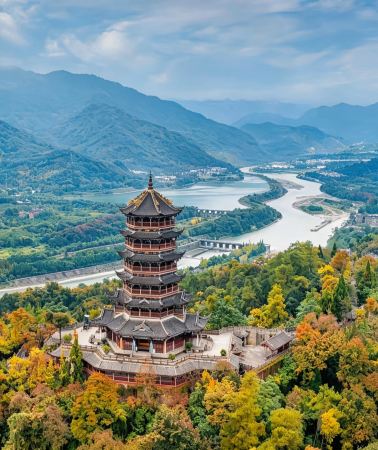
Shi-ku Garden in Chinais located on Shigu Mountain on the south bank of the Wei River in Baoji, to the north it overlooks the Wei River, to the east it borders the Yinxiang River, and to the south it adjoins Tiantai Mountain National Forest Park. Legend has it that the pre‑Qin stone drums unearthed in the early Tang were found in this area. The ten granite, drum‑shaped stones are inscribed with stone drum script, a writing that follows bronze script and anticipates small seal script. The Tang writer Han Yu wrote the "Song of the stone drums" to praise their value, and the original artifacts are now kept at The Palace Museum in Beijing, soShigu Mountaintook its name from this association. The park spreads along the mountain slope, integrating site conservation, bronze exhibitions, stone drum culture displays, garden sightseeing, and archaeological research into a cultural ecology park. At a high point in the park, the Shigu Pavilion is the landmark building. Modeled on Qin and Han styles, its outer‑five, inner‑nine tiering is especially striking, and from the pavilion you can look down on the urban areas on both banks of the Wei River. At the foot of the mountain, the Baoji Bronze Ware Museum houses Western Zhou bronze masterpieces such as the He zun and the Lai pan. The museum and the Shigu Pavilion, one high and one low, form the main tour route. You can also walk past the Zhou Culture Wall, the Han character gallery, the plaza for heaven worship and ancestor veneration, and the Shigu Mountain corridor bridge. At night, the Shigu Pavilion and the corridor bridge are illuminated, and the park takes on a different atmosphere.China · Baoji
More ways to travel from Li County
Private Tours in Li County
View More Private Tours in Li County








Free things to do in Li County
Gansu Qin Culture Museum
Li County · 993m from downtownGansu Provincial Museum
China · LanzhouQingmuchuan Ancient Town
China · NingqiangLanzhou Old Street
China · LanzhouTianshui Ancient City
Tianshui · 65.5km from Li CountyZhongshan Bridge
China · LanzhouBaoji Bronze Ware Museum
China · BaojiWanxia Lake Scenic Area
Xihe · 22.2km from Li CountySongpan Ancient City
China · SongpanShi-ku Garden in China
China · Baoji
What travellers say about Li County

_We***5018 March 2020
4.0
The Gansu Qin Culture Museum is located in the Qinren Square, Dongxin South Road Development Zone, Chengguan Town, Li County, Longnan City, Gansu Province. It covers a total area of about 43,864.7 square meters and a total construction area of 20,533 square meters. The main building area of the museum is 8,350 square meters, including exhibition halls, conference rooms, warehouses, academic halls, etc. The total investment is 36.9 million yuan. The research was completed by the Northwest Municipal Design Institute. The Gansu Provincial Architectural Design Institute completed the planning and design on the basis of fully absorbing the design and planning of the Peking University Cultural and Museum Institute and the Shaanxi Ancient Building Design Institute. The architectural features reflect the simple and majestic pre-Qin architectural style.
Gansu Qin Culture Museum

M14***996 October 2026
5.0
Lina, the lecturer at the Gambo Museum, is exceptionally skilled. During the two-hour learning experience, she demonstrated a thorough understanding of the chronological order and comparative analysis of the artifacts, meticulously integrating historical evolution with everyday life. I look forward to the completion of the new Gambo Museum and visiting it again next time.
Gansu Provincial Museum

爬山🐯13 September 2026
4.0
Qingmuchuan Ancient Town is located at the junction of Shaanxi, Sichuan and Gansu provinces. The ancient buildings are well preserved. Must-see attractions include the Wei Family Residence, Rongshengkui, and the opium den. You must also stroll along Huilongchang Old Street and climb Huilong Pavilion to overlook the entire ancient town.
Qingmuchuan Ancient Town

大叔的星辰大海!21 April 2026
4.0
Lanzhou Old Street is quite close to the Yellow River Tower. We walked there after visiting the Yellow River Tower. The old street area isn't small, and it feels like a newly built commercial district. In the afternoon during the off-season, there were very few people. I wonder if it will be more crowded at night? The shops are mainly restaurants, plus souvenir shops. If you're passing by, you can check it out!
Lanzhou Old Street

行走在民间的艺术家23 November 2025
5.0
5 stars! A thousand-year-old city hidden in Northwest China, the night view and food are absolutely amazing!
A must-visit treasure in Tianshui! The free admission to the ancient city is such a generous offer; I was instantly hooked after exploring it. The ancient residences from the Ming and Qing dynasties are incredibly well-preserved, with exquisite wood and brick carvings that are breathtaking. The courtyard layout of the north and south houses is particularly stunning; stepping inside feels like stepping back in time. Wearing Hanfu for photos is incredibly photogenic, and in the morning when it's less crowded, you can take pictures effortlessly.
The vibrant atmosphere of the ancient city is truly captivating! The streets and alleys are filled with Tianshui's signature snacks: spicy and chewy "guagua," refreshing and tangy "jiangshui noodles," and springy "laolao" (a type of noodle). You can't go wrong with any of the small shops; sit down and slurp down a bowl after a long walk—pure bliss! There are also shops selling intangible cultural heritage handicrafts and creative cultural products; you can discover many surprises at a leisurely pace. It's not overly commercialized, allowing for a truly relaxing stroll.
And the night view deserves special mention! As dusk settles, red lanterns illuminate the cobblestone streets, creating a vibrant atmosphere in the ancient buildings. Occasionally, you might even catch a street band performance or a Qinqiang opera, adding to the lively yet charming ambiance. The guesthouse we stayed at in the ancient town was incredibly stylish with its retro decor. The owner was warm and attentive, even sharing hidden tourist routes. It was within walking distance of the Fuxi Temple and Yuquan Temple, making it super convenient.
The facilities were excellent, and the staff were very attentive. Overall, a fantastic experience! Whether you want to immerse yourself in history and culture or simply enjoy the food and photos, Tianshui Ancient Town is definitely worth a visit. I'll definitely bring my friends back next time!
Would you like me to compile a detailed list of "food and photo spots" in the ancient town, highlighting specific shops and the best photo locations?
Tianshui Ancient City

Jamie Ning20 July 2026
4.0
Before coming to Lanzhou, I had no idea what this bridge was like.
I arrived around 3 PM; the sun was still blazing, and the iron railings on the bridge felt hot to the touch. This iron bridge, built in 1909, spans the Yellow River, looking sturdy yet silent. Standing on the bridge, the Yellow River surged beneath my feet, carrying the scent of silt. Speedboats darted out from under the arches, splashing up waves, and children on the bank screamed excitedly—their jubilation was unstoppable.
I didn't rush up the mountain; instead, I found a seat at a teahouse under the bridge. I ordered a cup of "Sanpaotai" (a type of local tea), 15 yuan, with refills. The bamboo chair was a bit old, but just the right amount of comfortable. Several local old men around me were cracking sunflower seeds and playing chess, occasionally glancing up at the river and saying, "The water's risen again." That relaxed feeling is rare in tourist spots.
You absolutely must try the Sanpaotai at the teahouse. Don't rush; sit for at least half an hour, just gazing at the river and daydreaming—that's the real deal.
The cruise ticket is only a few dozen yuan, not expensive at all, and worth experiencing the view from under the bridge.
Speedboats and sheepskin rafts are available on the shore; thrill-seekers can give them a try.
Regarding photography: the "Zhongshan Bridge" stone monument on the south side of the bridge is a classic spot for photos.
Take your time; although the sun is strong 🌞, the river breeze is very pleasant.
Zhongshan Bridge

blu***hh15 August 2026
5.0
The teacher's explanations made our visit truly meaningful. The explanations were very comprehensive and detailed; I'll need to review some of the points later. I really liked the architectural style of the Baoji Bronze Museum; it was definitely worth the long journey.
Baoji Bronze Ware Museum

不见不念4 October 2021
4.0
I stayed in Xihe for one night on my way to Yangba. I was amazed by this 4A-level scenic spot in Xihe. It is five kilometers away from Xihe. The scenery is beautiful in the early morning after the rain. I drove around the lake. The air was very fresh and there were farmhouses all around. Attractions worth visiting
Wanxia Lake Scenic Area

只想去玩12 August 2025
5.0
Returning to Chengdu from Jiuzhaigou, I took the high-speed rail in Songpan and rested for a while in the ancient city. There are many mushroom sellers in the ancient city, and they can also take you to pick mushrooms. It is a very distinctive town in western Sichuan.
Songpan Ancient City

首席监理30 May 2022
4.0
The Chinese Stone Drum Park is one of the key tourist and cultural scenic spots in Baoji City, Shaanxi Province. It is located on the Stone Drum Mountain, where the Stone Drum, which was praised by Kang Youwei as "China's No. 1 Antiquity", was unearthed. It is adjacent to Yinxiang River in the east, Jifeng Mountain, the main peak of Qinling Mountains in the south, the urban area in the west, and the Weihe River in the north. It covers an area of more than 500 acres and has a total construction area of 47,000 square meters. It is a cultural ecological park with the theme of Zhou and Qin history and culture. There are five major areas, Baoji Bronze Museum, Chencang Stone Drum Pavilion, Qin Culture Square, Stone Drum Square, and Jinshi Garden, which integrate site protection, bronze exhibition, stone drum culture display, garden sightseeing, archaeological research and leisure and entertainment, and fully display the profound history and culture of Baoji as the birthplace of Zhou and Qin culture.
Through the protection and shaping of natural landscapes, the park has become a collection of the five characteristics of Baoji, Shaanxi, namely, mountain, water, forest, plateau, and city. Through the integration and reproduction of Zhou and Qin history, the park has become a microcosm of ancestral culture and a charming place with both natural and humanistic characteristics. The two iconic buildings of the China Stone Drum Park, Chencang Stone Drum Pavilion and Baoji Bronze Museum, have become the new city coordinates of Baoji.
Shi-ku Garden in China


