Lingyun

Things to do in Lingyun

Search attractions or local attractions & tours
Search

Explore top experiences

Top 10 attractions in Lingyun

View all Attractions
Haokun Lake
No. 4 of Best Things to Do in Baise

Haokun Lake

7
4.3/5
309 reviews

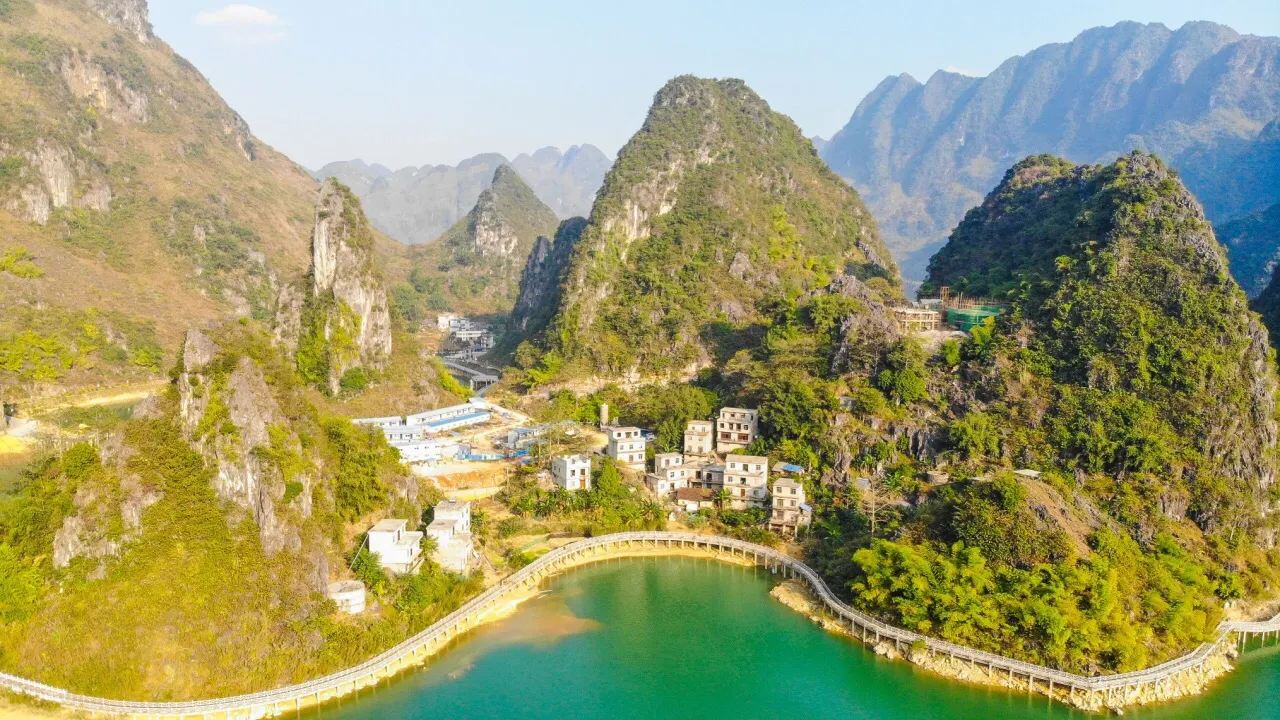
Haokun Lake is a tourist attraction in Guangxi Zhuang Autonomous Region, located along the road from Baise to Lingyun. Formed by damming the Chengbi River system, it lies just 5 km from Shenyun Dragon Palace. The lake spans 500–1,000 meters in width and serves as a scenic area centered around natural landscapes and ecotourism. Surrounded by mountains with crystal-clear waters, Haokun Lake resembles a sparkling gem embedded in the earth. Its tranquility and pristine beauty attract numerous visitors seeking relaxation and an escape from urban noise. Visitors can take a cruise to leisurely explore the lake, admiring the green mountains, clear waters, and stunning reflections along the shores. The Haokun Lake Scenic Area features multiple viewpoints where you can pause to capture breathtaking moments of the picturesque landscape. For hiking enthusiasts, the trails around the lake offer opportunities to explore nature—stroll through the woods, listen to birdsong, and immerse yourself in the tranquility and harmony of the surroundings. Haokun Lake Scenic Area is a paradise for fishing enthusiasts, boasting abundant fish resources where you can enjoy the pleasure of angling. Additionally, the surrounding ethnic minority villages offer visitors opportunities to experience local culture, savor authentic ethnic cuisine, and participate in traditional folk activities. Whether you're seeking nature exploration, leisure vacation, or cultural immersion, Haokun Lake Scenic Area provides a rich and unforgettable travel experience.

Lingyun · 20.6km from downtown
Sanmenhai Area
No. 1 of Best Things to Do in Hechi

Sanmenhai Area

7.7
4.5/5
921 reviews

Nestled among the karst peaks of Fengshan County, Hechi, Guangxi, the Sanmenhai Area is a cluster of collapsed skylights connected by an underground river. The cave ceilings collapsed and linked with the surface, leaving seven skylights arranged like a string of beads resembling the Big Dipper, with three currently accessible by boat. The journey begins on a bright lake before entering a dark cave, then emerging back into the light, with the scenery of mountains, water, caves, and sky alternating before your eyes—creating the illusion of "seas within mountains and gates above seas," which inspired the name Sanmenhai. Geologists and cave researchers call this skylight cluster the "Window of the World" and the "Karst Geology Museum," as it remains largely untouched by human development. During the boat tour, the first stretch of water forms a lake encircled by cliffs, its surface a deep blue. The second skylight, known as the "Half-moon Skylight," reveals a rock opening resembling a crescent moon hanging above. The innermost skylight passage is deep and maintains a constant temperature—warm in winter and cool in summer. When sunlight slants through the opening onto the water, the turquoise lake and submerged rock walls reflect like a piece of jade immersed in water. The tour is primarily by boat, alternating between bright lakes and dark caves. Each passage through shadowy waterways is met with light from the skylights, offering perfect photo opportunities on sunny days when the water displays distinct layers of color. Due to its remote location, a round-trip to Fengshan town requires planning for travel time. The experience is boat-centric and pairs well with other karst views in the county on the same day.

Fengshan · 48.4km from Lingyun
Detian Transnational Waterfall Scenic Spot
2026 Asia 100 - Best Things to Do

Detian Transnational Waterfall Scenic Spot

9.1
4.7/5
27.6k reviews

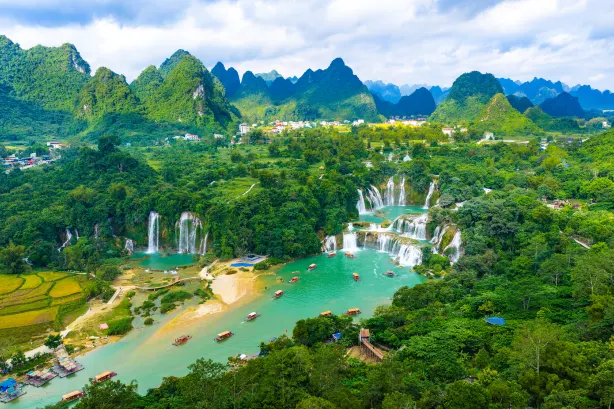
Detian Transnational Waterfall Scenic Spot is located on the Guichun River along the China-Vietnam border in Guangxi. Here the border river meets a cliff, and the water drops in three tiers with a fall of about 60 m, facing Vietnam's Ban Gioc Waterfall across the cliff. In the rainy season, when the water is abundant, the two waterfalls almost merge into one, with a combined width of more than 200 m, and the roar can be heard across the valley. This is also one of the filming locations for the TV drama The Journey of Flower. The highlights of the visit mostly unfold around this border river: after passing through the Detian Archway, you can take a bamboo raft from the bank toward the foot of the waterfall, look up as the curtain of water crashes down from the cliff top and mist hits your face, and experience up close the unique atmosphere of two countries just a step apart on the border river; on the river, you can often encounter Vietnamese border residents rowing small bamboo rafts to sell coffee, dried fruit, and other small goods, and the bargaining has much of the fun of a cross-border market. After coming ashore, follow the waterfall-viewing boardwalk and the multi-level viewing platforms to look back at the full panorama of the waterfall from different heights. The No. 53 boundary marker, erected in the Qing Dynasty and inscribed with "China Guangxi Boundary," is a popular photo spot. The waterfall view changes noticeably with water volume: during the summer wet season, the water is surging and visually stunning, while in the dry season it is relatively delicate; bamboo raft docks have long queues during peak season, so if you want to view the waterfall up close, it is recommended to plan an early start; there is heavy mist on the bamboo raft, so remember to protect your phone and camera from water.

China · Daxin
Huangguoshu Scenic Area
2026 Asia 100 - Best Things to Do

Huangguoshu Scenic Area

9
4.6/5
40.2k reviews

The Huangguoshu Scenic Area is located in Anshun, Guizhou, centered around the Huangguoshu Waterfall. Surrounded by deep gorges, dense vegetation, and dotted with limestone caves and stone forests, it is a typical karst landscape area. The waterfall's name originates from the locally abundant "Huangguoshu" (Ficus virens). Ming Dynasty traveler Xu Xiake visited and documented this site, contributing to its fame. The scenic area primarily consists of three main sections: the Great Waterfall, Tianxing Bridge, and Doupotang. Most travelers follow the sequence of Doupotang, Tianxing Bridge, and finally the Great Waterfall, saving the most spectacular view for last. The grand waterfall has a drop of nearly 80 m and a width of over 100 m. The Baishui River plunges from the cliff top into Rhinoceros Pool, creating a vast mist. Multiple viewing platforms around it allow visitors to experience its grandeur, wonder, steepness, and beauty from different angles—above, below, front, back, left, and right. A particularly unique experience lies behind the waterfall: a 100 m long Water Curtain Cave runs horizontally through its midsection, featuring cave windows and halls. Reaching through a window, one can touch the cascading water. The cave served as the filming location for the Water Curtain Cave in the 1986 TV series Journey to the West. Due to the heavy humidity inside, bringing a raincoat in advance is recommended. Tianxing Bridge is renowned for its harmonious blend of rocks, water, trees, and caves—where rocks rise from the water, caves hide within rocks, and trees stand beside caves. The stepping stones along the path are engraved with dates, allowing travelers to find their own "birthday stone." The attraction is divided into upper and lower sections. Many travelers turn back after completing the upper section, missing the Silver Chain Waterfall in the lower part—where water cascades like silver chains into a funnel-shaped pool, the highlight of Tianxing Bridge. The Doupotang waterfall is located approx. 1 km upstream from the grand waterfall. With a width of over 100 m at its crest, the water spreads out smoothly like a beaded curtain. During the high-water season, its deep roar earns it the nickname "roaring waterfall." The scene of the four pilgrims leading their horse across the river in the 1986 TV series Journey to the West was filmed here. In summer and fall, the waterfalls are full and powerful, while in winter and spring, the flow becomes gentler, offering different viewing experiences. Nearby, visitors can also enjoy local snacks like sticky rice, love tofu, and Anshun spring rolls.

China · Zhenning
Libo Xiaoqikong Scenic Area
2026 Global 50 - Cool Water Escapes

Libo Xiaoqikong Scenic Area

8.7
4.7/5
24.4k reviews

Libo Xiaoqikong Scenic Area is located among the peaks in the southern part of Libo County and is named after a seven-arch stone bridge built during the Daoguang era of the Qing Dynasty over the Xiangshui River. Set against a karst landscape, the scenic area brings together mountains, waters, forests, caves, lakes, and waterfalls, and is known as the "emerald on the Earth's belt." The Xiaoqikong ancient bridge is the attraction's signature view. The seven-arch stone arch bridge, built of bluestone, spans the Xiangshui River. Beneath the bridge, the water of Hanbi Pond is deep blue, and ancient trees tower on both banks, making it a classic photo spot. Following the Xiangshui River downstream, the 68-tier waterfall cascades in overlapping layers, with the river water dropping step by step over the karst rock surface with a roaring sound. Nearby, the Laya Waterfall pours down from the cliff beside the path, and visitors can feel the mist on their faces up close. The water forest is another unique view in the attraction, where trees take root among the streams in the water. Visitors walk along the stone stepping path through the forest, with babbling water beneath their feet and a canopy of green shade overhead. Mandarin Duck Lake is formed by two large lakes, the Male Mandarin Duck Lake and the Female Mandarin Duck Lake, connected with several small lakes. The lake surface is emerald green and serene, and boats can pass through the trees growing in the water. Wolong Pond is the surface outlet of an underground karst river. An arc-shaped stone embankment encloses the underground river water into a deep pond, and the water is as green as jade. Where the water overflows the stone embankment, a rolling-water waterfall forms, creating a striking contrast between the still pond and the moving waterfall. The area around the attraction is home to ethnic minorities such as the Bouyei and Yao, and villages like Yaoshan Ancient Village retain traditional dwellings and ethnic customs, adding cultural richness to the natural scenery. The attractions are distributed along the Xiangshui River; touring from Wolong Pond and Yuanyang Lake all the way down to the Xiaoqikong Ancient Bridge, walking along the stream is relatively effortless.

China · Libo
Lingyun Today's weatherOvercast 12-22℃
Lingyun weather for the next 2 days11/9: 11-15℃, 11/10: 11-18℃

Free things to do in Lingyun

What travellers say about Lingyun
user-avatar
一个孤独的生活14 September 2026
5.0
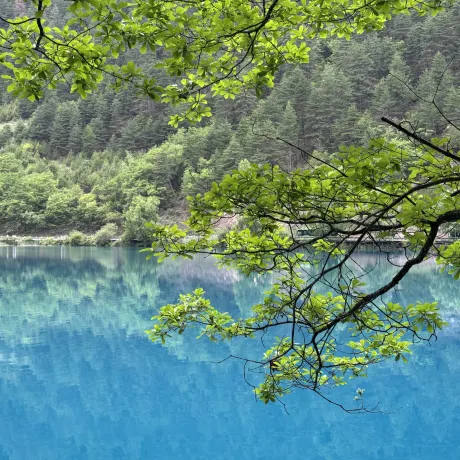
The karst landscape of Haokun Lake is quite different from other places. The peaks here are more majestic and unique, some even possessing a kind of "imperfect" beauty. The lake water blends perfectly with them, creating a landscape where the scenery is in the water and the water is in the scenery, resulting in a unique charm.

Haokun Lake

user-avatar
Anonymous user4 November 2026
4.0
We went on a cloudy day, and it rained a little, so we had to wear raincoats. The water was green, but it looked like a beautiful blue when photographed, so it wasn't the Tiffany blue that people talked about online. It was all just a camera filter effect. The trip felt a bit short. Although there was someone on the boat who gave a briefing, it was very simple, mostly about the water depth and to be careful.

Sanmenhai Area

user-avatar
Anonymous user1 November 2026
5.0
Aside from the water being a bit low when I went, everything else was fine. The boat ride past the waterfall was worth seeing, and the path to the viewing platform after disembarking was also okay. It was a bit commercialized but not overly so, and the facilities along the way blended well with the surrounding environment.

Detian Transnational Waterfall Scenic Spot

user-avatar
Anonymous user2 November 2026
5.0
Walking slowly along the path, a cool mist washes over you, and the holographic projections and the waterfall's flow intertwine, like a flowing galaxy. Reaching the central viewing platform, the 77.8-meter-high waterfall transforms into a giant natural screen. Lasers pierce the night sky, and rainbows and Buyi ethnic totems appear and disappear in the mist. The roar of the waterfall and the sound of drums resonate together; at that moment, you truly forget to take out your phone and just want to stand and watch the whole thing.

Huangguoshu Scenic Area
user-avatar
麻利贝贝哄9 May 2020
4.0
The main thing here is to see the caves and stalactites, which are in all kinds of strange shapes, and the lights show a very magical and beautiful feeling. Compared with stalactites in other places, this place seems to have a title called the No. 1 Cave in the South.

Naling Valley Scenic Area

user-avatar
肝灵老师2 November 2026
5.0
Qingxiu Mountain is a rare green lung in Nanning, and as a 5A-level scenic spot, the overall experience exceeded expectations. The entire mountain is lush with trees and diverse vegetation, offering picturesque views at every turn. The Longxiang Pagoda stands majestically on the mountain, offering panoramic views of the Yong River and city skyline. The Guanyin Temple is ancient, solemn, and serene, perfect for a tranquil stroll. The Orchid Garden is elegant, with flowers blooming year-round, and its landscaping is exquisite. The scenic area boasts well-developed trails, clear sightseeing bus routes, and ample rest stops. It offers opportunities for hiking, breathing in fresh air, connecting with nature, appreciating ancient architecture, and admiring flowers and plants, making it ideal for family outings or weekend getaways. Hidden amidst the bustling city, this tranquil mountain forest, untouched by excessive commercialization and offering a relaxed pace, is a must-visit destination in Nanning.

Qingxiu Mountain

user-avatar
吾自独行独行客7 June 2020
5.0
The Tea Mountain Pyramid is located in Anxiang Village, Jiayou Town, Lingyun County, Baise City, Guangxi Province, with an altitude of more than 1,100 meters. It consists of more than 50 tea peaks of various sizes. The scenic area is named because it resembles a series of green "pyramids". At present, the scenic area has developed scenic spots such as the Tea King Pavilion, the Tea Fairy Pavilion, the Tea Saint Pavilion, and the Tourist Tea Picking Park, as well as tea processing technology visits, tea making experience, tea ceremony, folk song performances and other projects. It is a tourist scenic spot integrating tea picking, tea making, tea tasting, and ecological agricultural sightseeing. It is also one of the first "National Agricultural Tourism Demonstration Sites" in Guangxi that have passed the evaluation and acceptance of the National Tourism Administration.

Tea Mountain Pyramid, Lingyun

user-avatar
Anonymous user7 November 2026
4.0
A beautiful escape into nature! 💚Crystal-clear turquoise water, waterfalls, green forests and breathtaking scenery everywhere.Libo Xiaoqikong is such a beautiful place to slow down, enjoy nature and appreciate the little moments. Every stop was worth exploring.A must-visit when travelling to Guizhou!

Libo Xiaoqikong Scenic Area

Popular cities near Lingyun

Frequently asked questions

How can I contact Trip.com customer support?

Get help anytime, anywhere within 30 secondsContact customer support

Change and cancellation policies vary by attractions and tours. Please check the product details page for more information.

Ticket prices may vary between weekdays and weekends, as well as during peak and off-peak seasons. When booking with Trip.com, you can also use Trip Coins to get extra savings. For more tips on booking discounted tickets, please visit Trip.com for the latest information.