Things to do in Luotian County
Explore top experiences
Top 10 attractions in Luotian County


Tiantangzhai Scenic Spot
Many high mountain peaks are located within Tiantangzhai Scenic Area. If you go to of the mountain at Tiantangzhai, you will have a glorious, unobstructed 360° view of the mountain peaks rolling away from you. Be sure to view a sunrise in the early morning or a sunset at night, during which the scenery is at its most spectacular. After rain has cleared out the sky, you can climb the mountain early in the morning to see the “cloud sea.” Tiantangzhai has been fought over by military strategists since ancient times and has been the focal point of many major campaigns. This was also an important area of action in the push of the Liu-Deng army into the Dabie Mountains.Luotian County · 49.4km from downtown

Hot Springs in Huanggang
Huanggang, located at the southern foot of Dabie Mountain, is rich in geothermal resources and is an excellent place to experience natural hot springs. Luotian Sanlifan Hot Spring, Bisheng Hot Spring, Huahai Huale and other hot springs are particularly famous in the area. Most of the hot springs here are high-temperature sulfur springs with clear water, rich in sulfur, radon, calcium, magnesium and other beneficial minerals and trace elements. The water temperature is between 40-60 degrees Celsius all year round, and it is known as the "health medicine spring". Soaking in it can not only relieve fatigue and relax the body and mind, but also benefit skin health and joint care. Huanggang Hot Spring Resort usually has beautiful mountains and rivers and a quiet environment. In addition to enjoying the warm hot spring pool, you can also overlook the continuous green of Dabie Mountain, listen to the sound of nature, and achieve deep healing of body and mind. The surrounding area is often equipped with famous natural scenic spots such as Bodao Peak and Tiantangzhai, which can easily achieve the perfect combination of "hot spring health + ecological sightseeing". Whether you are pursuing health and leisure, longing for winter warmth, or traveling with your family, a hot spring trip in Huanggang can provide a comfortable experience in all seasons, allowing you to enjoy the natural gifts of the Dabie Mountains in the misty hot air.China · Luotian County

Fall Foliage Sightseeing in Huanggang
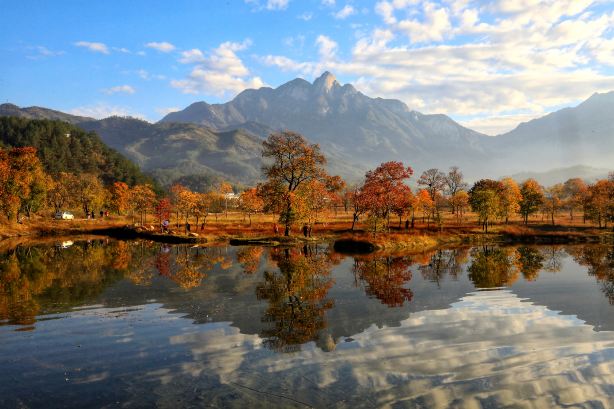
Huanggang, a city located in the eastern part of Hubei, is best viewed from October to November every year. When the autumn is infused, it turns into a gorgeous red leaf scroll, telling the romance of autumn with the magnificent scenery of the forests. There are mountains crisscrossing in Huanggang, and the remnants of the Dabie Mountains run through it. The unique geographical environment and mild climate have bred a rich variety of red leaf trees such as cotinus coggygria, Chinese tallow tree, and maple. When the autumn wind blows across the mountains, the chlorophyll in the leaves fades quietly, and the red leaves all over the mountains bloom one after another. The various colors of red leaves are scattered and set off against the vigorous pines and cypresses, the quaint villages, and the winding streams, forming a layered autumn picture. The misty peaks in the distance are looming, and the white-walled and black-tiled villages at the foot of the mountain are rising with curling smoke, adding a bit of poetry and fireworks to the red leaf scenery. Whether you are climbing high to see the magnificent view of the colorful forests, or strolling along the stream to feel the tranquility of the red leaves reflected in the water,the red leaves in Huanggang can bring a soul-stirring visual feast, making people indulge in the unique charm of autumn in eastern Hubei.China · Luotian County

Bodaofeng Peak
Located in Luotian County, Hubei Province, Baodao Peak is the core scenic spot of Dabie Mountain National Forest Park and Dabie Mountain National Geological Park. It mainly consists of three distinct areas: Wolong Hummock, Yuanmeng Valley and Xiguoding. The main peak of Wolong Hummock is as thin as a razor, like a dragon on the ridge, with Meirenguan, Tianzi Wanyao and other attractions. Feng Yuxiang's dagger group was stationed here before, so now it has become a Red Tourist attraction.Luotian County · 39.6km from downtown
Luotian Sanlifan Hot Springs Resort
Sanlifan Town is blessed with unique geothermal resources. The attraction features 2 hot springs 1.2 km apart, 6 geothermal wells with a daily water output of 691 tons, all providing high-temperature hot water with natural spring temperatures ranging from 79°C to 81°C. Luotian Sanlifan Hot Springs Resort offers diverse experiences including hot springs and sightseeing, making it a comprehensive leisure tourism destination. Here, you can truly unwind and rejuvenate your tired body, treating your hardworking self to a blissfully comfortable experience.Luotian County · 13.5km from downtown

Honghuajian Ski Resort
Honghuajian Ski Resort is located in the Tiantangzhai primeval forest of Dabie Mountains. It is a comprehensive tourist resort integrating outdoor skiing, leisure vacation, sightseeing and other projects. The alpine ski resort has three ski slopes: beginner, intermediate and advanced, equipped with entertainment projects such as snow tubing, snow spinning, snow tanks, magic carpets, snow play parks, etc. The ski resort is equipped with professional ski coaches who can help beginners master skiing skills in a short time. There is a glass sightseeing gallery on the top of the mountain, which is provided with refreshments and drinks. Visitors can overlook the beauty of the entire ski resort and the primeval forest and enjoy the pure and fresh air while exercising.Luotian County · 42.7km from downtown

Jinshi River Drifting
The Jinshi River Rafting Tourist Area is located in Dahe'an Town, Luotian County, 126 kilometers away from Wuhan City, with convenient transportation. The Dong'an River Reservoir upstream of the Attraction provides sufficient and safe water for rafting; the lush forests and vegetation on both sides of the river also make the rafting more interesting. During the 90-minute rafting, visitors can not only fight the waves, but also appreciate the strange rocks and waterfalls in the river, and feel the magical charm of nature. As the boat sways freely on the calm water, the art displays of human bodies, paintings, etc. on both sides of the river add a different kind of fun to the thrilling journey.Luotian County · 23.7km from downtown

Jiuzihe Town
Luotian County · 47.6km from downtown

Dabieshan National Forest Park
Luotian County · 49.4km from downtown

Mount Huangshan Scenic Area
Mount Huangshan is famous for its long history. "You would not want to visit mountains after visiting the Five Sacred Mountains, and you would not want to visit the Five Sacred Mountains after visiting Huangshan." Xu Xiake, a great traveler and geographer of the Ming Dynasty, twice ascended Huangshan to witness its magnificence, exclaiming it as "a wonder in life." Dramatic Pines, grotesque rocks, sea of clouds, and hot springs are known as the “Four Musts” of Huangshan. They are the uncanny workmanship of nature and cannot be missed. In addition, the haze, snow scene, and sunrise are unique landscapes of Huangshan. Each landscape has its unique beauty and makes you feel like you are in a fairyland.China · Huangshan City
Experiences you can't miss in Luotian County
Featured Outdoor experiences in Luotian County
View all Outdoor experiences

FromPKR 50,165.84

FromPKR 53,068.00
FromPKR 37,728.03
Free things to do in Luotian County
Jiuzihe Town
Luotian County · 47.6km from downtown
zan zi shi cun
Luotian County · 19.4km from downtown
Jingdezhen China Ceramics Museum
China · Jingdezhen
Jiangxi Provincial Museum
China · Nanchang
Sanhe Ancient Town
China · Feixi
East Lake Scenic Area
Wuhan · 97km from Luotian County
Hankou Beach
China · Wuhan
What travellers say about Luotian County

Anonymous user3 October 2026
5.0
The air was fresh and pleasant, but unfortunately it was a cloudy and rainy day, shrouded in fog. The sun peeked out briefly on the way down the mountain. The scenery would have been absolutely stunning if the weather had been better. It was a bit of a shame.
Tiantangzhai Scenic Spot

130***5825 August 2026
5.0
This scenic area is beautiful! Growing up in Hubei, I never knew such a place existed. It has pine trees similar to those in Huangshan. We took a shuttle bus up the mountain and then walked down, which took about two hours. Going down was quite strenuous on the knees; our whole family had sore legs the next day. Those with good stamina can choose to hike up and take the shuttle bus down. You can also go to Yuanmeng Lake for free, but my parents were too tired to walk, so we didn't go. The hot pot restaurants on the ancient street at the foot of the mountain are quite delicious and reasonably priced, making it a good weekend getaway near Wuhan. However, the steps in the scenic area are really narrow, and my chunky sneakers with their large soles were very inconvenient; I felt like I was going to fall many times.
Bodaofeng Peak
M2h***je6 January 2026
5.0
Parking is convenient, there's a natural hot spring, and the service is pretty good. I heard that soaking in the hot spring in winter can cure rheumatism and dispel cold. I bring my family here several times a year, and there are also many local hot pot restaurants nearby.
Luotian Sanlifan Hot Springs Resort

龙行202531 January 2026
5.0
The price-performance ratio is excellent, with few crowds and beautiful scenery. Highly recommended.
Honghuajian Ski Resort

爱生活10 July 2026
5.0
I go almost every year. It's not a long trip, but it's still quite exciting. I bought an early bird ticket, and it was a bit cold when I went. Also, because there were fewer people, the rafting time was even shorter. I don't take pictures while rafting, but I later stayed at a Taohuayuan Hot Spring Courtyard, which was quite nice. Here are a few pictures.
Jinshi River Drifting

无疆行1 November 2019
5.0
Jiuzi River is a popular tourist attraction that has emerged in recent years. Not far from the highway, you can see a memorial archway and a hundred-mile gallery. It is really beautiful, especially in autumn. However, I went there too early this time, and most of the Chinese tallow trees in the Sage Hall were not red. It was a little regrettable. I could only use Luotian chestnuts to soothe my wounded heart.
Jiuzihe Town

一樽星月17 March 2025
5.0
Dabie Mountain National Forest Park is located in the northern mountainous area of Luotian County. The park is divided into five scenic spots: Tiantangzhai Dabie Xiongfeng Natural Scenery Scenic Area, Qingtaiguan Ancient Pass Famous Temple Scenic Area, Bodaofeng Summer Resort Scenic Area, Jiuzihe Dabie Mountain Pastoral Scenic Area, and Tiantang Lake Water Orchestra. The park has an annual rainfall of 1,350 mm, 1,487 species of wild plants, and 634 species of animals.
Dabie Mountain National Forest Park was officially approved as a national forest park by the Ministry of Forestry of China in October 1996.
Tiantangzhai Tourist Area is located in the southwest of Jinzhai County, Lu'an City, Anhui Province, in the hinterland of Dabie Mountain and at the junction of Hubei and Anhui provinces. It borders Luotian and Yingshan County of Hubei Province in the southwest and southeast. It is 125 kilometers north of Meishan Town, Jinzhai County, 138 kilometers northeast of Huoshan County to Lu'an City, 217 kilometers to Hefei City, and about 278 kilometers southwest of Luotian County to Wuhan City. Geographical coordinates: 31°10′-31°15′N, 115°38′-115°47′E, with a total area of 12,000 hectares.
The main geological structure of Anhui Tiantangzhai National Forest Park is intermediate-acidic granite formed in the Yanshan period, and the basement rock is the ancient Dabie Mountain complex, with a geological age of 2.66 billion years. It is rich in geological relics, mainly including strange peaks, canyons, strange rocks, caves, etc. Anhui Tiantangzhai National Forest Park was first formed in the Sinian Period. During the Dabie Mountain Movement in the Proterozoic and Archean about 1.8 billion years ago, the Dabie Mountains were folded and uplifted, and then rose after the Luliang Movement. The Yanshan Movement in the Mesozoic Era caused some folds and faults in the Dabie Mountains, accompanied by extensive magmatic movement, forming locally uplifted block mountains, grabens and fault basins.
Dabieshan National Forest Park

sharex25 October 2026
5.0
Highly recommended to anyone seeking nature in its most dramatic, mythic form. Standing above a churning sea of clouds as jagged granite peaks pierced the mist felt like entering a classical scroll painting come alive. One of the sights that left an impression was the quiet poetry of the ancient Huangshan pines that clung impossibly to bare vertical rock faces. Mist swirling through the valleys below was an unforgettable, almost meditative spectacle that made every single step worth the climb.
Mount Huangshan Scenic Area


