Things to do in Shanghe
Explore top experiences
Top 10 attractions in Shanghe


National Museum of China
The National Museum of China is an institution that, on behalf of the country, collects, studies, displays and interprets representative material evidence that fully reflects China's fine traditional culture and advanced socialist culture. It is a national palace of history, culture and art and a cultural living room. The National Museum of China currently has more than 1.4 million collections, covering ancient cultural relics, modern and contemporary cultural relics, rare books and ancient books, and artworks. Among them, there are 815,000 pieces (sets) of ancient cultural relics, 340,000 pieces (sets) of modern and contemporary cultural relics, more than 240,000 pieces (volumes) of rare books and ancient books, and a total of nearly 6,000 first-class cultural relics. In recent years, especially since the 19th National Congress of the Communist Party of China, the National Museum of China has increased its efforts to collect representative material evidence reflecting contemporary advanced culture, and publicly collected cultural relics collections from the society, collecting an average of about 50 sets of ancient cultural relics and more than 1,000 sets of modern and contemporary cultural relics, physical objects and artworks each year. The exhibitions of the National Museum of China include three series: basic exhibitions, special exhibitions, and temporary exhibitions, forming a three-dimensional exhibition system covering theme exhibitions, basic exhibitions, special exhibitions, and temporary exhibitions. Among them, "Ancient China", "Road to Rejuvenation" and "Road to Rejuvenation in the New Era" are the basic exhibitions of the National Museum, and are also important positions for promoting Chinese traditional culture, advanced socialist culture, and cultivating and practicing the core socialist values. The special exhibitions are mainly based on the collection of cultural relics, including more than ten special exhibitions such as ancient Chinese bronzes, Buddhist statues, jades, porcelains, modern classic works of art, and African wood carvings. Temporary exhibitions include two categories: self-planned exhibitions and introduced exchange exhibitions, covering historical culture, fine cultural relics, archaeological discoveries, classic works of art, regional culture, international exchanges and other aspects, with an average of more than 40 exhibitions held each year. The National Museum of China has rich research resources, a solid research foundation and strong research capabilities, and is the industry leader in the development of the domestic museum industry. Since 2018, in accordance with the principle of "not seeking to collect but to exhibit, open cooperation, mutual benefit and win-win", we have established strategic cooperative relations with many cultural and museum institutions, institutes, universities and colleges at home and abroad, jointly carried out academic research, held high-quality cultural relics exhibitions, convened seminars, launched postdoctoral research workstations, and took the lead in establishing two international organizations, the BRICS Museum Alliance and the Silk Road Museum Alliance, striving to play a greater role and make greater contributions in promoting the core socialist values, enhancing cultural confidence, promoting exchanges and mutual learning between Chinese and foreign civilizations, and building a socialist cultural power.China · Beijing

Daming Lake Scenic Area
Daming Lake Scenic Area is located in the northeast of downtown Jinan, the northern part of the Old Town. It is a park that integrates bodies of water, garden landscape, and ancient architecture. Daming Lake is in the center of the park. Or one could say that the park is built along the lake. Daming Lake is a natural lake. The water source comes from many springs in the city. It has a long history, dating back to the Northern Wei Dynasty. In the park, you can visit the Lao She Memorial. In summer, you can enjoy the lotus blossoms in the garden.Jinan · 71.2km from Shanghe

The Best Spring In The World
The Best Spring In The World is located in downtown Jinan, featuring "one river (the moat), one lake (Daming Lake), three springs (the Baotu Spring, Heihu Spring, and Wulongtan spring clusters), and four parks (Baotu Spring Park, Huancheng Park, Wulongtan Park, and Daming Lake Park)." The attraction centers around Baotu Spring, renowned as the "No. 1 Spring Under Heaven." Its waters flow into rivers and converge into lakes, harmoniously blending with the ancient Mingfu City. To the north lies Wulongtan (Five Dragon Pool), while to the east stretches Jinan's Huancheng Park (home to the Black Tiger Spring and other springs), both highly celebrated in Jinan. These springs boast exceptional water quality. Daming Lake, a natural lake formed by the convergence of numerous springs, receives water from its southern shore. When full, the water flows out through the Northern Water Gate, built during the Song Dynasty on the lake's north shore. The lakebed consists of impermeable igneous rock, preventing flooding during heavy rains or drought. Often described as "a confluence of springs merging to embrace the Jiluo region," it's hailed as the "Pearl of the Spring City." Similarly, the moat formed by spring waters encircles the ancient city like a jade belt, offering scenic cruise rides along its course. The attraction boasts stunning natural scenery and rich cultural heritage, featuring not only springs, rivers, and lakes but also numerous historical landmarks. Highlights include the Chaoran Tower dating back to the Yuan Dynasty and the Luoyuan Hall originally built during the Northern Wei Dynasty (now a Ming-era structure). Historical sites include the Luoshang Terrace, the former residence site of Qin Qiong, and the Beishui Gate. Notable former residences include the Nanfeng Ancestral Hall, Jiaxuan Ancestral Hall, Li Qingzhao Memorial Hall and Yi'an Old Residence, Tiegong Ancestral Hall, and Lao She Memorial Hall. Red tourism sites include the Jinan Massacre Memorial and the former site of the Shandong Provincial Committee of the Communist Party of China.Jinan · 72km from Shanghe

Ancient Town of Qingzhou
Qingzhou is one of the ancient nine provinces of China. Since the early Western Han Dynasty, six cities—Guang County, Guanggu City, Dongyang City, Nanyang City, Dongguan Weizi City, and Qicheng—were successively built on this land, with a continuous urban history spanning over two thousand years. Today, the Ancient Town of Qingzhou has been comprehensively protected and restored, forming three major districts: the Beiguan ancient block in Dongyang City, the Ouyuan historical and cultural block and the South Gate block in Nanyang City, and the Zhaode ancient block in Dongguan Weizi City. Government buildings, traditional residences, and classical gardens are scattered across hundreds of ancient streets and alleys, such as North Gate Street and East Gate Street, with their blue bricks and dark tiles showcasing distinct Ming and Qing architectural styles. Unlike many entirely reconstructed ancient towns, this is a "living ancient town," where original residents still live in the old streets and alleys, and intangible cultural heritage items like the cuoqin are passed down on the streets, blending the vibrancy of daily life with ancient charm. A visit can begin by ascending the Fucai Gate Tower at the south gate of ancient Nanyang City for a panoramic view of the town's sea of dark tiles. Ouyuan is a preserved classical garden within the town, originally the eastern garden of the Ming Dynasty's Prince of Heng's residence and later the private garden of Feng Pu, a grand secretary during the Qing Kangxi era. Its three-peak rockery embodies the grandeur of northern landscapes. Figures like Fan Zhongyan and Ouyang Xiu once served as officials here, and Li Qingzhao lived in Qingzhou for over a decade, composing numerous ci poems. Historical relics like the Qingzhou Prefecture Examination Hall are also scattered throughout the streets, where traces of this cultural legacy can often be encountered. The main street is densely lined with shops, but to avoid crowds, one can turn into the side alleys or head straight to Zhaode Ancient Street—where rows of Ming and Qing-era houses remain, with wooden doors, stone steps, and flagstone paths offering a glimpse of old Qingzhou's daily life.China · Qingzhou

Sun Park
Chaoyang Park is found in Beijing's East Fourth Ring. The park is enclosed with lakes, trees, pavilions, and European castles. The environment is a beautiful sight to behold. There are also numerous children's play programs in the park, ideal for relaxing strolls and staying busy. There are several lakes connected to the park. Each lake has a boat dock and you can rent a boat to ride at any of them.China · Beijing

Shandong Museum
The Shandong Museum is located in eastern Jinan. As one of China's earliest provincial-level comprehensive museums, it houses over 400,000 artifacts with strong regional characteristics, particularly rich collections of ceramics, bronze ware, oracle bones, bamboo slips, Han Dynasty stone reliefs, costumes, calligraphy and paintings, rare ancient books, and revolutionary relics. The Shandong Museum features 23 exhibition halls with a total display area of 25,000m². Its exhibition system centers around the permanent collection "Haidai Rising: Shandong's Historical and Cultural Exhibition," supported by seven thematic exhibitions including "Buddhist Sculpture Art Exhibition," "Han Dynasty Stone Carvings: Images, Style, and Spirit," "Porcelain Elegance: Ming-Qing Imperial Kiln Ceramics from Shandong Museum Collection," "Great Migration of African Wildlife," "Shandong Dinosaurs: Through the Cretaceous," and "Crystal Wonders: Exploring the Magical Mineral World," complemented by original temporary exhibitions.Jinan · 72.5km from Shanghe

Tiananmen Square
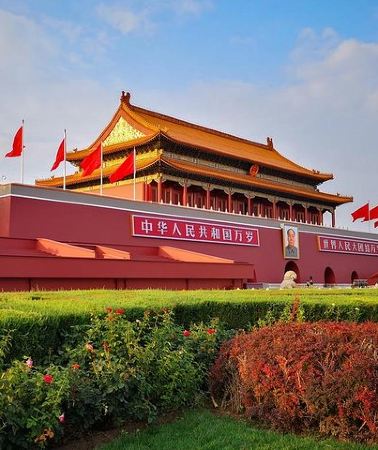
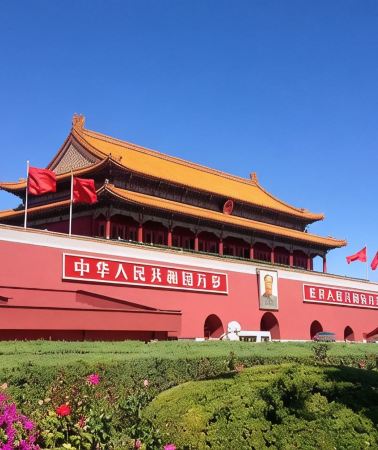
Tiananmen Square is located in the center of Beijing, with a length of 880 meters from north to south and a width of 500 meters from east to west, covering an area of 440,000 square meters. It can accommodate up to one million people for grand gatherings. Along the central axis of Beijing, there are the national flagpole, the Monument to the People's Heroes, the Chairman Mao Memorial Hall, and the Zhengyang Gate Tower standing from north to south in the square. On October 1, 1949, the founding ceremony of the Central People's Government of the People's Republic of China was held in Tiananmen Square, marking the birth of the People's Republic of China. From then on, a new chapter in Chinese history was opened. On the day of the founding ceremony, 300,000 military and civilian personnel gathered in Tiananmen Square. Since then, Tiananmen Square has become an important venue for the Party and the state to hold major celebrations, grand gatherings, and foreign affairs receptions.China · Beijing

National Maritime Museum of China
The National Maritime Museum of China is located on the shore of the Bohai Sea in Tianjin Binhai New Area. It is a comprehensive maritime museum integrating collection, exhibition, research, and education, often referred to as the "Forbidden City on the sea." The white streamlined main building stretches along the coast, resembling a giant ship docked by the shore from afar. With the vast sea outside, the architecture itself is a noteworthy landmark worth stopping by. The museum's exhibitions revolve around the theme of "the ocean and humanity," with each of the six exhibition areas and dozen-plus halls offering unique highlights. In the "Ocean today" hall, a 9 m-long whale shark specimen is astonishing in scale, while a plastinated giant squid specimen stretches its slender tentacles. Together with rare specimens like a pregnant shark and thousands of other marine life specimens, they showcase the diversity of ocean life with striking visual impact. "Ancient oceans" traces Earth's origins, connecting billions of years of evolution through trilobite and ichthyosaur fossils. "Age of dinosaurs" recreates Mesozoic landscapes of sea, land, and air, where ichthyosaur and pterosaur fossils alongside dinosaur models are particularly popular with children. "Chinese maritime civilization" and "From sails to stars" chronicle China's journey from ancient navigation to modern scientific expeditions. The "Ocean and astronomy" hall with its starry dome and the interactive experience zone demonstrating the power of marine disasters are also crowd favorites in the museum. The museum's content density is remarkably high, and a thorough visit requires at least half a day. It is recommended to follow the order from the first floor upward, starting with ancient fossils before moving to modern marine exhibits. Those interested in paleontology, marine life, or maritime history will all find something to enjoy.China · Tianjin

Guangfu Ancient City
Guangfu Ancient Cityis located in Guangfu town, Yongnian district, Handan city, Hebei province. It is a national 5A-level attraction, a famous historical and cultural town in China, and a wetland park with profound historical heritage. Featuring beautiful northern water town scenery and a long-standing tai chi culture, it is China's unique ancient town, water town and tai chi town. The ancient town. Guangfu ancient town has a history of over 2,600 years, with its city walls stretching 4.5 km in circumference and covering an area of 1.5 square kilometers. The town boasts numerous historical relics, including two national-level protected sites - Guangfu ancient town itself and Hongji bridge, along with over 20 provincial and municipal protected sites such as the former residences of Yang Luchan, Wu Yuxiang and Wu Ruqing. The water town. Guangfu ancient town is located in the Yongnian depression covering an area of 46,000 mu. Surrounding the town walls is a 5 km moat that's 100 m wide, with wetlands beyond it. This "town between two waters" forms a unique view of Guangfu. The depression has perennial water accumulation with lush reeds, thriving fish and shrimp, lotus ponds, and migratory birds, earning it the reputation of "little Jiangnan in the north". The city of taiji. Guangfu ancient town is the birthplace of Yang-style and Wu-style taijiquan, where the founders of the two major schools, Yang Luchan and Wu Yuxiang, were born. It is a renowned hometown of taiji, from which taijiquan spread across China and the world.China · Handan

Zhengding Ancient City
Zhengding Ancient City is located 15 km north of Shijiazhuang, the capital of Hebei Province. Built according to traditional Chinese planning concepts and architectural styles, it embodies China's historical and cultural characteristics from the 5th to 19th centuries, showcasing the wisdom and perseverance of ancient laborers. Historically known as one of the "Three Northern Strongholds" alongside Baoding and Beijing, its southern gate still bears a stone inscription reading "Stronghold of Three Passes." Zhengding is also the hometown of Zhao Zilong, a renowned general from the Three Kingdoms period. The long and rich history has endowed Zhengding Ancient City with magnificent and uniquely styled cultural relics and historic sites, renowned for its "Three Invisible Mountains, Nine Non-Flowing Bridges, Nine Towers, Four Pagodas, and Eight Great Temples, along with Twenty-Four Exquisite Memorial Archways." "Three Invisible Mountains" refers to the fact that Zhengding was historically the administrative center of the Zhongshan State, Hengshan Commandery, and Changshan Commandery, yet the area itself has no mountains. "Nine Non-Flowing Bridges" describes a single-arched three-path stone bridge in front of the Longxing Temple, as well as the pan bridges (ancient pan bridges typically featured three parallel bridges) in front of the Prefectural Confucian Temple and the Zhengding County Confucian Temple—none of which have flowing water. "Nine Towers, Four Pagodas, and Eight Great Temples" refers to the original four gate towers, four corner towers, and the Yanghe Tower within the city; the four pagodas are the Tianning Temple Pagoda, Huata Pagoda of Guanghui Temple, Xumi Pagoda, and Chengling Pagoda of Linji Temple; the eight great temples include Longxing Temple, Guanghui Temple, Linji Temple, Kaiyuan Temple in Zhengding Ancient City, Tianning Temple, Hongji Temple, Sheli Temple, and Chongyin Temple—the latter three of which have been destroyed. Zhengding once boasted 24 magnificent memorial archways, including the Xu Family Archway, Liang Family Archway, Ancient Changshan County, Supreme Virtue Reaching Heaven, Virtue Matching Heaven and Earth, and Wooden Bell for All Affairs. However, due to historical changes, weathering, and especially the destruction during the decade-long Cultural Revolution, many precious cultural relics were damaged. Yet with 9 nationally protected relics, 6 provincially protected relics, and over 10 county-level protected relics, Zhengding still retains the grandeur of a renowned historical and cultural city. The ancient city of Zhengding was designated as a provincial-level historical and cultural city in 1990 and recognized as a national historical and cultural city in 1994. Zhengding's tourism features a unique blend of "modern and ancient," "elegant and folk" characteristics. Among its historical sites, the Longxing Temple, originally built in 586 AD during the Sui Dynasty and expanded under the decree of Emperor Zhao Kuangyin, the founding emperor of the Song Dynasty, stands majestic and well-preserved. It enjoys high acclaim both domestically and internationally, praised by renowned architect Liang Sicheng as "the foremost temple beyond the capital." The temple's "Reclining Guanyin" mural sculpture was hailed by Lu Xun as "the Goddess of Eastern Beauty."Revolving Sutra LibraryDubbed by physicists as a prime example of Newton's laws in action, along with China's scripture cabinets. The Sui Dynasty Longzang Temple Stele is one of the country's renowned ancient stone inscriptions, showcasing the evolution from Han clerical script to Tang regular script, praised by Kang Youwei as "the finest Sui stele." Standing 22 meters tall, the grand Buddha statue is among China's earliest and tallest surviving bronze standing Buddhas. The cross-shaped Mani Hall exemplifies classic Song Dynasty architectural techniques. Zhengding's vicinity also boasts four famous pagodas, including Huagong Pagoda at Guanghui Temple—a brilliant fusion of diamond throne and floral pagoda styles. Tianning Temple's...Lingxiao PagodaIt is the foremost wooden pavilion tower in China. The symmetrical arrangement of the Tang Dynasty bell tower and ancient pagoda at Kaiyuan Temple in Zhengding Ancient City exemplifies the transition in Chinese Buddhist temple architecture from pagoda-centered to hall-centered layouts. The Chengling Pagoda at Linji Temple serves as the reliquary pagoda for Master Yixuan, founder of the Linji school of Buddhism, and has become a symbol of Sino-Japanese friendship. Located within Zhengding, the Zhengding Rongguo Mansion was meticulously designed and constructed according to descriptions in Cao Xueqin's literary masterpiece "Dream of the Red Chamber" while strictly adhering to China's "Great Qing Code", making it the country's first architectural complex replicating Ming-Qing architectural styles. Most scenes from the TV series adaptation of "Dream of the Red Chamber" were filmed here. The Qing Dynasty-style Ningrong Street by Rongguo Mansion's west gate stretches over 200 meters, where pivotal scenes like "Imperial Consort Yuan's Homecoming" and "Qin Keqing's Funeral" were shot. With over 1,600 years of history, Zhengding Ancient City's walls were originally earthen fortifications during the Eastern Jin Dynasty, rebuilt in stone during the Northern Zhou Dynasty, expanded into earthen walls during the Tang Dynasty, and finally reconstructed as 24-li (approximately 12 km) brick walls during the Ming Dynasty. The surviving 8,106-meter Ming-era walls feature four magnificent gates: Yingxu (later renamed Huancui) to the east, Changle to the south, Zhenyuan to the west, and Yong'an to the north. While time has eroded the western and northern gates, the eastern gate was entirely buried under 1960s military fortifications. In 2001, the southern gate tower and 50-meter flanking walls were restored through public donations of original bricks and a CNY 3.99 million investment.China · Zhengding
Experiences you can't miss in Shanghe
Featured Cultural experiences in Shanghe
View all Cultural experiences
5.0/5
· 2 reviews· 28 bookedFree cancellation
FromAU$8.59


FromAU$371.11

Featured Food & drink in Shanghe
View all Food & drink

5.0/5
· 3 reviews· 30 bookedFree cancellation
Instant confirmation
FromAU$30.04

Free cancellation
Instant confirmation
FromAU$42.69
Free cancellation
Instant confirmation
FromAU$36.04
Free cancellation
Instant confirmation
FromAU$205.08
More ways to travel from Shanghe
Private Tours in Shanghe
View More Private Tours in Shanghe

Free things to do in Shanghe
National Museum of China
China · BeijingBook now for tomorrowDaming Lake Scenic Area
Jinan · 71.2km from ShangheThe Best Spring In The World
Jinan · 72km from ShangheAncient Town of Qingzhou
China · QingzhouBook now for tomorrow, Cancel anytimeSun Park
China · BeijingShandong Museum
Jinan · 72.5km from ShangheTiananmen Square
China · BeijingNational Maritime Museum of China
China · TianjinGuangfu Ancient City
China · HandanZhengding Ancient City
China · Zhengding
What travellers say about Shanghe

E43***4413 October 2026
5.0
张洋导游讲解的非常好!All visitors should book the national Museum of China trip. It is not easy to book on your own, book through Trip.com and have a guide to share the history with you..
National Museum of China

Bolton Chen19 October 2026
4.0
Daming Lake holds the story of Emperor Qianlong and Xia Yuhe's "epic, tragic love" 😂 "Your Majesty, do you still remember Xia Yuhe by Daming Lake?"—When Emperor Qianlong toured the south, he encountered Xia Yuhe playing the zither in the Yuhe Hall, fell in love at first sight, wrote a poem and presented her with a fan, vowing that "a true friend is hard to find." However, after more than a decade apart, Yuhe fell ill with longing and died with her zither in her arms 😢 However, there is no historical record of this person; it's purely a romantic fiction by Qiong Yao. The lake shimmers, lotus flowers fill the pond, and the saying "lotuses on all four sides, willows on three" is truly fitting. The illuminated Chaoran Tower is even more breathtaking.
Daming Lake Scenic Area

M35***807 October 2026
5.0
This was my first time visiting Baotu Spring. I went in the afternoon to avoid the crowds, so the experience wasn't too bad. The three springs were bubbling away, and the water was crystal clear. No wonder it's called the City of Springs! 👍
The Best Spring In The World

268***267 October 2026
5.0
When visiting Qingzhou Ancient City, the Fucai Gate Tower is a must-see, considered the heart of the ancient city. There aren't many other attractions within the ancient city, but the tower has a great location, with convenient access via sightseeing electric carts. There are also plenty of food stalls to explore nearby.
Ancient Town of Qingzhou

YoYo_9H7U5N1A2 April 2026
5.0
The largest urban park within Beijing's Fourth Ring Road, it's free and incredibly welcoming. With its vast lawns, expansive lake, and stunning European-style architecture and fairytale castle, it's perfect for photos. You can run, boat, take your kids, and visit exhibitions. It's comfortable year-round, and locals often come here to relax.
Sun Park

Anonymous user6 October 2026
5.0
Unexpectedly, it was a special session with Teacher Lu. The coordination was very smooth, with a dedicated assistant team. The team members were all dressed formally. Teacher Lu's explanation was witty, humorous, vivid, and captivating. The route was planned according to the historical timeline, and the headset was very clear. Although there were many people, we still managed to see all ten of the museum's most treasured exhibits.
Shandong Museum

行万里路不如读万卷书24 September 2026
4.0
Tiananmen Square is a place that hundreds of millions of people yearn for; it is a symbol of the Republic, and every tourist visiting Beijing takes a photo in front of Tiananmen. However, advance reservations are essential, and security checks are a must. The only parts of the Tiananmen area open to the public are the Zhengyangmen Gate Tower, the Chairman Mao Memorial Hall, the Tiananmen Gate Tower, and the National Museum. Every year during the National Day holiday, Tiananmen Square is decorated with flowers for photos, and you can arrive early to watch the flag-raising ceremony. In short, a day trip to Beijing can include both Tiananmen and the Forbidden City, leaving a lasting impression of the capital's splendor.
Tiananmen Square

Joyce122711 October 2026
5.0
A Day Trip to the Maritime Museum
The Maritime Museum was a must-see on this trip to Tianjin.
It's free, but reservations are required. If you can't get a reservation, you can buy a special exhibition ticket.
There were several exhibitions, and I specifically chose the blue ocean one. I love aquariums, so I chose this one.
The aquarium isn't very big, but it has fish, jellyfish, and soft-shelled animals. There's also a mermaid show on the hour.
The exhibition hall is large and very unique.
From chaos to order, from the deep sea to the stars.
See ancient marine life frozen in rocks.
See humanity's journey from the ocean to the stars.
National Maritime Museum of China
Anonymous user3 October 2026
4.0
The hometown of Tai Chi has well-preserved ancient city walls and many performance programs, but it is still quite commercialized. During the National Day holiday, there are a lot of tourists, especially at night, which causes serious traffic jams.
Guangfu Ancient City
Anonymous user5 October 2026
5.0
This is a Buddhist holy site well worth visiting. The Thousand-Handed and Thousand-Eyed Buddha and the mural of the Reclining Guanyin are historical and artistic treasures that have been preserved intact for future generations to appreciate and understand history! An even greater gain was visiting the memorial hall of Mr. Liang Sicheng, where I learned about the contributions he and Lin Huiyin made to the preservation of historical sites in my country and their transmission in education, so that we, the later generations, can appreciate these historical sites!
Zhengding Ancient City


