
Things to do in Xiangfen
Explore top experiences
Top 10 attractions in Xiangfen

Fencheng Ancient Building Complex
Fencheng Ancient Building Complex was the site of Taiping County during the Ming and Qing dynasties. It currently preserves theCity God Temple,Confucian Temple,Examination Hall,County Government Office, Guan Temple,Drum Tower, Hongji Bridge, and many other ancient buildings from the Jin, Yuan, Ming, and Qing dynasties. The overall scale is quite impressive. In 1912, it was renamed Fencheng County because the county name was duplicated elsewhere. Later, it merged with Xiangling County to become Xiangfen, and the appearance of the old town has been preserved intact.Xiangfen · 16.1km from downtown

Yao Temple
The Temple of Yao is located next to Linfen City's Huamen Tourist Area. According to the legend, Linfen used to be the capital of the ancient ruler Yao. In later years people would build temples in honor of King Yao. The Temple of Yao was first built in the Jin Dynasty. It was later rebuilt and expanded many times. The majority of buildings which visitors can see today were recently built. The first thing visitors see when entering the Temple of Yao is the beautiful Wufeng Hall. Behind the Wufeng Hall, there is the Well of the Yao Pavilion. The pavilion is built in the form of a hexagon. The Guangyun Temple inside the Temple of Yao is also referred to as the Palace of Yao. It is said to be the place where Yao met with his court and ministers. It is also the main structure in the temple.Linfen · 20.2km from Xiangfen

Lingguang Temple Glazed Pagoda
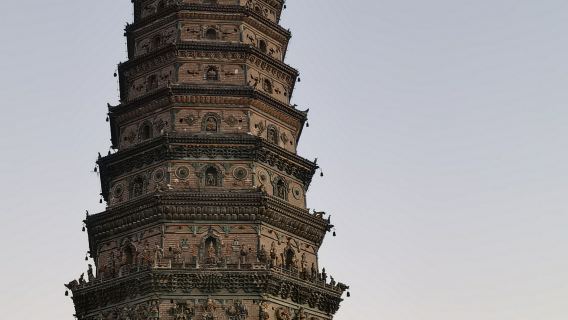
Xiangfen · 10.7km from downtown

Huamen
Sitting in the Yaodu district, Linfen City, China's Gate is more like a monument to Chinese civilization than a single gate. China's Gate was built to commemorate the unification of China by Emperor Yao who started the civilization of China and to show the long history of the Chinese nation. It consists of three parts: the base, the main door and the gate building. The main projects include the big steps, the podiums, the main gate and the attics. There are two floors underground and seven floors on the ground.Linfen · 20km from Xiangfen

Dingcun Site
Located 4 kilometers south of Xiangfen County, there are more than 40 residential courtyards in the Ming and Qing Dynasties in the village. It is the largest and well-preserved Ming and Qing residential buildings in northern China. Entering the village, you can see quaint quadrangle courtyards everywhere. These ancient courtyards are centered on the Guanyin Hall in the center of the village, and are divided into four parts: the north courtyard, the middle courtyard, the south courtyard, and the northwest courtyard. The houses in the four parts have different styles due to the different construction years: the decoration of the houses in the Ming Dynasty is mainly painted, and the style is simple and stable; the decoration of the houses in the Qing Dynasty is mainly wood carving, with fine carvings and beautiful shapes. Dingcun's dwellings provide valuable material materials for the study of the construction techniques and patterns of northern dwellings in the Ming and Qing dynasties.Xiangfen · 4.8km from downtown

Pujing Temple
Xiangfen · 25.8km from downtown

Taosi Relic Site
The Taosi site is a national key cultural relic protection unit. It is the main site of the Longshan culture Taosi type in the middle reaches of the Yellow River in China. It also includes the second phase of the Miaodigou culture and a small amount of remains from the Warring States, Han, Jin and Yuan dynasties. Located in the south of Taosi Village, Xiangfen County, Shanxi Province, it covers an area of about 3 million square meters. After research, the type of Tao Temple of the Longshan Culture in the Central Plains has been established; the age is about 2500 BC to 1900 BC. More than 70 similar sites have been discovered in the lower reaches of the Fenhe River and the Huihe River Basin in southwestern Shanxi. The discovery of giant cities such as Liangzhu and Taosi, the foundations of large palaces, and large tombs shows that, before the establishment of the Xia Dynasty, some areas with rapid cultural and social development had already emerged early states and entered the stage of ancient civilization.Xiangfen · 5.4km from downtown

Dayun Temple
Dayun Temple in Linfen, Shanxi Province, also known as Iron Buddha Temple, is an ancient Buddhist temple with a rich history. The temple faces west and east, divided into two courtyards, front and back. Along its central axis are the mountain gate, the Heavenly King Hall, the Main Hall, the Golden-Topped Pagoda, and the Sutra Library. A pair of giant stone lions stand before the mountain gate, their shapes vivid. Despite the passage of time, the Heavenly King Hall and the Main Hall remain magnificent. The Golden-Topped Pagoda is the centerpiece of the temple. It has six stories, the first five being square and the sixth an octagonal. Arranged according to the eight trigrams, it stands approximately 30 meters tall and is constructed of water-polished blue bricks. Twenty-eight iron peaks tinkle in the breeze at the four corners of the pagoda. Each floor features 64 glazed panels depicting Buddhist legends, crafted by artisans from Yangcheng County. The pagoda's innermost layer is hollow, housing a 6-meter-tall, 5-meter-diameter cast iron Buddha head, with a full figure and dignified features. Today, Dayun Temple is not only an important cultural relic, but also one of the cultural tourist attractions in Linfen City, attracting many tourists to visit.Linfen · 23.6km from Xiangfen

Emperor Qinshihuang's Mausoleum Site Museum
Emperor Qinshihuang's Mausoleum Site Museum, also known as the Terracotta Army, is located about 1.5 kilometers east of the Mausoleum of the First Qin Emperor and forms part of the extensive necropolis. There were more than a thousand terracotta soldiers unearthed here, each with a different facial expression. Standing before the massive underground army, you will feel the extraordinary might of the Qin Emperor that enabled him to unify six warring states two thousand years ago. The Qin Emperor Ying Zheng began building the mausoleum for himself at the age of 13. Nearly 720000 men and 38 years were required to complete this vast project.China · Xi'an

Fusheng Temple
Fusheng TempleLocated 17 km northwest of Xinjiang County in Yuncheng, Shanxi Province, it was founded during the Tang Dynasty's Zhenguan era (627–649 AD) and underwent major renovations in the 11th year of the Ming Dynasty's Hongzhi reign (1498).Fusheng Temple.Fusheng TempleFacing south with a northward orientation, the temple features a two-courtyard layout covering an area of 5,598 square meters. Along the central axis, the structures are arranged in sequence: the Mountain Gate, Heavenly King Hall, Amitabha Hall, Three Buddha Cave, and Scripture Repository. The Amitabha Hall and the lower cave section of the Scripture Repository retain their original Yuan Dynasty construction, while the remaining structures were built during the Ming and Qing Dynasties. The Mountain Gate is designed as a wooden archway-style structure, with seven layers of bracket sets supporting its majestic eaves. Bell and Drum Towers flank the east and west sides. The main buildings showcase the single-eave hip-and-gable roof style, surrounded by arched doorways. Wooden archways and east-west wing rooms enclose a small courtyard, creating a serene skywell layout.Xinjiang · 27.8km from Xiangfen
Experiences you can't miss in Xiangfen
Featured Outdoor experiences in Xiangfen
View all Outdoor experiences![Hukou Waterfall tourist area of the Yellow River 1-day tour [door-to-door pickup│optional skip-the-line]](https://ak-d.tripcdn.com/images/0350412000q8nl0kh22AB_C_568_320.jpg?_fr=wc)
5.0/5
· 2 reviews· 77 bookedFree cancellation
Instant confirmation
Book now for tomorrow
FromTHB 1,439.93
5.0/5
· 4 reviews· 23 bookedFree cancellation
Instant confirmation
Book now for tomorrow
FromTHB 1,589.93
5.0/5
· 2 reviewsFree cancellation
Instant confirmation
Book now for tomorrow
FromTHB 4,090.71
Instant confirmation
Book now for tomorrow
Save THB 20.97
FromTHB 2,075.52THB 2,096.49
5.0/5
· 1 reviewFree cancellation
Book now for tomorrow
FromTHB 10,681.29
5.0/5
· 2 reviewsFree cancellation
Instant confirmation
Book now for tomorrow
FromTHB 2,989.86
Free cancellation
Instant confirmation
Book now for tomorrow
FromTHB 4,829.31
Free cancellation
Instant confirmation
Book now for tomorrow
Save THB 17.04
FromTHB 1,687.43THB 1,704.47
Free things to do in Xiangfen
Fencheng Ancient Building Complex
Xiangfen · 16.1km from downtownYao Temple
Linfen · 20.2km from XiangfenImmediate access, Book now for today, Cancel anytimeLingguang Temple Glazed Pagoda
Xiangfen · 10.7km from downtownHuamen
Linfen · 20km from XiangfenImmediate access, Book now for today, Cancel anytimeDingcun Site
Xiangfen · 4.8km from downtownPujing Temple
Xiangfen · 25.8km from downtownTaosi Relic Site
Xiangfen · 5.4km from downtownDayun Temple
Linfen · 23.6km from XiangfenEmperor Qinshihuang's Mausoleum Site Museum
China · Xi'anImmediate access, Book now for today, Cancel anytimeFusheng Temple
Xinjiang · 27.8km from Xiangfen
What travellers say about Xiangfen

行走毛毛17 November 2025
5.0
Some attractions will never regain their former tranquility. For example, there is a group of ancient buildings that used to be so quiet and not open to the public. Now that it is open, there are always all kinds of crowds. Some people say that the gate has been blocked off and that an entrance fee may be charged in the future.
Fencheng Ancient Building Complex

crystalura16 September 2026
5.0
Shanxi is truly an underrated treasure province, with many historical and cultural buildings hidden in the city's heart, including the Yao Temple. With over 1700 years of history, it contains ancient trees and buildings, serving as a sacred site for emperors throughout the ages to worship Emperor Yao and for descendants of Yan and Huang from home and abroad to pay homage to their ancestors. Perhaps because it's off-season now, there aren't many people, allowing for a leisurely experience.
Yao Temple

Anonymous user6 April 2026
5.0
Huamen, the First Gate Under Heaven, is located on Yaodu Avenue, west of Yaomiao Square, Yaodu District, Linfen City, Shanxi Province. It is a monument to Chinese civilization. Huamen consists of a base, the main gate, and the gate tower. The three gates on the front symbolize the three emperors Yao, Shun, and Yu. The main gate, at 18 meters high, is the largest gate in the world. A 25-meter-long waterfall wall runs in front of the main gate. Fifty-six yellowish-brown steps lead up to the gate, representing the 56 ethnic groups of China.
The first-floor pavilion houses the "Nine Linked Tripods," a bronze artifact. One main tripod connects eight auxiliary tripods, symbolizing the unification of China and the power of a single word, showcasing the majesty of these important Chinese artifacts. Eight giant bronze dragon pillars stand tall and majestic in the main hall, complementing the exhibits on various dynasties, creating a profound and awe-inspiring display of China's 5,000-year cultural heritage.
The Nuwa sculpture in the "Hall of Heroines" on the fourth floor is an innovative masterpiece of Nuwa sculpture in China. The fifth-floor rooftop offers panoramic views of the surrounding scenery.
Overall, the visit was quite pleasant. The architecture is impressive and photogenic, especially beautiful when lit up in the evening. The interior isn't particularly large, but it's clean and tidy, with information about Chinese history and the Yao culture on each floor. You can take an elevator to each floor. As a must-see attraction in Linfen, it's worth stopping by for a look and some photos; suitable for both locals and tourists. It takes about 30 minutes to an hour to see everything.
Huamen

好景致29 September 2020
4.0
There are many archaeological relics in the Dingcun site, which are concentratedly displayed in the Dingcun Folk Museum. Due to time constraints, we will have a brief visit. Although the ancients did not have the advanced automation of today, their wisdom is something that modern people cannot fully appreciate. In fact, in order to survive and reproduce, the more difficult and harsh the environment, the more they need to create an environment suitable for living. The ancients are constantly fighting with nature, exploring and looking for various favorable factors that can change their environment in practice. This exploration has continued to this day.
The residential houses in Dingcun were built in the Ming and Qing dynasties, mostly in quadrangle structures, and there are currently 26 courtyards. In terms of scale, each courtyard is different from the merchant courtyards in Jinzhong. Here, the residential function is more reflected. Each courtyard is very delicate, dignified and generous, and the decoration is gorgeous. Most of the courtyards have main halls, halls, gatehouses, and wing rooms, all of which are brick and stone wooden structures. There are wood carvings and brick and stone carvings on the building components, such as figures, flowers, birds, animals, classical operas, and historical stories. There are also various paintings and sculptures on the steps, column bases, beams, and window lattices of the house. The carving art is very exquisite. The first thing you feel when you walk in is that you have entered a deep courtyard. The walls are very high and have a strong protective function. Of course, it is reasonable for these wealthy families who are officials or rich people to first protect themselves. There are the same side doors between different courtyards of the same family, mainly to facilitate communication, and also as an escape route in case of accidents. For strangers, it is difficult to understand the internal structure in a short time. This is indeed a means to prevent emergencies.
At present, there are some folk customs displays in weddings, funerals, festivals and sacrifices. What I am most interested in is dough sculpture. The ancients were able to calm down and fully express their wisdom with dough sculptures. The exquisite and superb craftsmanship is amazing.
I saw the manger of the rich family and felt the luxury of the rich. When the poor family was worried about their lives, the manger of the rich family had exquisite carvings. It is really "rich people are particular, and poor people make do".
For thousands of years, the Chinese people have had the tradition of buying land and building houses when they have money. This is not only a reflection of wealth, but also a way to show off the glory of the family. This is still the case today with villas everywhere.
Dingcun Site

老虎abc14 September 2024
3.0
The door is usually closed. I asked a fellow villager passing by, and he said there should be an old man guarding the door inside. I knocked for a long time but there was no response, and no phone call. Maybe I went too early at 8:30. My fellow villager said that there might be someone there at noon, and if I couldn't wait, I would just pass by.
Pujing Temple

殷都老虎19 June 2026
4.0
Taosi Site (National Cultural Relics Site)
Located in Taosi Village, Xiangfen County, Shanxi Province, it is the largest Longshan Culture site in the Central Plains region. Dating from 2300 to 1900 BC, it holds significant academic value for reconstructing the social nature of the late Neolithic period in China, the history of state formation, and exploring the Xia culture. It is one of China's three major prehistoric city sites (along with Liangzhu Ancient City in Zhejiang and Shimao Site in Shenmu, Shaanxi), and is suspected to be the capital of Emperor Yao.
Taosi society exhibited a stark disparity between rich and poor, with a small number of nobles accumulating vast wealth, forming a privileged class and paving the way for the transition from the state-state era to the regional state era. This is of great significance for exploring the origins of ancient Chinese civilization and the social history of the Yao and Shun era.
The site and museum showcase astronomical facilities used for exploring the universe over 4000 years ago—an ancient observatory, city walls, palaces, royal tombs, religious and ritual buildings, dragon-patterned pottery plates, red-inscribed flat pots, gnomons, bronze gears, and hourglasses. The ancient inhabitants calculated solar terms, formulated calendars, and precisely managed time, having already established a preliminary complete timekeeping system for years, months, days, and hours. Fragments of a flat-bottomed pot were unearthed, bearing two characters in red ink. One character is "文" (wen), while the other has been interpreted by experts as "尧" (Yao), "易" (Yi), or "命" (ming), among other interpretations, which are significant for the study of the origins of Chinese characters.
The Taosi culture began with the excavation of foundation trenches and the construction of rammed earth walls in its early stages. In its middle period, a ceremonial gate with a gate indicating rank and status was built at the southeast gate of the palace city. Many small house foundations were discovered at the residential site, surrounded by roads, wells, pottery kilns, and a relatively dense number of ash pits. The house foundations are categorized into three types: above-ground, semi-subterranean, and cave dwellings. The interior floors were coated with a mixture of straw and mud, compacted or fired, and most were then coated with a layer of white lime, with the wainscoting also finished with white lime. The walls have niches of varying sizes. A stove was located on one side of the interior, with a flue connecting to the outside at the rear. The well was round at the top and 13 meters deep, with a wooden retaining structure built near the bottom.
Travel Guide: Transportation: Linfen West Station—Taosi Direct Bus (two buses, 8:00 AM and 2:00 PM) (Free for veterans with preferential treatment cards in the city area)
Ticket Price: 50 yuan. (Half-price for veterans with preferential treatment card)
Time: 2-6 hours.
Accommodation and meals: Inconvenient.
Route: The museum is 5 kilometers from the ruins; there is no shuttle bus. For those driving, it is recommended to take the route: Observatory—Southeast Gate of the Palace City—turn back; then drive to the museum.
Nearby attractions: Hongtong Big Locust Tree (for ancestral worship), Xiaoxitian, Guangsheng Temple, Taosi Ruins Museum, Tiefo Temple, Fusheng Temple.
Taosi Relic Site

大松树叶子5 September 2020
4.0
Dayun Temple is no longer a temple and has no monks. It is a national cultural relic protection unit. Admission is free. There are paper-cutting and calligraphy and painting exhibitions in the side halls on both sides of the entrance. The most amazing things are the iron Buddha head and glazed pagoda from the Tang Dynasty, which are truly rare treasures.
Dayun Temple

Carolina Villani16 October 2026
5.0
Sito bellissimo, incredibile la storia. Da visitare assolutamente nel pomeriggio dove la folla della mattina è passata. Noi all'ingresso abbiamo contrattato con varie guide e alle fine con 30€ abbiamo preso una guida solo per noi (ci hanno detto che il pomeriggio c'è maggior facilità di contrattazione perché non ci sono molti turisti). Il giardino non siamo riusciti a vederlo perché avevamo finito il tempo ma dice meriti...
Emperor Qinshihuang's Mausoleum Site Museum

丁大侠26 July 2026
5.0
Legend has it that this temple inspired Wu Cheng'en's novel *Journey to the West*, and it boasts a history of over 1400 years. Originally built during the Northern Qi Dynasty, it was further expanded by imperial decree during the Zhenguan era of the Tang Dynasty (627-649 AD). The legend says that Emperor Taizong of Tang ordered the construction of a temple to enshrine the ancestor Lin Xiangru, a high-ranking official from the village surnamed Lin, which is also the origin of the temple's name, "Little Thunderclap Temple." The temple enshrines Confucianism, Buddhism, and Taoism. During the Jin Dynasty, it was officially named "Fusheng Temple," and later renamed Fusheng Monastery. Imperial edicts and inscriptions record this within the temple grounds.
The main hall of Fusheng Temple, the Amitabha Hall, enshrines Amitabha Buddha as the main deity, flanked by Bodhisattvas Guanyin and Mahasthamaprapta, both original works from the Yuan Dynasty. The altar is surrounded by sixteen Arhats and the Four Heavenly Kings, which were added during the Ming and Qing Dynasties. Inside the Heavenly Kings Hall were originally the two generals Heng and Ha, namely Zheng Lun and Chen Qi, who were responsible for guarding the mountain gate and protecting the temple's safety, but they are no longer there, and the temple itself is also... alas... The back of the Buddha statue is adorned with sculptures of Guanyin of the South Sea, Sudhana, and the Bright King, also original works from the Yuan Dynasty. The Guanyin of the South Sea is particularly renowned as the most beautiful and is included in the "Complete Collection of Chinese Art". On page 3, there were originally Tang Sanzang and his disciples, but now only a monkey-shaped fragment remains: with a pointed mouth and fiery eyes, wearing a rat-head hat, and a lively posture, very similar to Sun Wukong. On page 1, the mount under Guanyin's feet is the Golden-haired Roar, the true form of Sai Tai Sui from "Journey to the West". The sculpture details (antlers, eagle claws, fish scales) are exactly as described in the novel, and the money-scattering boy at the feet is an image of Red Boy. Below in page 3, the Dragon King and Turtle Prime Minister recreate the scene of the East Sea Dragon Palace. The three-headed, six-armed Mingwang figures on either side of the suspended sculpture in page 4, riding on wind-fire wheels, are artistic representations of the two generals, Heng and Ha. The film *Black Myth: Wukong* directly uses these figures as character prototypes.
Furthermore, Fusheng Temple is also known as Little Leiyin Temple, and the inscription at the temple entrance is also a case of the Yellow-Haired Monster impersonating Leiyin Temple. The suspended sculptures predate Wu Cheng'en's novel *Journey to the West* by 300 years. Legend has it that Wu Cheng'en saw these sculptures during his travels in Shanxi, which inspired his creation of *Journey to the West*. Although there's no definitive record, they seem authentic to me; otherwise, what a coincidence! The sculptures depict Guanyin crossing the sea to deliver all beings, which aligns with Wu Cheng'en's depiction of Guanyin of the South China Sea. They are incredibly beautiful and a highlight of my northern tour of Yuncheng. The guide, who seemed to be the temple's caretaker, explained everything very well and fluently. However, upon closer inspection, some of the Arhats in the Amitabha Hall appear somewhat off… ten heads were stolen in 1993, and these were later restored. The differences are quite noticeable; some have expressive features, while others appear stiff. Moreover, the criminals haven't been completely apprehended; the gang was enormous and repeatedly scouted the temple for theft. All ten heads have not yet been recovered. Finally, I'll quote a short passage related to Fusheng Temple from Mr. Yang Xianrang's *Some Things Behind the Fourteen Journeys Along the Yellow River*, which is truly heartbreaking to read. (The last two pictures are included.)
Fusheng Temple


