Jiangle

Things to do in Jiangle

Search attractions or local attractions & tours
Search

Explore top experiences

Top 10 attractions in Jiangle

View all Attractions
Yuhua Cave
No. 2 of Family-friendly Attractions in Sanming

Yuhua Cave

5.3
4.5/5
883 reviews

Yuhua Cave attraction is located in Jiangle County, Sanming City, Fujian Province, known as the "First City of Deep Breathing in Beautiful China." Covering a total area of 43 km², it offers convenient transportation, with just a 5-minute drive from Jiangle Railway Station and Jiangle Expressway toll gate to the visitor service center. Renowned for its unique karst landscape and breathtaking natural scenery, the area boasts a pleasant climate, livable mountain villages, lush forests, and captivating views. Rich in culture, it features Yuhua Cave, a national-level scenic spot, and Tianjie Mountain, a national forest park. Recognized as a national 4A-level tourist attraction, it has also earned multiple honors, including provincial geological park, provincial eco-tourism demonstration zone, provincial civilized scenic tourism area, provincial 5-diamond smart attraction, as well as titles like provincial research and practice education base, provincial science education base, provincial forest wellness retreat, and summer getaway destination. Yuhua Cave, formed 270 million years ago with a total length of approx. 6 km, is a combined corridor-hall karst cave system comprising six chambers (White Cloud Cave, Xiyuan Cave, Yellow Mud Cave, Fruit Cave, Thunder God Cave, and Grain Storage Cave) featuring over 180 attractions. As Fujian Province's limestone karst cave, it's acclaimed as "Fujian's premier cave", "Wuyi's unparalleled wonder", and one of "China's four great caves". Ming Dynasty explorer Xu Xiake praised it as "a dazzling display of ingenuity and mystery, filled with profound wonders". Maintaining a year-round temperature of 15–18°C (59–64°F) with fresh air, the cave is celebrated as nature's "underground sanatorium" and a "cool summer paradise". In 2024, the attraction underwent a revitalizing upgrade, introducing a more relaxed and comfortable "mountain entry, valley exit" route. Additional investments were made to enhance the cave lighting system, incorporating cutting-edge digital lighting concepts from global designs. This transformation creatively showcases local intangible cultural heritage treasures, Yang Shi culture, and Xu Xiake's legacy through the innovative "Sound Journey Through Yuhua" themed experience, offering visitors an immersive "audio + exploration" cave adventure.

Jiangle · 4.6km from downtown
From KRW 24,650
Golden Lake
No. 7 of Fall Viewing Attractions in Fujian

Golden Lake

6.7
4.3/5
2.6k reviews

📸The scenic wonder of Jin LakeUnlockThe best lake and mountain in the worldThe hidden red rock wonderland Jin Lake is located in Taining County on the southern side of the Dashanling Mountains in the middle section of the Wuyi Mountains in northwestern Fujian Province. It was named after the gold-rich sands in the Jinxi River basin. The vast and profound lakes perfectly blend with the diverse Danxia wonders, creating a harmonious balance between masculine strength and feminine grace, as well as boldness and delicacy, forming a myriad of spectacular waterborne Danxia landscapes. The highlight moment of Jin Lake: - 2005: SelectedGlobal geoparkIt has become one of the five major parks in Taining Global Geopark. - 2010: Selected as a core component"China Danxia" world natural heritage; - 2011: AwardedNational 5A scenic areaThe attraction covers a total area of 140 km², including 36 km² of water area. Key highlights | The perfect collision of danxia landforms and emerald waters: The red cliffs and emerald waters are the two essences of Jin Lake. The majestic and picturesque mountains blend harmoniously with the serene and elegant lake, creating a perfect fusion of strength and grace. The crimson cliffs extend into the heart of the lake, while the clear waters embrace the mountain ranges, showcasing both grandeur and delicate beauty. This rare waterborne Danxia wonderland in China brims with vitality, where the auspicious harmony of mountains and waters converges. Must-visit attractions | Nature's wonders and cultural marvels at every step: -Tianji waterfallThe Baishuiji waterfall cascades down between two opposing peaks, standing approx. 20 m high and approx. 10 m wide. Under sunlight, it resembles strings of bright pearl curtains descending from the sky, presenting a spectacular and dynamic sight. The Tianji water curtain is located at the junction of different geological layers, with the lower stratum consisting of hard volcanic rock formed over 300 million years ago, while the upper layer...65-million-year-old soft Danxia sedimentary rockAfter prolonged erosion by flowing water, the soft rock layers were worn away while the hard rock layers formed cliffs, creating a spectacular waterfall view as the water cascades down. -Ganlu templeThe "soul's eye" of Jin Lake, also the prototype model for the Great Buddha Hall of Nara, Japan. It is embedded in an inverted triangular rock cave and adoptsA single pillar stands on the ground without a single tileThe unique design of this temple features the entire structure supported by a single red pillar, constructed entirely of wood without a single iron nail, making it an architectural marvel. Legend has it that the spring water here is as clear, sweet, and refreshing as nectar, hence the name. -Yuanyang LakeEvery winter and spring, flocks of mandarin ducks come here to overwinter in pairs, hence the name "Yuanyang Lake". This is a typical example of Danxia landform.Peak cluster viewThe mountain bases are connected and have not been completely eroded through, preserving their unique natural formations. -Chibi red cliffsOne of the iconic views of Jin Lake, featuring a massive naturally formed imprint on the cliff face."Xian"Opposite the character, cursive script faintly appears on the peach-shaped red cliff.LongevityThe characters "xian" and "shou" complement each other perfectly, forming a natural masterpiece crafted by nature's divine hand. -Slanted sky on landThe unique geological wonder of Jin Lake, unlike ordinary narrow gorges, features tilted rock crevices formed by composite joints and perennial water erosion, creating tensile fractures.A unique sense of "slant",You have to experience it in person to truly understand. -Shili PinghuNestled among rolling mountains and dotted with islands, the landscape blends water, hills, and sky into one harmonious palette. The scenery transforms with the weather: sparkling waves on sunny days, misty mountains in the rain, with mountain fog, sunrise, and sunset each offering their own charm—like a living ink painting. In the distance,Mao'er MountainIt is one of the landmarks of Jin Lake, standing at an altitude of 516 m, resembling a golden cat crouching with its head raised, gazing into the distance; upon closer inspection, it appearsThree sword peaksThe view features three towering rock pillars resembling swords piercing the sky, representing the iconic Danxia peak cluster landform.

Taining · 43.2km from Jiangle
Save KRW 1,603From KRW 31,063
Wangxian Valley
2027 Global 100 - Night Attractions

Wangxian Valley

9
4.5/5
27.1k reviews

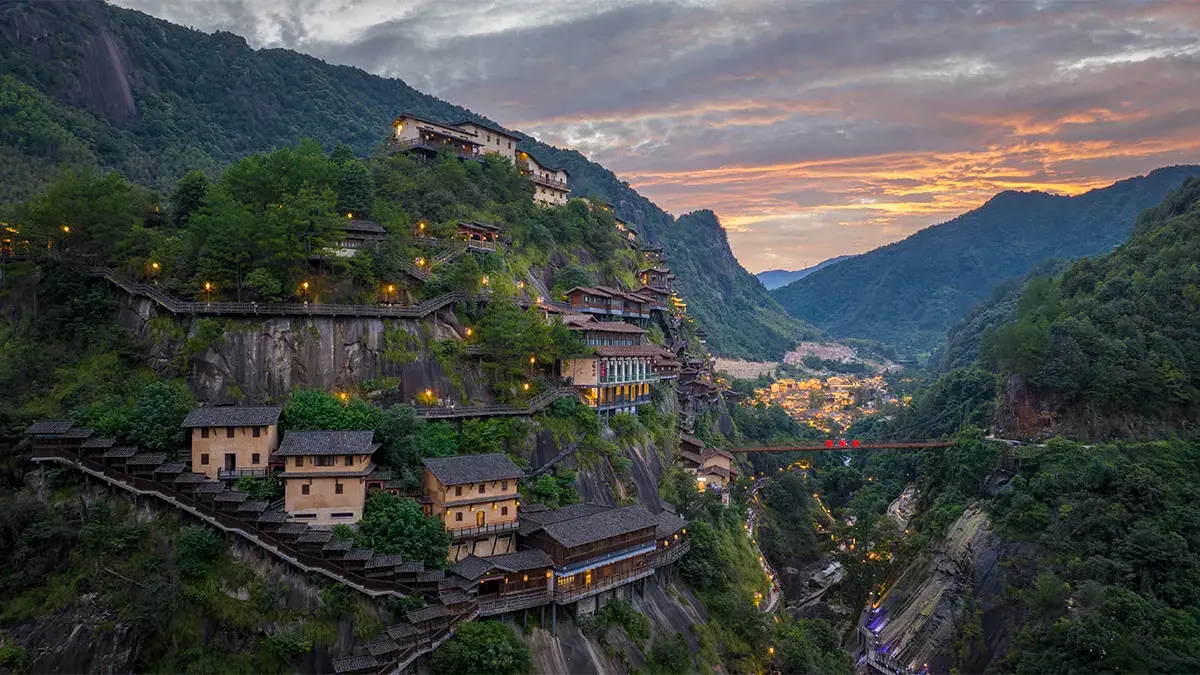
Wangxian Valley is located at the northern foot of Lingshan Mountain, hidden among mountain streams and gorges. It was formerly an abandoned granite quarry and, after years of ecological restoration, has been built into the valley town it is today. The attraction is structured around the Jiuniu Stream Gorge, where streams flow through the valley and waterfalls cascade in layers; the Sandie Waterfall and Sankou Pot are among its most recognizable natural views. In summer, visitors can also experience gorge rafting that winds through the ancient town. The cliffside building complex on Baihe Cliff is the attraction's signature view. On the nearly 100-meter-high cliff face, cantilevered guest rooms, plank walkways, and viewing platforms climb upward in a zigzag pattern, looking up from the valley floor like pavilions in the sky. After nightfall, the cliff lights come on one after another, and the entire valley resembles a painted scroll of lights; standing on Lanyue Bridge and gazing at the full panorama of Baihe Cliff is a classic photo spot here. The Yanpu Old Street in the valley restores the appearance of traditional dwellings in northeastern Jiangxi, with rammed earth walls, bluestone slab paths, and horse-head walls interwoven throughout. Workshop Street is lined with traditional handicraft workshops for brown sugar, brewing, papermaking, cloth dyeing, and more, where you can watch ancient production methods on site; Mingchan Alley gathers intangible cultural heritage crafts such as bamboo weaving and woodwork. Bawei Street offers a dazzling array of Jiangxi-style snacks such as dengzhan guo and taro dumplings. When visiting, it is recommended to enter the attraction in the afternoon so that you can clearly see the gorge landforms in daylight without missing the spectacular lighting after nightfall. The entire route requires walking and climbing stairs, so comfortable, slip-resistant shoes are advisable.

China · Shangrao
From KRW 28,057
Wuyuan Huangling Scenic Area
2027 Global 50 - Spring Outings

Wuyuan Huangling Scenic Area

9
4.6/5
24.5k reviews

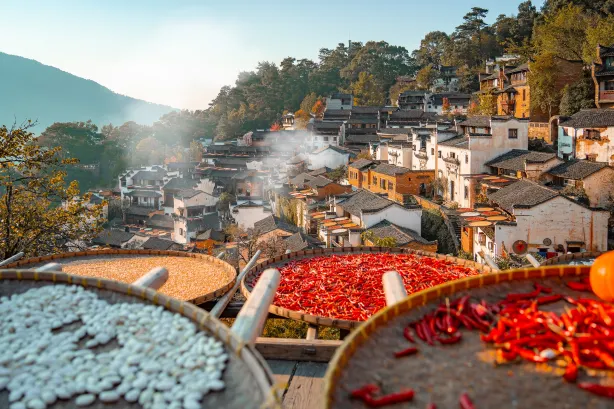
Wuyuan Huangling Scenic Area sits among the Shi'er Mountains of Wuyuan, with the ancient village of Huangling at its core—a Huizhou ancient village nearly six hundred years old. The village is built along steep mountain slopes, where "there is no flat ground three chi wide"; residences are arranged in a fan-shaped, terraced layout around the water outlet, with white walls and dark tiles layered one upon another on the cliffside, earning it the name "Tiyun Renjia" (Households in the Terraced Clouds). Surrounded by ancient trees and terraced fields, it is itself a three-dimensional painting of a mountain village. Huangling is the birthplace of the "shaiqiu" (autumn sun-drying) culture. Constrained by the terrain, villagers have since ancient times set up drying racks on rooftops to dry crops; every fall, red chili peppers, yellow chrysanthemums, pumpkins, and more fill the rooftop drying trays, with colors shifting as the seasons change. In spring, rapeseed flowers bloom in layers across ten thousand mu of terraced fields, dotted with pink peach blossoms and snow-white pear blossoms; the lower-elevation first-phase flower sea and the higher-elevation second-phase Gaoling flower sea bloom in succession, with the flowering period lasting into April. Riding the cable car up the mountain, visitors can overlook the entire golden flower field, and the view is especially open when passing the Leixin Bridge glass walkway, with layered terraced fields and distant mountains below. Tianjie in the village is the main sightseeing axis paved with bluestone slabs, linking classic Huizhou-style ancient buildings; shops line the street with workshops behind storefronts, and along the way visitors can taste authentic Wuyuan snacks such as steamed cakes, Qingming guo, and huizhi guo, and also take part in making folk snacks and handicrafts. Visiting in fall, besides the spectacular shaiqiu scene, the village's red maples are also a highlight, with maple forests fully tinted and echoing the harvest colors drying on the rooftops. Throughout the year, Huangling has something to offer in every season, and its core charm always lies in the unique Huizhou everyday vitality of this mountain village.

China · Wuyuan
From KRW 29,059
Kulangsu
No. 1 of Best Things to Do in Fujian

Kulangsu

8.7
4.5/5
54.7k reviews

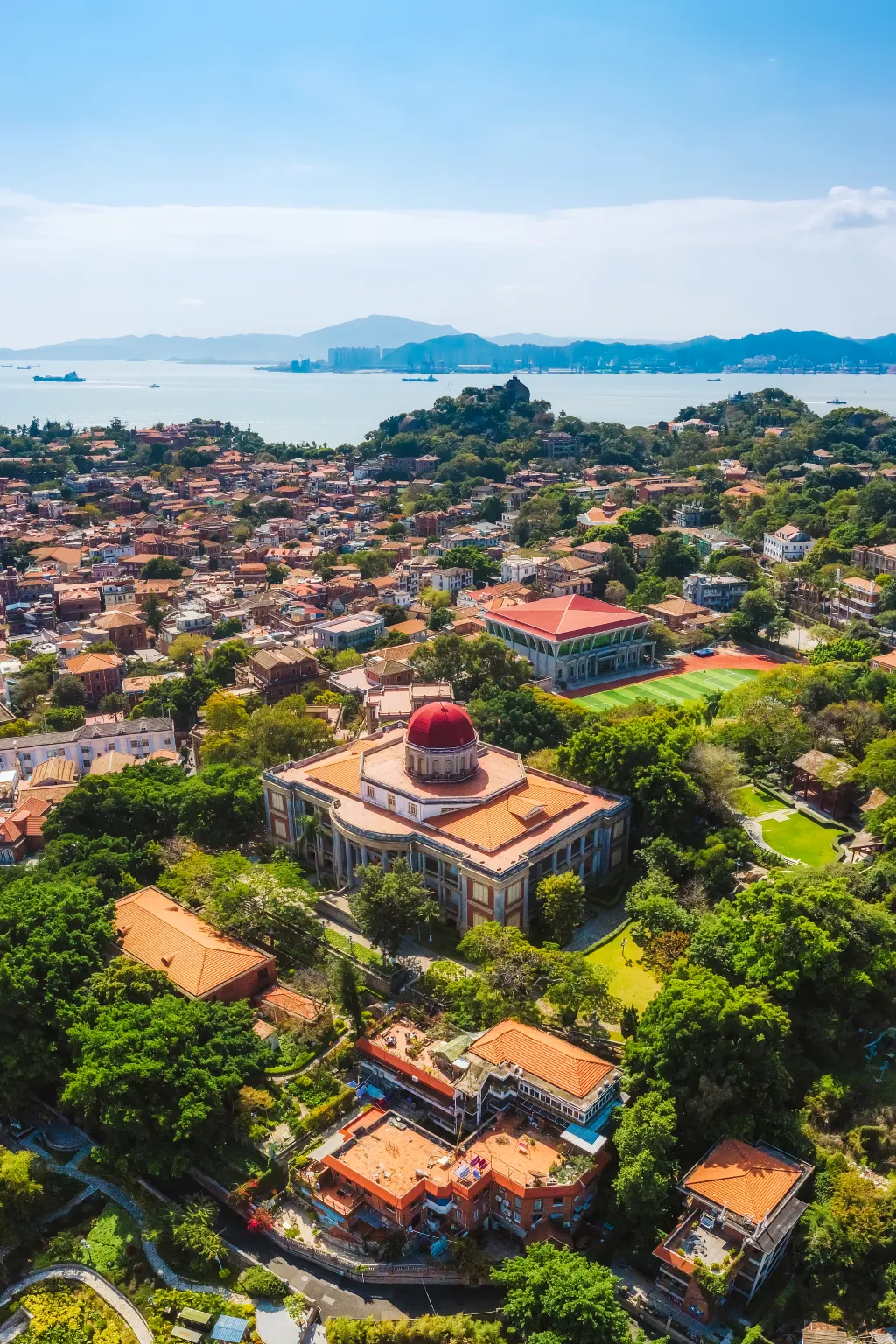
Kulangsu is located in the southwest corner of Xiamen, Fujian Province, facing Xiamen Island across the Lujiang Strait. The island covers an area of about 1.88 km² and is a "garden on the sea, island of pianos, and exhibition of architecture from around the world" that blends nature with culture. In 2017, it was inscribed on the World Cultural Heritage List as "Kulangsu, a Historic International Settlement." The island is a bedrock island with a winding coastline and many natural harbors and reefs; its terrain is mainly hilly, with the highest peak, Sunlight Rock, at 92.7 m above sea level. It has a subtropical maritime monsoon climate, warm and humid, with spring-like weather all year round, making it suitable for visiting throughout the year. Motor vehicles are prohibited on the island, so there is no noise of traffic—only birdsong, flowers, waves, and piano music. Hundreds of historic buildings from the late 19th century to the mid-20th century still stand, spanning Gothic, Victorian, Baroque, Nanyang arcade, and traditional Minnan courtyard styles, and are acclaimed as a "World Architecture Expo" and a living specimen of a modern East Asian international community. Representative buildings include the Bagua Mansion (Organ Museum), Shuzhuang Garden, Haoyue Garden, the former site of the HSBC Mansion, Trinity Church, and the former residence of Lin Yutang. The island has a profound musical cultural heritage. Since the late Qing Dynasty, Western music was introduced through missionary schools. The density of pianos on the island has long ranked among the highest in the country, and musical masters such as Yin Chengzong and Xu Feiping were born here, earning it the reputation of "Island of Pianos" and "Island of Music." The Piano Museum houses century-old antique pianos, and the Organ Museum holds a giant pipe organ. Piano music is often heard among the streets and alleys, and the tradition of family concerts continues to this day. The core attractions on the island each have their own distinctive features. Sunlight Rock is the highest point on the island; from the summit, visitors can enjoy a 360° panoramic view of the entire island, Xiamen main island, and the Taiwan Strait, and there is a saying that "you haven't truly visited Xiamen until you've climbed Sunlight Rock." Shuzhuang Garden was the private residence of the wealthy Taiwanese merchant Lin Erjia, designed to "hide the sea within the garden and embrace the mountains as scenery," blending Jiangnan garden aesthetics with mountain and sea views; the garden's Piano Museum houses nearly a hundred antique pianos. Haoyue Garden features a 15.7 m tall granite statue of Zheng Chenggong facing the sea, built to commemorate the national hero who recovered Taiwan. Bagua Tower is a landmark building on the island, blending Chinese and Western architectural aesthetics, and houses hundreds of antique organs. Yuyuan Garden, Gulang Stone, Yanwei Mountain Ecological Park, and other cultural and natural attractions are scattered across the island, linking together a century of charm and the poetry of mountains and sea. Tour tips Island access: You need to take a ferry from the ferry terminal on Xiamen Island to get there. There is no general admission ticket; core attractions require separate tickets or a combo ticket. Mode of travel: Walking tours across the island; paid sightseeing electric carts are available; motor vehicles are prohibited. Recommended season: suitable all year round; spring and fall (April-May, October-November) offer comfortable weather and blooming bougainvillea, making the scenery especially beautiful.

China · Xiamen
From KRW 1,003
Wuyishan National Park
2027 Global 50 - Cool Escape Attractions

Wuyishan National Park

8.6
4.6/5
13.5k reviews

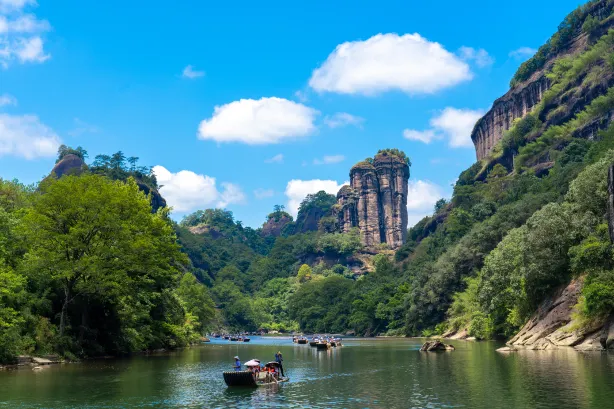
Wuyishan National Park is located in the northern section of the Wuyishan mountain range in northwestern Fujian, stretching across the border area between Fujian and Jiangxi provinces. It is one of China's first established national parks, and Wuyishan itself was inscribed as a UNESCO World Heritage Site for both culture and nature as early as 1999. The park was formed by integrating the former Wuyishan National Nature Reserve and Wuyishan Scenic Area: the Tongmu area in the north focuses on ecological conservation and scientific research, preserving a rare intact mid-subtropical forest ecosystem at this latitude. The main peak of the Wuyishan range, Mount Huanggang, is also located here, and this core area does not offer regular tourism activities. Sightseeing activities are concentrated in the scenic areas along both banks of the Nine-bend Stream, namely the four major sections: Tianyou Peak to Taoyuan Cave, Nine-bend Stream to Wuyi Palace, One-line Sky to Tiger Roaring Rock, and Dahongpao to Water Curtain Cave. The attractions in the scenic area are relatively scattered with considerable distance between them. A leisurely visit typically requires two to three days. If you only have one day, start by ascending Tianyou Peak for a panoramic view of the emerald waters and crimson mountains along the Nine-bend Stream, then take a bamboo raft downstream from Xingcun Wharf. Along the way, you'll pass landmarks like Jade Maiden Peak, Great King Peak, cliff inscriptions, and suspended boat coffins. The rafting journey ends at Wuyi Palace, making it an ideal classic route. Tea enthusiasts may prefer spending time on the leisurely Rock Bone Floral Trail between Dahongpao and Water Curtain Cave. This gentle path connects core Wuyi rock tea production areas like Liuxiangjian and Huiyuankeng, offering a uniquely fragrant experience. With two days, you can cover all four major sections. For more time, consider visiting the ancient tea merchants' residences in Xiamei Village, the starting point of the ancient Tea Horse Road, or exploring the ruins of the Minyue King's City near Chengcun Village—the latter also being part of Wuyishan's world heritage site. Bamboo rafting is very popular, so please make arrangements in advance during peak season. To get close to the ecological heart of the park, you can take the Wuyishan National Park No. 1 scenic route. Places like Moon Bay and Qinglong Waterfall are suitable for self-drive or private charter. As for food, street snacks like flat meat dumplings and Vietnamese noodles are common, while Langu smoked goose and local dishes cooked with alpine bamboo shoots and mushrooms are also worth trying.

China · Wuyishan
From KRW 14,029
Tengwang Pavilion Tourist Area
No. 2 of Night Attractions in Jiangxi

Tengwang Pavilion Tourist Area

8.7
4.5/5
30.3k reviews

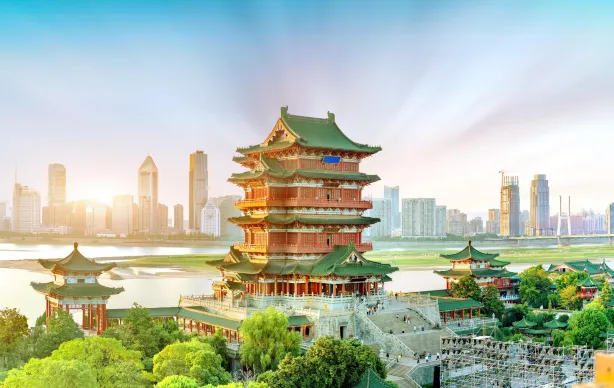
Tengwang Pavilion Tourist Area is located on the east bank of the Gan River in Nanchang, with the riverside Tengwang Pavilion as its centerpiece. Originally built in the fourth year of the Yonghui era of the Tang Dynasty by Li Yuanying, Prince of Teng and son of Emperor Gaozu of Tang, it gained eternal fame through Wang Bo's "Preface to Tengwang Pavilion." Alongside the Yellow Crane Tower and Yueyang Tower, it is hailed as one of the "Three Great Towers of Jiangnan." Historically destroyed and rebuilt nearly thirty times, the current structure is a Song-style replica completed in 1989, designed based on Liang Sicheng's reconstruction sketches. With its green tiles and layered eaves, it remains a landmark of Nanchang to this day. The main pavilion follows a "three visible, seven concealed" layout: appearing as a three-story structure with encircling corridors from the outside, while actually containing seven interior floors—nine levels including the two-tiered base symbolizing ancient city walls. Turquoise-roofed galleries extend north and south from the base's flanks, connecting at their ends to auxiliary pavilions named "River-taming" and "Greenery-embracing," forming a mountain-shaped silhouette with the main tower. Below, an artificial lake and the nine-bend wind-and-rain bridge add classical garden charm to the majestic architecture. Each floor of the pavilion offers something remarkable. The white marble relief "A timely wind delivers Tengwang Pavilion" in the first-floor preface hall depicts the legend of Wang Bo riding the wind to compose his famous preface. The second-floor mezzanine features the long scroll painting "Gallery of eminent figures," gathering Jiangxi's historical luminaries like Tao Yuanming, Ouyang Xiu, Wang Anshi, and Tang Xianzu in one artwork. The third-floor mural "Linchuan dream" recreates Tang Xianzu's staging of "The peony pavilion" here. The fourth-floor "Land of wonders" painting compresses Jiangxi's iconic landscapes—Mount Lu, Sanqing Mountain, Dragon-Tiger Mountain, and Poyang Lake—into a single masterpiece. The fifth floor is the highlight for panoramic views: its central hall displays a bronze tablet inscribed with Su Dongpo's calligraphic version of "Preface to Tengwang Pavilion," while the east hall exhibits a scale model of the pavilion. Strolling the veranda offers sweeping views of the Gan River and modern skyline across the water. The top floor bears the plaque "Ninth heaven," with its west hall housing an antique-style theater flanked by replica ancient instruments like chime bells and stone chimes. Above, spiral-arranged bracket sets adorn the caisson ceiling, and between the double eaves hangs Su Dongpo's gilded "Tengwang Pavilion" plaque. After descending from the main pavilion, take time to explore the garden area: the square in front of the pavilion, the grand Song-style archway, the antique street lined with calligraphy and antique shops, and the small Suzhou-style garden Fuchang Garden with its lake reflections and bridge views—perfect for slowing your pace. To experience the poetic scene of "a solitary wild duck flying with the sunset glow, while the autumn water blends with the vast sky," an evening ascent to the pavilion is ideal. The fifth-floor corridor offers an expansive view, making it a prime spot to admire the sunset over the Gan River.

China · Nanchang
From KRW 10,021
Ge's Fairy Village
2027 Asia 100 - Night Attractions

Ge's Fairy Village

8.5
4.8/5
12.7k reviews

Ge's fairy village is located in Yanshan County, Shangrao City, Jiangxi Province. It was invested and constructed by Xinbang Group in June 2016, with a total investment exceeding 1.569 billion yuan. Backed by the thousand-year-old Taoist mountain Ge's Fairy Mountain, it aims to become "a new landmark of Jiangxi tourism." The project is divided into two phases, with a planned construction area of approx. 300,000 square meters. The core attraction area covers 650 mu, including three main sections: the distribution center area, Ge's Fairy Village resort, and the Tianjing Terrace attraction. Future development will continue to expand outward along the valley. Ge's fairy village is developed around the Ge's fairy mountain attraction, inspired by the cultivation stories of immortal Ge Xuan on the mountain. It integrates the cultural essence of Taoism with classical landscape painting aesthetics, recreating the mountain village scene where Ge Xuan lived and practiced during the late Han dynasty. Using water, bamboo, and village as creative elements, it aims to create a natural sanctuary and fairy village combining eco-tourism, leisure vacations, business conferences, and Taoist cultural experiences. Introduction to attractions in Ge's fairy village Yuánfāng - Heaven and earth hidden in the mountains and forests The name "Elements" is derived from the Taoist concept of "the sky is round and the earth is square." The bronze compass within Elements, meticulously crafted by renowned artists, embodies the Taoist understanding and profound mastery of the universe's principles. The overall design follows the concept of a "vanishing building," featuring a facade of glass mirrors and bamboo. From a distance, the glass mirrors reflect the natural scenery of the mountains, making the structure appear hidden within the forest. Without careful observation, one might easily overlook the building and the hidden paradise behind it. Zhongmiao pavilion - profound and mysterious, both real and illusory Zhongmiao pavilion is the highest point of the attraction, featuring an ancient architectural structure. The main building stands 26 m tall with a three-story, four-pillar pure wood design. Pavilions are typically used for storing books or enshrining deities, which adds more cultural significance to this structure. In the evening, the solemn and magnificent Zhongmiao Pavilion show takes place here, where the combination of modern technological lighting and ancient architecture creates a dreamlike and visually stunning experience. Culture has a long history The ancestral hall square mainly consists of the jiao altar at the center and the Ge Weng ancestral hall. The jiao altar is a place for capping, wedding, and sacrificial ceremonies. It served as the venue for ancient capping rites, wedding ceremonies, and rituals praying to deities. Traditional folk cultural performances are staged in the central area of the ancestral hall square. Dust-washing gate·Emerald pool - Wash away the mundane Under the moonlight, seekers perform the traditional Taoist greeting, embracing the path of Taoism. The "gate of purification," crafted with mist curtain installations, presents a mesmerizing interplay of light and shadow amidst ethereal fog, cleansing worldly dust from those who journey from afar. Water curtain film - magnificent and breathtaking The water stage at Zhongmiao Pavilion presents a grand live-action water screen movie every evening, where the fusion of water screens and light creates a dazzling visual feast. Performers dance to the rhythm of alternately intense and soothing music, bringing to life a series of dramatic legendary tales from a flourishing era. China town artifact culture museum - A long history of town artifact culture The China town artifact culture museum is located at the entrance of Lingbao Fairy Street, featuring horse-head walls that showcase the distinctive Huizhou architectural style. Inside, visitors can explore China's ancient town artifact culture through exhibition areas, retail zones, and workshop sections, gaining a deeper understanding of this cultural heritage while admiring historical artifacts.

China · Yanshan
Save KRW 602From KRW 25,451
Jiangle Today's weatherFoggy 7-21℃
Jiangle weather for the next 2 days11/30: 8-22℃, 12/1: 11-24℃

Free things to do in Jiangle

What travellers say about Jiangle

user-avatar
Anonymous user7 October 2026
5.0
Yuhua Cave has beautiful scenery and is worth a visit. The guided tour is well-organized, with a fixed guide at each point and two NPC activity points. However, due to the rain, we didn't have time to visit the two museums outside.

Yuhua Cave

user-avatar
Anonymous user7 October 2026
5.0
Ganlu Temple and Yixiantian at Dajin Lake have nice scenery and don't require much physical exertion. There weren't many people during the National Day holiday, so there were no long queues, which is an advantage of less-visited attractions. However, we weren't allowed to take a boat back; we took a tour bus instead. And for safety reasons, no one was allowed to go up to the deck to see the lake view, which was a bit of a pity.

Golden Lake

user-avatar
Anonymous user26 November 2026
5.0
Wangxian Valley truly exceeded my expectations! The cliffside ancient village scenery is breathtaking; the canyons, waterfalls, and suspended buildings offer stunning views at every turn, with the mountains, water, and ancient architecture blending together in a unique and charming way. Strolling along the boardwalk is very pleasant, and the atmosphere is absolutely amazing after the lights come on at dusk, making for fantastic photos. Ticket checking is smooth, and the facilities are excellent, making it well worth a special trip to visit.

Wangxian Valley

user-avatar
景闹闹29 November 2026
5.0
It's an ancient mountain village, quite charming on a nice day. It got very crowded on Saturday, so I'd recommend avoiding weekends to make taking photos easier. The autumn harvest here happens year-round; a leisurely stroll and some pictures are a great way to explore.

Wuyuan Huangling Scenic Area

user-avatar
红糖泡泡16 November 2020
5.0
Longqishan National Nature Reserve is located in the south of Jiangle County, with a total area of ​​156.93 square kilometers. It is a nature reserve with subtropical evergreen broad-leaved forest as the main protection object. The car can drive directly to the top of the mountain, where you can have a bird's eye view of the entire mountain scenery, which is very pleasing to the eye.

Longqishan Nature Reserve

user-avatar
206***3228 November 2026
5.0
A fantastic experience! Each attraction had something to see, do, and explore. Ticket checking was convenient, and with a well-planned route to avoid backtracking, a half-day was just the right amount of time to eat and drink your way around. You even caught two organ performances! Gulangyu Island – a resort destination that won't disappoint.

Kulangsu

user-avatar
Anonymous user24 November 2026
5.0
Great place with beautiful views and nice weather. The organization of sightseeing busses plus city busses is great, you can get around easily and quickly. The place is crowded but the park is huge and people spread around. If one is willing to walk longer, certain trails are almost empty of people. It can be very beautiful and quiet. The overall admission + bus ticket price is fair considering the service given. Worth staying multiple days to enjoy different parts of the park and the sangu resort area across the river is very lively at night with beautiful atmosphere.

Wuyishan National Park

user-avatar
gongzuo123429 November 2026
5.0
Even if you can't recite the Preface to the Pavilion of Prince Teng, you can still climb it fifty times to enjoy the panoramic view. It's still worthwhile. Knowing it's been rebuilt 29 times, and originally only had two stories, modern technology has made it taller and more robust.

Tengwang Pavilion Tourist Area

user-avatar
M15***5328 November 2026
5.0
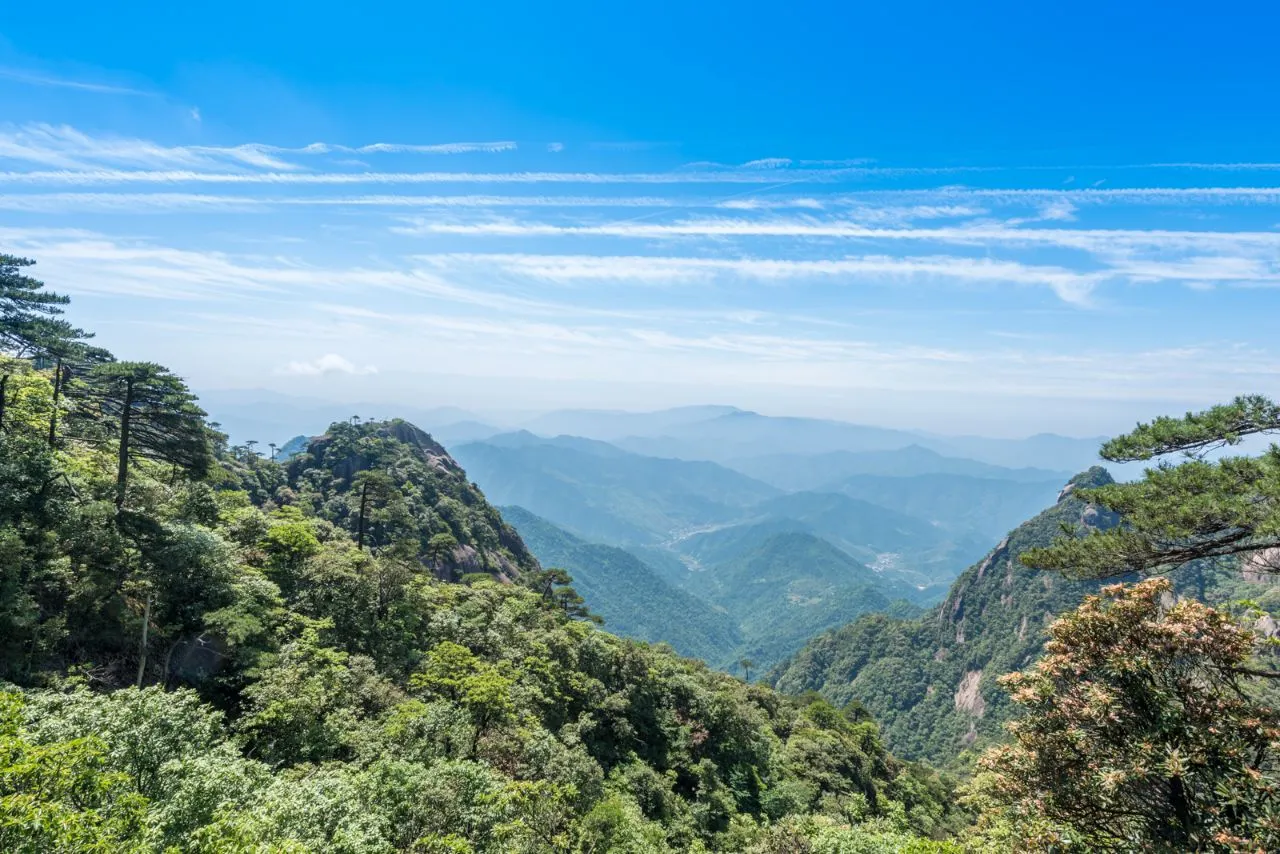
With its uniquely shaped peaks and rocks, exuding an ethereal beauty, Sanqing Mountain boasts iconic landscapes such as the "Giant Python Emerging from the Mountain" and the "Eastern Goddess," which appear and disappear amidst the clouds and mist, creating a truly breathtaking sight. Many visitors say that seeing it in person confirms the undeniable wonder of nature's artistry.

Sanqingshan Mount Scenic Area

user-avatar
Anonymous user26 November 2026
5.0
The childcare experience was absolutely fantastic! The staff were incredibly responsible, gentle, attentive, and patient, taking excellent care of the children. They kept us updated on our child's progress in real time and even offered a photo service, making us feel completely at ease throughout. The environment was clean, tidy, and charmingly decorated, creating a wonderful atmosphere. They played fun games with our children, providing meticulous and attentive care without any perfunctory attitude. I felt completely reassured leaving my child here, without any anxiety whatsoever! The service was excellent, the childcare teachers were incredibly responsible, caring, and reliable, and the value for money was exceptional. Highly recommended! Parents who need childcare should definitely check it out! 🥳

Ge's Fairy Village

Trip Moments in Jiangle

Popular cities near Jiangle

Frequently asked questions

How can I contact Trip.com customer support?

Get help anytime, anywhere within 30 secondsContact customer support

Change and cancellation policies vary by attractions and tours. Please check the product details page for more information.

Ticket prices may vary between weekdays and weekends, as well as during peak and off-peak seasons. When booking with Trip.com, you can also use Trip Coins to get extra savings. For more tips on booking discounted tickets, please visit Trip.com for the latest information.