Things to do in Song County
Explore top experiences
Top 10 attractions in Song County


The Hukou Waterfall Scenic Area
The Hukou Waterfall is a famous waterfall on the Yellow River. The roiling water of the Yellow River roars downward here with great power. The Hukou Waterfall area is divided by the Yellow River. On the west side is Yichuan County, Shaanxi, and on the east side is Ji County, Shanxi. The waterfall is also divided into the Hukou Waterfall (the part of the falls in Shaanxi) and the Shanxi Hukou Waterfall (the part of the falls in Shanxi). Separate tickets are sold for each area. The Shanxi section of the Hukou Waterfall is located 45 kilometers west of the seat of Ji County in Linfen City, Shanxi.China · Ji County

Xi'an Museum
Xi'an Museum is a modern comprehensive museum built upon the cultural relic protection site—the ruins of the Tang Dynasty Jianfu Temple and its iconic structure, the Small Wild Goose Pagoda. It integrates cultural relic collection and protection, academic research, exhibition and display, social education, and garden leisure. Its core area is the location of the original Tang Dynasty royal temple, Jianfu Temple, while the precious and striking historical relic existing within the temple—the Small Wild Goose Pagoda—has become the museum's unique landmark and soul. Therefore, the Jianfu Temple ruins and the Small Wild Goose Pagoda are not only the foundation and core carrier for the establishment of Xi'an Museum, but also important outdoor historical exhibition areas and focal points for visitors. The main building of the museum is located on the north side of the ancient temple ruins. The three elements (ancient temple ruins, ancient pagoda, and modern museum building) are organically integrated, jointly forming a unique cultural space that combines "museum, pagoda, temple, and garden," vividly showcasing the historical context of Xi'an from ancient times to the present. Xi'an Museum officially opened to the public on May 18, 2007. Its establishment aims to comprehensively showcase the glorious history and splendid culture of Xi'an (ancient Chang'an) as the capital of thirteen dynasties, filling the gap of a comprehensive museum of Xi'an's urban history. Collection highlights: The museum houses over 100,000 precious cultural relics from various historical periods of Xi'an. The collection spans from prehistoric times to the Ming and Qing dynasties, with particular emphasis on artifacts from the prosperous dynasties of Zhou, Qin, Han, and Tang, including bronze ware, jade articles, gold and silverware, ceramics, murals, stone steles, epitaphs, and Buddhist statues, systematically reflecting the political, economic, cultural, social life, and foreign exchanges of the ancient capital Chang'an. Main exhibition: The permanent exhibition "Ancient capital Xi'an" takes the urban development history of Xi'an as the main thread, showcasing the evolution and achievements of Xi'an as a capital (Zhou Fenghao, Qin Xianyang, Han Chang'an, Sui-Tang Chang'an) and a prefectural city (Song, Yuan, Ming, and Qing dynasties) through a large number of precious cultural relics, models, charts, and multimedia means. Unique environment: The museum's greatest feature lies in its surroundings. Travelers can not only visit modern exhibition halls but also stroll through the expansive heritage park encompassing the Small Wild Goose Pagoda, the ancient architectural complex of Jianfu Temple (including structures like the Ming dynasty bell tower housing a Jin dynasty ancient bell), an ancient stone sculpture art exhibition area, and garden views—experiencing the charm of the millennia-old capital at its historical site. The view of "morning bells at the Wild Goose Pagoda" is particularly renowned. Functional positioning: The museum is not only an important center for cultural relic collection, research, and display, but also an urban cultural park where citizens can relax, entertain, and immerse themselves in history and culture, undertaking significant social education and cultural exchange functions.China · Xi'an

Sui And Tang Dynasties Luoyang City Yingtian Gate Site
Yingtianmen is the south gate of Luoyang City Palace City in Sui and Tang Dynasties. It was built in the first year of Daye in Sui Dynasty, that is, in AD 605. It has gone through four periods of Sui, Tang, Five Dynasties and Northern Song Dynasty successively. The Jinbing was burnt and used for 523 years. Yingtianmen was an important place for holding major state celebrations and diplomatic activities at that time. If Yuanzheng, Winter Solstice, Chenle, banquets, pardoning sins, removing the old and clothing the new, when the tributary messengers of all countries, the guests of the four barbarians and other important celebrations, the emperors all came to listen to the government. Similar to the current Beijing Meridian Gate. This city gate has witnessed the prosperity of the dynasty when Emperor Yang Guang of Sui Dynasty entered the Eastern Capital, Emperor Gaozong of Tang Dynasty released King Fuyu of Baekje, the queen ascended the throne and became emperor, and Emperor Xuanzong of Tang received the eighth envoy from Japan to the Tang Dynasty. Every Shangyuan Festival, Yingtianmen Square will also hold a grand Baixi performance. When it is grand, the performance team will stretch from here to the main south gate of Guocheng, which is 4 kilometers away. Yingtianmen has different names in different periods: it was built in the early Sui Dynasty, according to the "Analects of Confucius", "Only the sky is the greatest, only Yao is the rule", taking the meaning of "taking the sky as the rule", so it is called "Zetianmen"; the first year of Tang Shenlong 705 During the reign of Emperor Zhongzong Li Xian of Tang Dynasty, after avoiding Wu, he was honored as "The Great Sage Emperor Zetian" and renamed Yingtianmen. During the Kaiyuan period of Emperor Xuanzong of the Tang Dynasty, this building was renamed Wufeng Building, and Wufeng Building was used until the Five Dynasties and Northern Song Dynasty. At the end of the Northern Song Dynasty, Jinbing invaded the Central Plains, Luoyang became a battlefield and was severely damaged. Jinbing burned down the building. The city of Luoyang in the Sui and Tang Dynasties, which was prosperous for more than 530 years, gradually faded out of people's sight. Yingtianmen is one of the buildings that can show identity and status in the Chinese etiquette system. "Yuan·Henan Chronicle" records: the main gate of the palace city is called Zetianmen, the gate has two views, the upper one is called Ziwei microscopic, the left and right are connected with the ques, and the ques are 120 feet high. Calculated at 29.4 centimeters per foot in the Tang Dynasty, equivalent to about 36 meters today, this magnificent tower is almost twelve or three stories high today. The Tang Dynasty poet Bai Juyi once looked south on Yingtianmen and wrote a poem: "Longmen Cui Dai Mei is opposite, Yishui Golden Line is a line". From Yingtianmen, you can see Longmen Yique, which is 15 kilometers away, showing the majesty of Yingtianmen.Luoyang · 69.4km from Song County

Hukou Waterfall tourist area of the Yellow River
The Hukou Waterfall tourist area of the Yellow River is located on the riverbed of the Yellow River in the Qin-Jin Grand Canyon, where the provinces of Shanxi and Shaanxi face each other across the river. The main stream of the Yellow River, originally hundreds of m wide, suddenly narrows to dozens of m and plunges into a deep trough with a drop of 20–30 m, resembling water being poured from a giant pot—hence the name "Hukou" (Pot Mouth). Due to the large amount of sediment carried by the river, the waterfall presents a rare golden-yellow view: the turbid waves roar down with a sound like distant thunder rolling through the valley, while the rising mist lingers before the cliff, earning the nickname "smoke rising from the water." On sunny days, sunlight casts a rainbow over the waterfall, known as "a rainbow playing in the water." The mist may drench visitors even without wind or rain, creating the wonder called "rainfall under a clear sky." Hukou waterfall is regarded as the symbol of the "soul of the Yellow River" and the spirit of the Chinese nation. In 1938, when poet Guang Weiran crossed the Yellow River, he witnessed the roaring waves of Hukou and the boatmen's chants, which inspired him to create the now-legendary Yellow River Cantata. Liang Heng's essay of the same name was selected for middle school Chinese textbooks, and the back of the fourth series CNY 50 banknote also features this scene. Many first learned about it through textbooks and currency before visiting in person. In the past, cargo ships had to leave the water and bypass the waterfall here, leaving behind the maritime memory of "sailing on dry land." The scenery here varies with the seasons: In early spring, the upstream ice melts and the water level rises sharply, coinciding with the blooming of mountain peach blossoms on both banks, known as the "March peach blossom flood." In midsummer, the rainy season brings abundant water, with muddy waves towering into the sky. After fall begins, the rainy season subsides, and the water becomes high and steady. As the fall breeze sweeps by, rainbows often appear, earning the name "Hukou autumn breeze." In deep winter, layers of ice form along the banks, and overflow freezes into inverted ice peaks, glistening under the sunlight, creating the spectacular "upside-down ice peaks." The viewing platform on the Shaanxi side stretches along the cliff top on the western bank, offering a commanding view of the "thousand-mile Yellow River funneled into one pot" and the ten-mile-long Dragon Trough below the waterfall. During high-water seasons, the mist is heavy, and clothes get soaked quickly, so remember to protect your camera and phone; the boardwalk is slippery, so watch your step while walking and taking photos.China · Yichuan

Xi'an Bell Tower
Xi'an Bell Tower is one of the larger and well-preservedBell tower, originally built in 1384, during the Hongwu reign of the Ming Dynasty,Bell towerLocated in the heart of Xi'an, it is one of the landmarks of the ancient city, radiating east, south, west, and north streets from its center, connecting to the east, south, west, and north gates of the Xi'an city wall respectively. The Xi'an Bell Tower was originally located on Guangji Street in the west. As the city center shifted eastward, it was relocated toDrum towerEast side, today's location. The Xi'an Bell Tower features a typical Ming Dynasty architectural style, with a square brick-and-stone base at the bottom and a triple-eaved pyramidal roof structure at the top, covered with dark green glazed tiles. The gilded pinnacle at the roof's apex is particularly striking under sunlight. Each side of the base has a central arched doorway approx. 6 m high, which were interconnected and once served as passageways for the intersection of four major streets—east, south, west, and north—allowing pedestrian and vehicular traffic. These doorways are now sealed, with a traffic roundabout built around them and an underground pedestrian passage. The entrance to the Xi'an Bell Tower is located within this underground passage, accessible via a spiral staircase. Inside the tower, there is a replica of the "Jingyun Bell," whose original was cast in the second year of Emperor Ruizong's Jingyun era (711 AD) during the Tang Dynasty and is now housed in the Xi'an Beilin Museum. Standing on the Xi'an Bell Tower, you can see the four main streets extending east, south, west, and north from the Xi'an Bell Tower. Around the Xi'an Bell Tower, there are bustling commercial areas and not far awayDrum towerTravelers can also enjoy wonderful historical performances when visiting the Xi'an Bell Tower.China · Xi'an

Museums in Xi'an
Xi'an Museum Tour explores imperial, archaeological, and artistic key museums with immersive activities, revealing the ancient capital's history across thirteen dynasties. Imperial Mausoleum Site Museums:Unearth the secrets of the Terracotta Army. At this UNESCO-listed site, witness the “Eighth Wonder of the World”—a stunning display ideal for history enthusiasts and families to explore the legacy of the Qin Dynasty. Archaeological Science & Art Museums:Get hands-on with the science of excavation. Here, visitors engage with restored artifacts, tech-assisted archaeology, and exhibits on cultural progress—highlighting the blend of science and art behind uncovering the past. Stele Calligraphy Art Museums:Dialogue with stone-carved classics. Home to steles, epitaphs, and calligraphic masterpieces, this museum offers a journey through the evolution of script, Confucian texts, and the legacy of Central Plains civilization. Prehistoric Sites & City History Museums:Trace the roots of ancient Chang'an. The Banpo Museum showcases a 6,000-year-old matriarchal village, while Xi'an Museum combines the Xiaoyan Pagoda landscape with artifacts from Zhou to Tang dynasties, illustrating the city's birth and growth. Museum Combo Tour: A curated combination of museum visits that weaves together iconic collections to form a holistic understanding of Chang'an from multiple perspectives, offering profound insights into the cultural legacy of this ancient capital of thirteen dynasties.China · Xi'an

Henan Museum
Located in the city of Zhengzhou, Henan Museum has a rich collection of exhibits displaying Henan's 5,000-year history and offering a window into traditional Henanese culture. The museum has eight exhibition halls that can be visited in chronological order. The collection includes several national treasures, including the lotus crane vase, cloud copper chest, Saohao vase, Jiahu bone flute, Wushu copper plate and more. Be sure to visit them all.China · Zhengzhou

zhong yuan xiao er hai
Song County · 11.7km from downtown
Wudang Mountains
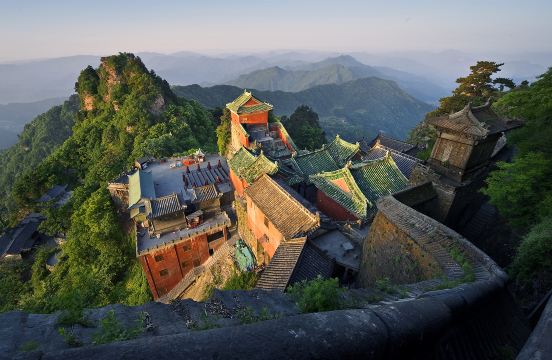
The Wudang Mountains are located in Shiyan, northwestern Hubei province. Its main peak, Tianzhu Peak, stands at an elevation of over 1,600 m. Legend has it that Emperor Zhenwu cultivated and ascended to immortality here, while Taoist Zhang Sanfeng further synthesized the essence of martial arts during the late Yuan and early Ming dynasties, making this the birthplace of Wudang martial arts. During the Yongle era of the Ming dynasty, the imperial court launched the monumental project of "constructing the Forbidden City in the north and building the Wudang Mountains in the south." The mountain temples were built according to royal standards, with their layout unfolding layer by layer following the mythological narrative of Zhenwu's spiritual cultivation. The palaces blend harmoniously with the peaks, cliffs, and streams, creating an ethereal and mystical atmosphere befitting a sacred mountain. The attractions unfold along the mountain terrain from the base to the summit, connecting key areas like Taizi Slope, Zixiao Palace, Nanyan Palace, and Taihe Palace. At Taizi Slope, the undulating Nine-bend Yellow River Wall follows the mountain contours, while Wuyun Tower's "one pillar supporting twelve beams" remains an architectural marvel. Zixiao Palace, a well-preserved imperial Taoist temple, features the stately Zixiao Hall with its double-eaved, nine-ridged roof. Nanyan Palace clings dramatically to a cliff face, offering vertiginous views of the valley below. Ascending the stone-paved ancient path to Tianzhu Peak's summit reveals the gilded bronze Golden Hall—the architectural masterpiece of the entire complex. As the birthplace of Wudang martial arts, this place attracts enthusiasts from home and abroad who come to seek masters and practice martial arts. The Taizi Slope on the mountain and the Xuantian Yuxu Palace at the foot serve as daily training grounds for practitioners. If you happen to encounter Taoist priests or students demonstrating Wudang boxing techniques, take a moment to quietly observe and appreciate the centuries-old martial arts heritage. A two-day visit is recommended: On the first day, enter from the mountain gate to visit Taizi slope and Zixiao palace, then stay overnight near Wuyaling. On the second morning, first visit Nanyan palace, then ascend to the golden summit before hiking down or taking the cableway at Qiongtai. After exiting the mountain gate, you may also visit Xuantian Yuxu palace. The attraction's shuttle buses connect all major core attractions, allowing flexible combinations of hiking and riding. Most dining and lodging options are concentrated around Nanyan, convenient for rest during the climb. From late October to November each year, when the forests are ablaze with color and red leaves cover the mountains, it's the perfect time to enjoy the fall scenery in the mountains.China · Danjiangkou

Tang Paradise
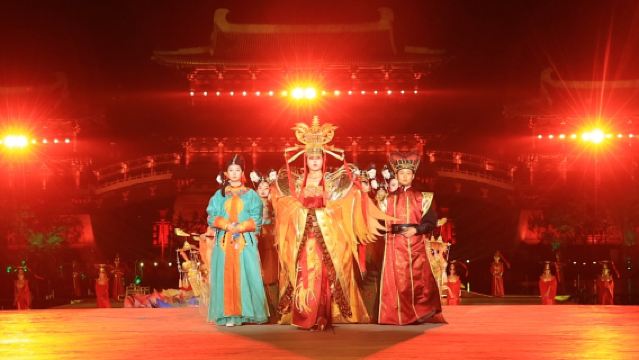
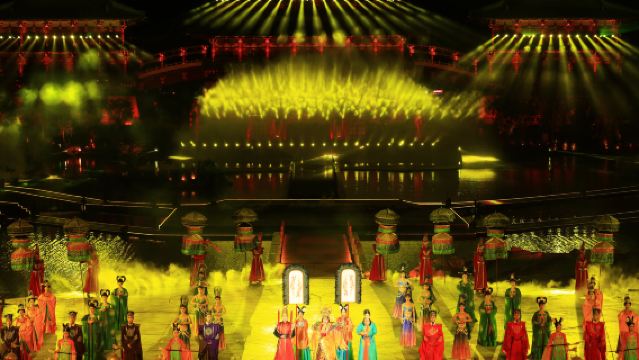
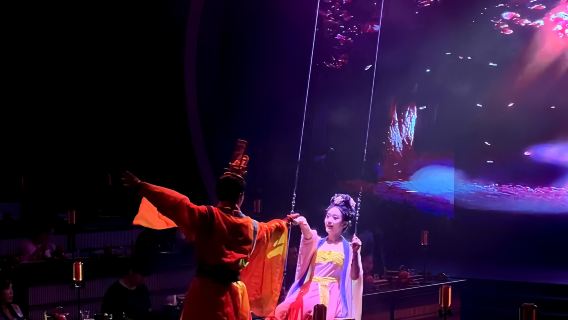
Tang Paradise, a national 5A attraction, is located in Qujiang New District in the south of Xi'an City, not far away from the Big Wild Goose Pagoda. It covers an area of 998 acres, including 300 acres of water area, 440 acres of green space, and a construction area of nearly 100,000 square meters. The overall planning and architectural design of the park's architecture is by Mr. Zhang Jinqiu, an academician of the Chinese Academy of Engineering, and the garden landscape design is by Mr. Hiroshi Akiyama, a Japanese garden master. It is a large-scale cultural theme heritage park that comprehensively displays the style of the prosperous Tang Dynasty. Since its official opening to the outside world on April 11, 2005 (the third day of the third lunar month), it has been committed to creating high-quality, high-standard brand tourist attractions. Tang Paradise aims to build "a garden of history, a garden of spirit, a garden of nature, a garden of humanity, and a garden of art". It specially invited more than ten Tang historians, Tang poems, Tang paintings, etc. from the China Tang Dynasty Literature Society. An expert group composed of Tang construction experts, doctoral supervisors, researchers and tourism experts re-excavated and sorted out the historical and cultural content of Tang Paradise, re-planned and positioned the entire garden landscape, and divided into fourteen ares including the imperial cultural area, female Cultural area, poetry culture area, imperial examination culture area, tea culture area, song and dance culture area, food culture area, folk culture area, diplomatic culture area, Buddhist culture area, Taoism culture area, children's play area, gate landscape culture area and water show performance area, fully reproduce the splendid civilization of the Tang Dynasty. There are more than 20 scenic spots such as Ziyun Tower, Ladies Pavilion, Lu Yu Tea House, Apricot Garden, Caixia Corridor, Qujiang Drinking, Beauty Walk, Tang Poetry Gorge, Dogwood Terrace, etc. It displays the Tang Dynasty's dazzling spiritual outlook and splendid and unparalleled culture and art. It is known as a tourist attraction that “shocks the Chinese people and amazes the world”. The theme performance of the attraction is the large-scale water dance light and shadow show "Chasing Dreams of the Tang Dynasty", and you can take a boat trip to the dreamy holy land; the large-scale super-dimensional situation dance drama "Dreams of the Tang Dynasty" is majestic and dreamlike; the palace Yan music of the Tang Dynasty "Drums" performs Dongcang drum music, an intangible cultural heritage of mankind, as well as high-quality cultural tourism activities such as the New Year Festival, Shangsi Festival, and Qujiang Flower Moon Banquet. Brands and projects. The multiple Complimentary attractions and exciting performances every day are a warm invitation from the Tang Dynasty royal family to tourists, allowing them to experience the sacred and grandeur of royal culture in a shocking way. As a theme heritage park with excellent quality, full of personality and rich cultural connotation, Tang Paradise is a cultural window for Xi'an to show the world the ancient historical heritage of Chang'an and the prosperous Tang Dynasty, and a cultural gateway to attract the world to understand China...China · Xi'an
Experiences you can't miss in Song County
Featured Cultural experiences in Song County
View all Cultural experiences
5.0/5
· 1 reviewFree cancellation
Instant confirmation
Book now for tomorrow
From€58.56
5.0/5
· 2 reviewsInstant confirmation
From€23.84

Free cancellation
Instant confirmation
From€32.93
Free cancellation
Instant confirmation
Book now for tomorrow
From€50.68

Free cancellation
Instant confirmation
Book now for today
From€34.59
Featured Food & drink in Song County
View all Food & drink
4.8/5
· 25 reviews· 578 bookedFree cancellation
Book now for tomorrow
220 travellers saved
From€26.55
4.8/5
· 4 reviews· 28 bookedFree cancellation
Instant confirmation
Book now for today
From€25.21
Free cancellation
Instant confirmation
Book now for tomorrow
From€50.68
Free cancellation
Book now for tomorrow
From€30.57

5.0/5
· 1 reviewFree cancellation
Book now for tomorrow
From€26.55
Free cancellation
Instant confirmation
Book now for tomorrow
From€39.96
Featured Outdoor experiences in Song County
View all Outdoor experiences

5.0/5
· 1 reviewInstant confirmation
Book now for tomorrow
From€60.10
5.0/5
· 1 reviewFree cancellation
Instant confirmation
Book now for tomorrow
From€105.25
5.0/5
· 2 reviewsFree cancellation
Instant confirmation
Book now for tomorrow
From€326.85

From€58.73
Free cancellation
Instant confirmation
Book now for tomorrow
From€64.73

Free cancellation
Instant confirmation
Book now for tomorrow
From€50.86
Free things to do in Song County

What travellers say about Song County

蓝水悠悠25 October 2026
5.0
Hukou Waterfall is truly a must-see in person; photos simply can't capture its breathtaking beauty. We explored the west side this time, and the Dragon Cave is a must-see – the 20 yuan entrance fee is well worth it! Standing at the bottom of the cave, looking up at the Yellow River crashing down overhead, the spray hitting your face, the deafening roar, you're completely enveloped – an experience you can't fully grasp from above. However, it is indeed very wet inside the cave, so it's best to put your phone in a waterproof case. In the morning, when the light is good, you can even see a rainbow, and if you're lucky, the photos will be stunning. Parking in the scenic area is quite convenient, and the shuttle bus service is smooth.
The Hukou Waterfall Scenic Area

Anonymous user25 October 2026
5.0
Advance reservations are required through official channels and can be made free of charge. Arrive on time. It's recommended to allow 2-3 hours. The exhibition halls are quite worthwhile to visit first, and then you can explore Jianfu Temple and the Small Wild Goose Pagoda.
Xi'an Museum
Anonymous user25 October 2026
4.0
The service staff were very enthusiastic and had a great attitude. They called ahead to confirm the license plate number and arranged for free parking. They proactively helped us with our luggage, carrying it up the steps and to our room. They were also prompt in responding to any requests. Thumbs up! The room wasn't very soundproof, and it was a bit noisy at night.
Sui And Tang Dynasties Luoyang City Yingtian Gate Site

蓝蓝姐姐26 October 2026
5.0
The scenic area said the water flow was decent, but seeing it in person was still quite breathtaking and spectacular.
One ticket allows you to see both sides of the river, but we were short on time and only saw the Shaanxi side. It's a pity we didn't get to see the Shanxi section. There are free performances of the Yellow River Cantata at 2 PM and 4 PM, which are definitely worth seeing. The scenery along the drive was also beautiful.
Hukou Waterfall tourist area of the Yellow River

山泉里26 October 2026
5.0
The Bell Tower is a landmark ancient building in Xi'an. During my visit, the second and third floors of the tower were under maintenance and closed to the public. Visitors could only tour from the second-floor terrace, and the ticket price was reduced from 30 yuan per person to 15 yuan per person. The Bell Tower is built on the central axis of the ancient city. Standing atop the Bell Tower, one can see the Drum Tower and Yongning Gate in the distance, as well as the bustling commercial district and constant flow of traffic surrounding the Bell Tower Square, experiencing the profound history and modern vitality of this ancient capital. To enter the Bell Tower, one must pass through the Bell Tower Square underground passage (connected to the Bell Tower subway station). A couplet on the second floor aptly expresses the feelings of climbing the tower: "Ancient sites can be found, but time cannot be relived; palaces and towers recall the past; Zhongnan Mountain remains evergreen, the Wei River flows eternally; poetry and music, bells and drums, enter a new sound."
Xi'an Bell Tower

羊乘二25 October 2026
5.0
This was well worth the money! Thank you, Teacher Jiang, for your thorough explanation. Many things I could only say "beautiful" or "amazing" to myself, but to truly appreciate their excellence and beauty, I needed to hear the stories behind them.
Henan Museum

M29***7225 October 2026
4.0
Today, the Golden Summit was shrouded in thick fog and wind, so we couldn't see anything and had to come down quickly. The scenic area was well-managed, and the staff were very dedicated. I originally planned to spend two days there, but ended up finishing in one day.
Wudang Mountains

CS@L21 October 2026
4.0
Basically it is a big theme park that recreates the Tang Dynasty vibes and gorgeous era during the Tang Dynasty period. Best to go late evening and stay until all the lights up. If short on travel time actually can skip this place.
Tang Paradise


