 NO.1
NO.1










Hotels: Save up to 10% (Book online or on Mobile)
Homes & Apts: Save up to £39 (App-only deal)

When planning your trip to Japan, you might wonder if you need a visa to travel there from the UK. The good news is that, in most cases, you don't. For short tourist stays, visa-free entry to Japan is possible, provided you meet a few basic requirements.
However, it is not always as automatic as it might seem. It depends on your country, how long you want to stay, and the documentation you have with you. So, in this guide, we'll explain the requirements for travelling to Japan, how long you can stay, and what you might be asked for at immigration control.

In most cases, you won't need a visa for Japan if you're travelling for tourism and your stay is short. This is exactly what makes Japan so appealing right now, as visa-free entry is quite straightforward for many countries.
However, it's not just a case of turning up; there are some basic conditions you absolutely must meet.
To get you started, here's what you'll typically be asked for at immigration:
However, you might be asked for something else at border control. For example:
If sightseeing isn't your thing, then this is for you:
Region | Countries |
Eastern Europe & Eurasia | Russia and some neighbouring countries |
Asia | China, India, Philippines, Vietnam |
Africa | Most African countries |
Latin America | Bolivia, Venezuela, Colombia, Paraguay, Brazil (e-visa) |
Central America & Caribbean | Cuba, Haiti, some others depending on passport type |
Region | Visa-free Countries/Region |
Europe | United Kingdom, Ireland and most European countries |
Americas | United States, Canada, Mexico, Chile, Argentina |
Oceania | Australia, New Zealand |
Asia | Singapore, South Korea, Hong Kong, Taiwan, Malaysia |
British citizens do not need a visa to travel to Japan for short stays, typically up to 90 days, and in some cases up to 6 months, whether for tourism, business, conferences, or visiting friends and family. This is exactly what makes Japan such an accessible destination for travellers from the UK right now. However, that doesn't mean you can simply arrive without a plan.
The entry requirements for Japan for British citizens are quite clear, and straightforward too.
The maximum stay under visa-free entry is 90 days and is intended solely for tourism, occasional business trips, or visiting friends and family. British citizens who wish to stay longer can apply for an extension at an immigration office in Japan, which may allow them to extend their stay to a total of up to 6 months under the bilateral agreement.
If you're travelling from other English-speaking countries, the good news is that entering Japan is often just as straightforward as it is for British citizens. This makes things much simpler, as you generally won't need to deal with complicated paperwork for short trips.
That said, it's still important to fine-tune the details depending on your country. While the overall rules are similar, each nationality has its own specific conditions, so it's always worth checking what applies to your situation.

The requirements for travelling to Japan from the United States are clear and relatively straightforward. U.S. citizens do not need a visa for stays of up to 90 days for tourism, business, or personal visits. Upon arrival, you'll need a passport valid for the duration of your stay, a confirmed return or onward ticket, and details of your accommodation in Japan.
It's also worth noting that immigration officers may ask for proof of sufficient funds or a travel itinerary, even if this isn't always required. As part of standard entry procedures, your fingerprints and photo will be taken.

It's a similar situation for travellers from Canada. Canadian citizens can visit Japan visa-free for up to 90 days for tourism or short-term business purposes. Entry procedures are generally smooth, but border control expects your travel plans to be clear and consistent.
This means you should be ready to provide details about where you're staying, how long you'll remain in Japan, and your departure plans. A return ticket is commonly checked, and you may be asked about the purpose of your visit.

For travellers from Australia, the process is also very similar. Australian citizens do not need a visa for short stays of up to 90 days. However, you must meet the standard entry requirements, including holding a valid passport and an onward or return ticket.
It's advisable to have your accommodation bookings confirmed in advance. Japan is strict about the permitted length of stay, and extensions are not typically granted without strong justification, so it's best to plan your travel dates carefully.

Unlike the countries mentioned above, Indian citizens are generally required to obtain a visa before travelling to Japan, even for short-term tourism or business. Applications must be made in advance through the Embassy or authorised visa centres.
The process is usually straightforward if all documents are in order. You'll need to provide detailed information about your trip, including your itinerary, accommodation, return flight tickets, and proof of sufficient funds. Processing times can vary, so it's best to apply well in advance of your planned departure.

Although visa-free entry to Japan is quite straightforward for many travellers, your documentation still needs to be in order. It's not complicated, but it's best not to be complacent. To start with, your passport must be valid for the entire duration of your stay. It doesn't need to have six months' extra validity like in some other countries, but it must be in good condition and valid.
Then there's the point that many people overlook. Japan requires a return ticket or, at the very least, an onward flight to another country. To put it clearly, you need to prove that you won't be staying longer than permitted.
You'll also need to specify where you're staying. Whether it's a hotel, an apartment, or even the home of a friend, you'll need a clear address for immigration control in Japan.
For a quick look:
Requirement | Required | Details |
Passport | ✔ | Valid for the duration of your stay |
Proof of onward travel | ✔ | You may be asked for this at security |
Accommodation | ✔ | Hotel or accommodation address |
Proof of funds | ⚠️ | Sometimes requested |
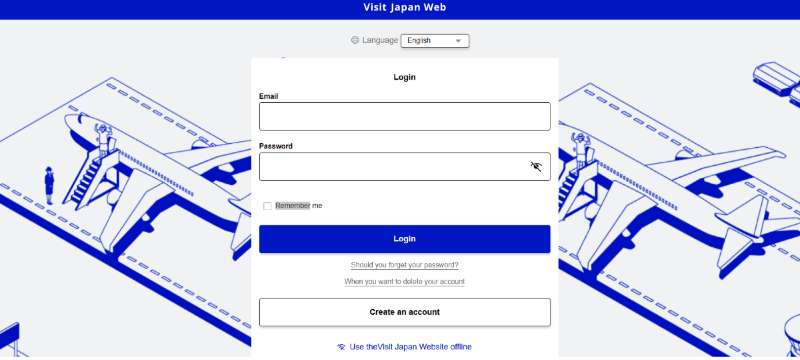
Visit Japan Web is a pre-flight step you should definitely take if you want to breeze through airport entry procedures. It's not mandatory, but in practice, it can make your arrival much smoother.
This is the official Japanese government platform where you can complete your immigration and customs information online before your trip. It serves as a digital alternative to the traditional paper forms you would otherwise fill out on the plane. Paper forms are still available, so you can choose whichever option suits you best. Once you've completed the online process, you'll receive a QR code to present upon arrival.
When should you sign up for Visit Japan Web? As soon as you have your first accommodation confirmed. You'll need to provide an address in Japan, even if it's just for your first hotel.
What's more, the process is quite straightforward:
And that's not all. Everything is stored digitally, so you don't have to worry about keeping track of paper forms or making last-minute mistakes.
While most travellers can enter visa-free, there are certain situations where you'll need to sort out a visa before you set off. For starters, if you're planning to stay longer than the permitted time, that's a whole different scenario. A visa for Japan for stays longer than 90 days is mandatory as soon as you exceed that tourist limit. Japan keeps a pretty close eye on these types of stays, after all.
It's not just a matter of time; it also depends on the type of trip:

For this, you'll definitely need a student visa for Japan. And, of course, it's not just a case of simply applying for it. Usually, you'll first need an acceptance letter from a Japanese school or university, which will then work with you to manage the Certificate of Eligibility (COE)—a key document issued by Japanese immigration.
With that sorted, you're ready to apply for your visa at the consulate. You'll also need to show proof of sufficient funds to cover your stay and, in some cases, submit a study plan.

To work in Japan as a British citizen, you'll need a specific work visa depending on the type of job. Typically, you'll need a Japanese company to sponsor you, as well as a COE, before you can apply for the visa.
💡 The COE in Japan stands for Certificate of Eligibility, and it's a key document if you're planning to live in Japan for more than 90 days.
As part of the requirements for this visa, you'll usually need relevant training for the role, work experience, or a university degree. You can't simply enter as a tourist and look for work once you're there. Here are some of the work visas available for Japan:
If you're planning to stay for more than 90 days and don't fall into the study or work categories, you'll need to provide a solid justification for your visit. A visa for Japan for stays longer than 90 days depends heavily on your specific circumstances, but it always involves prior paperwork and approval from Japan.
If you're travelling to live with family members who are residents in Japan, you'll need a specific dependant or family visa. In this case, the person already living in Japan acts as your sponsor and will usually handle the COE application too. You'll also need to provide official documentation to prove your family relationship.
🎟️ Discover the best things to do in Japan: Explore historic temples, iconic parks, and unique experiences across the country with tours and tickets at the best prices.
✈️ Cheap flights to Japan from £335: Book your flights to Japan now and enjoy the journey

Japan is a very organised country, but it's also quite strict when it comes to entry requirements. Being prepared makes all the difference. To start with, always keep your documentation clear and accessible; it sounds basic, but many travellers get flustered at that very moment. Also, having your bookings well organised helps a lot. You don't need to carry a dossier, but you should know where you're staying and what your itinerary looks like.
And that's not all; there are little details that make everything so much easier:
✈️🏨 Plan your trip to Japan with Trip.com - Book flights + hotels in one go and save on your journey with exclusive deals and flexible options.