Shinkansen Rail Map & Destinations in Japan

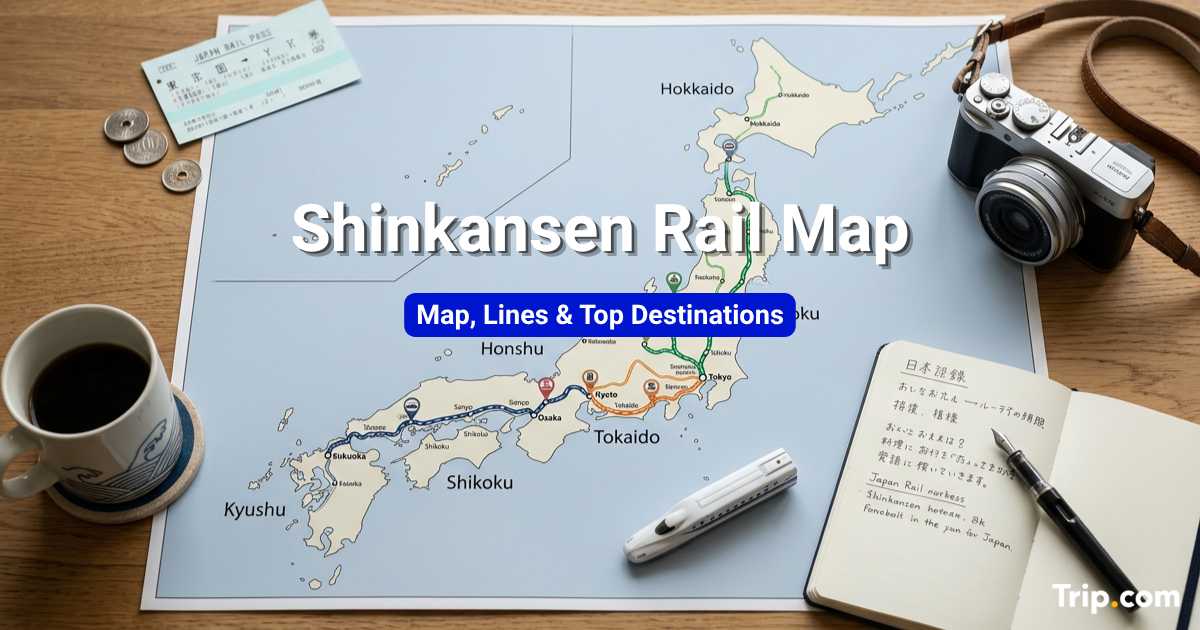
Since its inauguration in 1964 between Tokyo and Osaka, the Shinkansen has never stopped expanding. Today, its network covers over 3,000 km (1,864 mi) of dedicated tracks and connects most of Japan's major cities, from Hokkaido in the north to Kagoshima in the south. But with so many lines, names, and destinations, it can be tricky to get your bearings at first glance. This guide introduces you to each line, its key destinations, and the must-do journeys to help you build your perfect Japan itinerary.
What Is the Shinkansen? Key Facts to Know
The Shinkansen is Japan's high-speed train, first launched in 1964 between Tokyo and Osaka – the very first of its kind in the world. What's truly surprising on board is the punctuality: an average delay of just 54 seconds per year, even including typhoons!
Trains depart to the second, and cleaning crews turn around an entire carriage in just 7 minutes flat. There's no security screening, no luggage check-in (you just hop on, get settled, and hey presto, you've arrived).
For many travellers, the Shinkansen journey remains one of their favourite memories of Japan, even before they've reached their destination.
👇Book Japan Train Tickets with Trip.com👇
Official JR partner · Wide coverage · Easy changes
Shinkansen Rail Map Overview
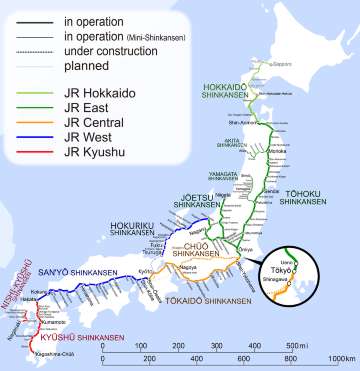
Map source: Wikipedia
The Shinkansen network currently boasts 10 lines in commercial service, including two "mini-Shinkansen" lines that run on converted conventional tracks.
Each line is operated by a regional company within the Japan Railways (JR) group, serving a specific region of the archipelago.
Line | Route | Distance | Max Speed | Operator |
Tōkaidō | Tokyo → Shin-Osaka | 343 miles (552.6 km) | 177 mph (285 km/h) | JR Central |
San'yō | Shin-Osaka → Hakata | 400 miles (644.0 km) | 186 mph (300 km/h) | JR West |
Tōhoku | Tokyo → Shin-Aomori | 443 miles (713.7 km) | 199 mph (320 km/h) | JR East |
Hokkaido | Shin-Aomori → Shin-Hakodate-Hokuto | 92 miles (148.8 km) | 162 mph (260 km/h) | JR Hokkaido |
Jōetsu | Tokyo → Niigata | 207 miles (333.9 km) | 171 mph (275 km/h) | JR East |
Hokuriku | Tokyo → Tsuruga | 358 miles (575.6 km) | 162 mph (260 km/h) | JR East / JR West |
Kyushu | Hakata → Kagoshima-Chūō | 180 miles (288.9 km) | 162 mph (260 km/h) | JR Kyushu |
Nishi-Kyushu | Takeo Onsen → Nagasaki | 43 miles (69.6 km) | 162 mph (260 km/h) | JR Kyushu |
Yamagata* | Fukushima → Shinjō | 92 miles (148.6 km) | 81 mph (130 km/h) | JR East |
Akita* | Morioka → Akita | 79 miles (127.3 km) | 81 mph (130 km/h) | JR East |
*Mini-Shinkansen: these trains run on converted conventional tracks and do not have dedicated lines.
🌐Click for the best eSIM for Japan from just £0.32 🔥
 190057 booked

Tokaido Shinkansen Line: Japan's Busiest Route
The Tōkaidō line is the heart of the Shinkansen network and by far the busiest in the world, with over 150 million passengers every year!
It connects Tokyo to Shin-Osaka, running along the Pacific coast and passing through Yokohama, Nagoya, and Kyoto along the way. This is the line served by the famous Nozomi, Hikari, and Kodama trains (three types of trains with different stops and speeds).
Top destinations
Departure | Destination | Duration | Recommended train | Book |
Tokyo | Nagoya | 1h 33m | Nozomi | |
Tokyo | Kyoto | 2h 15m | Nozomi | |
Tokyo | Osaka (Shin-Osaka) | 2h 22m | Nozomi |
💡 Good to know: the Nozomi is the fastest train, but it isn't covered by the standard Japan Rail Pass. Opt for the Hikari if you're travelling with a pass (it only takes 25 minutes longer for the Tokyo–Kyoto journey).
🏨 Best hotels in Japan: most popular cities
❤️ Top 50 best things to do in Japan
🌐 Best eSIM for Japan from just £0.32


![[Lunch Cruise Ticket Optional] One-Day Tour of Takachiho Gorge in Kyushu, Japan + Kumamoto Aso Volcano and Kusasenri Scenic Area](https://ak-d.tripcdn.com/images/0352112000u46jzwf17DE_C_568_320.jpg)
Sanyo Shinkansen Line: Travel West to Hiroshima
The San'yō Line takes over at Shin-Osaka and heads west to Hakata (Fukuoka), serving Hiroshima, Okayama, and Kobe along the way. It's often used in combination with the Tōkaidō Line, as Nozomi and Sakura trains run direct services from Tokyo all the way to Hakata without the need for a change.
Top destinations
Departure | Destination | Duration | Recommended train | Book |
Tokyo | Hiroshima | 4h | Nozomi | |
Tokyo | Hakata (Fukuoka) | 4h 46m | Nozomi | |
Shin-Osaka | Hiroshima | 1h 30m | Nozomi / Hikari | |
Shin-Osaka | Hakata (Fukuoka) | 2h 21m | Nozomi |
Tohoku Shinkansen Line: Routes to Northern Japan
The Tōhoku line is the longest in the network, boasting 443 miles (713.7 km) of dedicated tracks! It heads north from Tokyo, passing through Sendai and Morioka before reaching Shin-Aomori at the northern tip of Honshu island.
This line is also the fastest, with the Hayabusa train reaching a top speed of 199 mph (320 km/h) here. It serves as the gateway to Hokkaido via the Hokkaido Line, while the Yamagata and Akita mini-Shinkansen lines branch off at Fukushima and Morioka, respectively.
Top destinations
Departure | Destination | Duration | Recommended train | Book |
Tokyo | Sendai | 1h 31m | Hayabusa / Yamabiko | |
Tokyo | Morioka | 2h 10m | Hayabusa | |
Tokyo | Shin-Aomori | 2h 59m | Hayabusa | |
Tokyo | Yamagata* | 2h 22m | Tsubasa (mini-Shinkansen) | |
Tokyo | Akita* | 3h 37m | Komachi (mini-Shinkansen) |
Hokkaido Shinkansen Line: Crossing the Tsugaru Strait
The Hokkaido line extends the Tōhoku line beyond Shin-Aomori, crossing the Seikan undersea tunnel—the longest railway tunnel in the world!
It ends at Shin-Hakodate-Hokuto, the gateway to the island of Hokkaido. The journey from Tokyo to Shin-Hakodate-Hokuto takes 3 hours and 57 minutes, making it one of the most spectacular trips on the Shinkansen network.
Coming soon: the extension to Sapporo
The extension of the line to Sapporo is currently under construction (now expected to open no earlier than fiscal 2038). Once operational, you'll be able to travel from Tokyo to Sapporo in around 5 hours without needing to fly.
Joetsu Shinkansen Line: Tokyo to Niigata
Less well-known to international travellers, the Jōetsu Line connects Tokyo to Niigata (a port city on the Sea of Japan) in just 1 hour and 29 minutes.
It cuts through the Japanese Alps and stops at Takasaki, the junction point for the Hokuriku Line. It's the perfect route for reaching the ski resorts of northern Japan (Yuzawa, Naeba) from Tokyo in under an hour.
Hokuriku Shinkansen Line: Tokyo to Kanazawa and Tsuruga
The Hokuriku Shinkansen line has recently undergone a major expansion with the opening of its Kanazawa–Tsuruga section in March 2024.
It now connects Tokyo to Tsuruga in just 3 hours and 8 minutes, serving Karuizawa, Nagano, Toyama, Kanazawa, and Fukui—a region that remains relatively off the beaten track but is brimming with exceptional cultural and natural treasures.
Top destinations
Departure | Destination | Duration | Recommended train | Book |
Tokyo | Nagano | 1h 22m | Kagayaki / Hakutaka | |
Tokyo | Kanazawa | 2h 27m | Kagayaki | |
Tokyo | Tsuruga | 3h 08m | Tsuruga |
💡 Coming soon: the Tsuruga–Shin-Osaka extension is scheduled for 2046. Once complete, the Hokuriku line will connect Tokyo to Osaka via a new route running through the heart of Japan.
Kyushu Shinkansen Line: Exploring Southern Japan
The Kyushu line connects Hakata (Fukuoka) to Kagoshima-Chūō in just 1 hour 17 minutes, serving Kumamoto and its iconic volcanic landscapes along the way. Thanks to direct Nozomi and Sakura services from Tokyo via the San'yō line, the whole of Kyushu is now accessible from the capital in under 4 hours.
Top destinations
Departure | Destination | Duration | Recommended train | Book |
Hakata (Fukuoka) | Kumamoto | 33m | Sakura / Tsubame | |
Hakata (Fukuoka) | Kagoshima-Chūō | 1h 17m | Mizuho / Sakura | |
Tokyo | Kagoshima-Chūō | ~6h 30m | Nozomi + Sakura |
Nishi-Kyushu Shinkansen Line: Japan's Newest Route
Opened in September 2022, the Nishi-Kyushu line is the newest Shinkansen line in the network. It connects Takeo Onsen to Nagasaki in just 23 minutes, reducing the Hakata–Nagasaki travel time to 1 hour 20 minutes by combining it with a conventional express train.
It's a short but strategic route for travellers looking to discover Nagasaki and the Sasebo region.
Future Shinkansen Lines and Expansion Projects
As briefly mentioned above, the Shinkansen network continues to expand. Here are the major projects currently underway and those on the horizon:
Line | Section | Opening (Estimated) | Travel Time |
Hokkaido | Shin-Hakodate-Hokuto → Sapporo | 2031 or later | Tokyo → Sapporo: ~5 hrs |
Hokuriku | Tsuruga → Shin-Osaka | 2046 | Kanazawa → Shin-Osaka: ~1 hr 20 mins |
Chūō (Maglev) | Shinagawa → Nagoya | 2034 or later | Shinagawa → Nagoya: ~40 mins |
Chūō (Maglev) | Nagoya → Osaka | 2037 | Shinagawa → Osaka: ~1 hr 7 mins |
The most impressive project remains the Linear Chūō Shinkansen, a magnetic levitation (maglev) train capable of reaching 500 km/h (310 mph), which will connect Shinagawa (Tokyo) to Nagoya in just 40 minutes.
Its opening, originally scheduled for 2027, has been pushed back to 2034 at the earliest due to construction challenges in the mountainous terrain.
🏨 Best hotels in Japan: the most popular cities
❤️ Top 50 best things to do in Japan
🌐 Best eSIM for Japan from just £0.32
Most Popular Shinkansen Routes for Travellers
🗾 The classic Tokyo–Kyoto–Osaka route
This is quite simply the ultimate itinerary for a first trip to Japan. Tokyo, Kyoto, and Osaka are home to most of the archipelago's must-see sights (temples, geishas, gastronomy, pop culture, and more). The Tōkaidō line connects these three cities along a single route, with departures every 10 minutes during peak hours.
- Tokyo → Kyoto: 2 hours 15 minutes (Nozomi)
- Kyoto → Osaka: 15 minutes (Shinkansen or local train)
🌸 Tokyo → Hiroshima for a day trip
Thanks to the direct Tōkaidō and San'yō lines, you can reach Hiroshima from Tokyo in just 4 hours. A day trip is perfectly doable—for example, spend the morning in Hiroshima, the afternoon on the island of Miyajima, and head back to Tokyo in the evening.
🍜 Tokyo → Fukuoka (Hakata)
Hakata is the gateway to Kyushu and one of Japan's top foodie destinations (the birthplace of tonkotsu ramen and Hakata-style gyoza).
⛷️ Tokyo → Nagano or Niigata for skiing
Two options under 90 minutes from Tokyo to reach Japan's top ski resorts: Nagano via the Hokuriku Line (Hakuba, Shiga Kogen) and Niigata via the Jōetsu Line (Yuzawa, Naeba). An ideal choice for a snowy weekend getaway.
Book your Shinkansen ticket and begin your exploration of Japan!
What the Shinkansen Network Does Not Cover
Some key regions are still not covered by the Shinkansen network today. This is particularly true for Shikoku (which has no Shinkansen lines at all), the east coast of Kyushu (including Beppu and Miyazaki), and much of northern Hokkaido beyond Shin-Hakodate.
For these destinations, Japan Railways Express or Limited Express trains will take you the rest of the way.
FAQ – Shinkansen Rail Map & Destinations
-
Does the Shinkansen go to Tokyo airports (Narita or Haneda)?
-
Can you travel to Sapporo by Shinkansen?
-
Can you do a Tokyo to Osaka trip in one day with stops?
-
Does the Japan Rail Pass cover all Shinkansen lines?
-
Which is the fastest Shinkansen line?
More Japan Travel Guides
Trending Searches
-
Train Blogs
-
Trains in Europe and Asia
- Best day trips from Liverpool by train
- 16-25 Railcard Discount
- Best day trips from Newcastle
- Getting from Leeds to Southampton
- GWR Delay Repay
- do trains run on bank holidays
- Getting from London to Bristol
- Shenzhen North Railway Station
- how to get to windsor castle from london
- China Fuxing Trains
- train to legoland
- Nanjing South Railway Station
- Shenzhen East Railway Station
- lost railcard
- China Train Classes