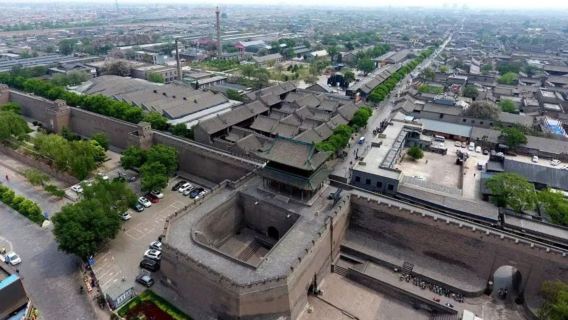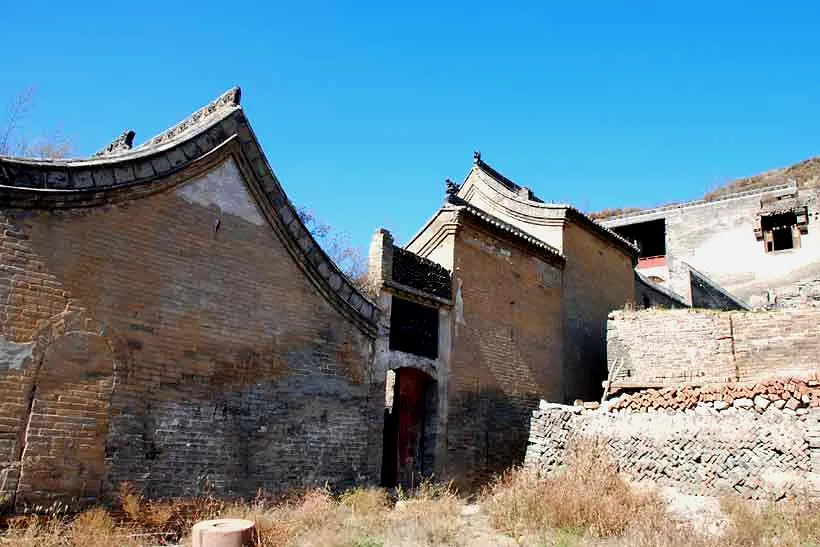
Jiaokou

Things to do in Jiaokou

Search attractions or local attractions & tours
Search

Explore top experiences

Top 10 attractions in Jiaokou

View all Attractions
Guangsheng Temple
No. 3 of Best Things to Do in Linfen

Guangsheng Temple

7.4
4.7/5
2.4k reviews

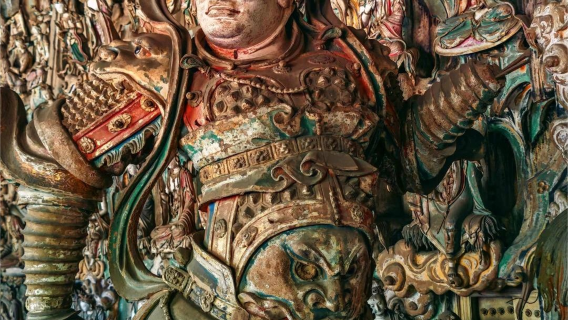
Guangsheng Temple is located at the southern foot of Huo Mountain in Hongtong County, Linfen, Shanxi. It is said to have been initially built during the Eastern Han Dynasty and renamed to its current name in the Tang Dynasty. Despite being repeatedly destroyed by wars, fires, and earthquakes over the centuries, the surviving halls are primarily structures from the Yuan and Ming Dynasties. The attraction consists of the upper temple on the mountain peak, the lower temple at the foot of the mountain, and the Water God Temple, forming a high-low connection that creates a natural upward visiting route. The Feihong Pagoda in the upper temple is the visual center of the entire complex. This octagonal thirteen-story brick pagoda, standing over forty meters tall, is adorned with glazed tiles in yellow, green, blue, white, and other colors from the second floor upwards. Figures of Buddhas, bodhisattvas, celestial beings, coiled dragons, and lion-like beasts protrude from the brick surfaces layer by layer. When sunlight hits it on clear days, the entire structure refracts rainbow-like brilliance, which is said to be the origin of its name "Feihong" (Flying Rainbow). The 1986 TV adaptation of *Journey to the West* filmed the episode where Tang Monk sweeps the pagoda to uncover an injustice here. In the 1930s, Liang Sicheng and Lin Huiyin also highly praised the quality and craftsmanship of the pagoda's glazed decorations during their survey. Behind the pagoda, a row of dark red sutra cabinets still stands in the Amitabha Hall, where the Buddhist canon "Zhaocheng Golden Tripitaka" was once stored. This engraved Tripitaka from the Jin Dynasty lay forgotten for centuries until its rediscovery in 1933. During the Anti-Japanese War, to prevent it from falling into Japanese hands, local soldiers and civilians risked their lives to transport it overnight. Now housed in the National Library of China, it is regarded as one of the library's most treasured collections. The sutra cabinets remain in the hall, and this legendary tale is worth pausing to hear. The Water God Temple at the foot of the mountain, the Mingying Wang Hall, is adjacent to the Huo Spring outlet. Its walls are adorned with over ten Yuan Dynasty murals centered around themes of praying for rain, rainfall, and giving thanks to deities. These murals depict water god worship and urban life rather than the typical Buddhist or Taoist subjects found in ordinary temples. The eastern section of the southern wall features "The grand performance troupe Zhongduxiu performing here," showcasing over ten actors and musicians representing various role types (sheng, dan, jing, mo, chou) on the same stage. This is a precious image for studying Yuan Dynasty zaju performances and, along with "The ball-hitting game," has been included in history textbooks. The adjacent Great Buddha Hall of the Lower Temple is a Yuan Dynasty wooden structure. Its original large-scale murals were stripped and sold overseas in the late 1920s, with the famous "Illustration of the Bhaisajyaguru Sutra" now housed at the Metropolitan Museum of Art in New York. To appreciate Yuan Dynasty murals, focus your attention on the Water God Temple. A bottom-up route is recommended: first visit the water god temple and lower monastery, then ascend via stone steps or the mountain road to see the Feihong pagoda at the summit. The glazed colors appear especially vibrant on sunny days, making it easier to capture great photos.

Hongtong · 94.4km from Jiaokou
Guanque Tower
No. 3 of Family-friendly Attractions in Shanxi

Guanque Tower

7.5
4.5/5
5k reviews

A national AAAA-level tourist attraction and one of the top ten attractions in Shanxi Province, Guanque Tower is located on the eastern bank of the Yellow River west of Puzhou Ancient City in Yongji, Shanxi. Alongside the Yellow Crane Tower in Wuhan, Hubei; Yueyang Tower in Yueyang, Hunan; and Tengwang Pavilion in Nanchang, Jiangxi, it is renowned as one of China's four great historical and cultural towers. Originally built during the Northern Zhou Dynasty (557–571 AD) by military commander Yuwen Hu as a defensive watchtower, the tower earned its name from the storks that frequently perched on its structure. The Tang Dynasty poet Wang Zhihuan's celebrated poem "On the Stork Tower" ("The sun along the mountain bows; The Yellow River seawards flows. You will enjoy a grander sight; If you climb to a greater height.") has become an enduring masterpiece, widely known both domestically and internationally. After standing for over 700 years through the Tang and Song dynasties, the tower was destroyed during warfare in the early Yuan Dynasty (1222 AD). The reconstructed Guanque Tower follows Tang-style architecture, featuring four eaves externally with three visible tiers, while internally comprising six floors. With a total height of 73.9m, it epitomizes the grandeur of the Tang era. Ascending Guanque Tower not only offers breathtaking panoramic views but also immerses visitors in the brilliance of China's 5,000-year civilization.

China · Yongji
Baota Mountain
No. 19 of Best Things to Do in Shaanxi

Baota Mountain

7.4
4.5/5
5.1k reviews

Baota Mountain is located in the center of Yan'an city, by the side of the Yan River, and is named after the pagoda on the mountain. The pagoda was first built in the Tang Dynasty, and the existing structure is a pavilion-style brick pagoda rebuilt in the Ming Dynasty. The pagoda, together with the mountain, the Yan River, and the bridge, forms the city skyline of Yan'an and is also a symbol of the revolutionary holy land in people's hearts. The poet He Jingzhi wrote in "Returning to Yan'an" the famous line, "How many times in my dreams have I returned to Yan'an, embracing Baota Mountain with both hands," adding emotional weight to this mountain. The mountain is densely scattered with historical sites, including Song dynasty cliff carvings, Fan Gong Well, beacon towers, Star-gazing Tower, Jialing Academy, ancient city walls, and the former site of the Japanese Workers' and Peasants' School. Among them, the inscriptions "Jialing Mountain" in clerical script and "My chest harbors tens of thousands of armored soldiers" by Fan Zhongyan of the Northern Song dynasty have long been renowned. An iron bell cast in the Ming dynasty still hangs beside the pagoda, which was used for timekeeping and alarms during the CPC Central Committee's Yan'an period. Ascending the mountain path to Star-gazing Tower and beacon tower areas offers panoramic views of Yan'an city and the Yan River. After nightfall, the mountain and pagoda illuminate, and gazing back at the lit pagoda from near Yan River Bridge remains a favorite photo spot for many travelers.

China · Yan'an
Donghu Vinegar Garden
No. 4 of Family-friendly Attractions in Shanxi

Donghu Vinegar Garden

7.3
4.9/5
1.3k reviews

Explore Donghu Vinegar Garden and discover the history of vinegar brewing in Shanxi. As a national AAAA-level tourist attraction, a national industrial tourism demonstration base, and a provincial research and practice education demonstration base for primary and secondary schools, Donghu Vinegar Garden covers a total construction area of approximately 16,667 square meters. Rooted in Shanxi's long-standing Yellow River farming culture, it preserves and innovates the history of the "Meiheju" vinegar workshop founded during the Hongwu period of the Ming Dynasty, the national intangible cultural heritage "Meiheju" aged vinegar brewing technique, and Shanxi's vinegar history and culture. Based on the ancient brewing process of "steaming, fermenting, smoking, filtering, and aging," it truly embodies "inheriting traditional craftsmanship and realizing a health-oriented philosophy." Since its opening in 2000, Donghu Vinegar Garden has launched distinctive "intangible cultural heritage" vinegar culture study tours, offered Shanxi aged vinegar DIY courses, added "intangible cultural heritage" vinegar-making experience programs, and developed traditional Shanxi vinegar-themed banquets. It has welcomed over 5 million visitors from home and abroad, with annual visits by minors exceeding 30,000, making it a highlight for promoting traditional Chinese agricultural culture and vinegar culture in China's condiment industry. The garden features twelve specialized exhibition halls including "Donghu Meiheju Development History Museum," "Vinegar Therapy Garden," "Vinegar Museum," "Vinegar Cellar," and "Craft Brewing Workshop," each displaying agricultural tools and vinegar-making equipment from different historical periods. Donghu Vinegar Garden showcases the unique charm of "National Intangible Cultural Heritage - Traditional Vinegar Brewing Techniques" to visitors from around the world through displays of ancient and modern utensils, vinegar product exhibitions, and hands-on experiences of intangible cultural heritage vinegar-making techniques. It opens a time tunnel for people to understand Shanxi's vinegar culture, deeply experience the intangible heritage vinegar-making process, and recognize the health benefits of Shanxi aged vinegar. Visitors can not only explore the profound history of Shanxi vinegar culture, breathe in the rich aroma of Donghu vinegar, enjoy a "Donghu vinegar sauna," and taste authentic Donghu aged vinegar, but also deeply engage with the national intangible cultural heritage of traditional vinegar brewing techniques. Visitors can also sample various vinegar-infused specialties like vinegar-soaked beans and vinegar snacks, as well as traditional Shanxi vinegar banquets, gaining a deeper understanding of Shanxi aged vinegar. Over its 20+ years of operation, Donghu Vinegar Garden has earned honors such as the "Certificate of Origin Registration," "National Silver Quality Award," and inclusion in China's "Intangible Cultural Heritage" protection list. It is highly revered by domestic and international biology experts as the "Living Fossil of Chinese Grain Vinegar Brewing" and the "Finest Vinegar in China." Praised by Europeans and Americans as the "Secret of China" and by Japanese merchants as the "Chinese Mystique," it has evolved into an immersive vinegar experience center integrating production, tourism, dining, and research, becoming a cultural landmark of Shanxi with distinct ethnic charm.

China · Taiyuan
The Luoyang Museum of Ancient Tombs
No. 18 of Best Things to Do in Henan

The Luoyang Museum of Ancient Tombs

7.3
4.7/5
1.2k reviews

The Luoyang Museum of Ancient Tombs is the first museum of ancient tombs in the world. The museum is divided into three major exhibition areas: the tomb area of successive dynasties, the imperial tombs of the Northern Wei dynasty, and the Henan mural gallery. It houses dozens of tomb chambers from various periods of ancient China, all simulated and restored based on their original sites, and displayed in the underground exhibition area according to tomb structure. Visitors can closely observe and understand the internal environment of ancient tombs from multiple perspectives, including tomb chamber architecture, unearthed artifacts, tomb murals, brick carving art, and cultural relics. Burial areas of successive dynasties The burial areas of successive dynasties are located in the eastern part of the museum, divided into above-ground and underground sections, and are a highly distinctive part of the museum that attracts many visitors. The above-ground structure is a group of Han-style buildings, housing exhibition rooms such as the "typical tomb models of the Xia, Shang, and Zhou dynasties" and the "sculpture group of the Han dynasty imperial funeral procession." The underground section features the relocated and restored 25 representative tombs from the Luoyang area, dating from the Western Han dynasty to the Song and Jin periods, with a total of several hundred artifacts on display, as well as a large quantity of murals. The various restored tombs (chambers) in the underground section were all relocated as a whole. The bricks and stones in the tombs were numbered on site by archaeologists before being dismantled, and then reassembled here one by one in their original form. Each tomb chamber is not far from the others, connected by passageways. You can walk through the passages, passing before the tomb chambers of different eras. These chambers, in all their varied forms and distinct architectural styles, reflect one aspect of ancient Chinese architectural art. The tomb chamber also displays replicas of many unearthed artifacts, such as pottery figurines and household vessels from the Northern Wei dynasty, and Tang dynasty sancai ceramics. The tomb chamber also contains epitaphs from the Western Jin, Northern Wei, Tang, and Song dynasties, as well as a rich variety of murals, such as the demon-beating scene, the woman opening the door, and the ascension to immortality, which can be regarded as treasures of ancient painting art. Imperial tombs of the Northern Wei dynasty Located in the western part of The Luoyang Museum of Ancient Tombs. This exhibition area is centered on the "Luoyang Museum of Ancient Tombs - Jingling" of Emperor Xuanwu of Northern Wei, Emperor Shizong, and consists of the relocated and restored tombs of Yuan Xing, Prince Wenxian of Qinghe, and Yuan Cha, Prince of Jiangyang. The burial mound of Luoyang Museum of Ancient Tombs - Jingling is circular, with a rammed earth mound over 20 m high. Visitors can walk down along the passage all the way to the center of the tomb chamber, where a coffin is placed, and there is nothing inside the coffin. The ceiling of Yuan Yi's tomb chamber is painted with an astronomical chart, which contains more than 300 stars. This chart is about 400 years earlier than the "Dunhuang Star Chart" and is precious physical material for the study of ancient Chinese astronomy. Mural gallery The Henan Mural Museum displays authentic tomb murals from multiple dynasties, including the Western Han, Eastern Han, Wei and Jin, Tang and Song, and Jin and Yuan. These murals feature clear images and a wide range of subjects, covering astronomy, geography, human affairs, and deities. The owners of the mural tombs range from emperors, concubines, and high-ranking officials to local minor officials and ordinary commoners.

China · Luoyang

Experiences you can't miss in Jiaokou

Featured Culture & history in Jiaokou

View all Culture & history

Jinzhong Jinyaoji ancient-style costume experience (multi-dynasty costume rental + ancient-style makeup and styling experience)
󱌍
FromBRL 96.02
Half-Day Tour of Pingyao Ancient City (English Guide)
󱌍
Duration: 5.5 hrs
English
Free cancellation
Instant confirmation
Book now for today
FromBRL 694.36
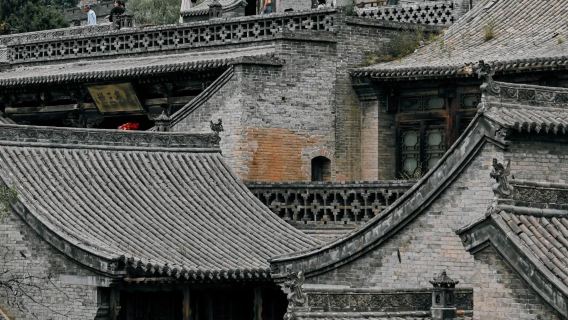
WANG JIA DA YUAN and Zhang Bi Ancient Fortress private tour (departing from Taiyuan)
󱌍
Duration: 3.5 hrs
English
Free cancellation
Instant confirmation
FromBRL 487.96
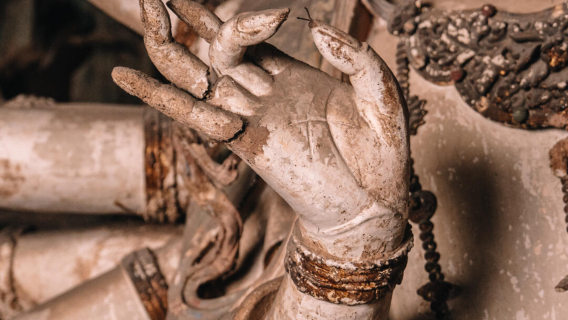
Shuanglin Temple, Wang Family Compound & Pingyao Ancient City Pingyao Private Day Tour
󱌍
Duration: 9.5 hrs
English
Free cancellation
Instant confirmation
FromBRL 687.04
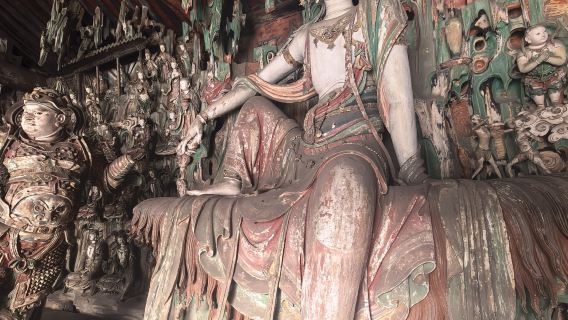
From Taiyuan: One-Day Trip to Pingyao Ancient City and Shuanglin Temple and Zhenguo Temple
󱌍
Duration: 13.5 hrs
English
Free cancellation
Instant confirmation
FromBRL 694.36

Pingyao Ancient City 1-day tour
󱌍
Duration: 5 hrs
English
Free cancellation
Instant confirmation
Book now for tomorrow
FromBRL 793.56
From Taiyuan: One-Day Trip to Pingyao Ancient City and Shuanglin Temple
󱌍
Duration: 11.5 hrs
English
Free cancellation
Instant confirmation
FromBRL 644.76
Jiaokou Today's weatherClear -6-0℃
Jiaokou weather for the next 2 days11/20: -6-3℃, 11/21: -5-6℃

Free things to do in Jiaokou

What travellers say about Jiaokou

user-avatar
M11***6314 November 2026
5.0
I was quite disappointed with Pingyao Ancient City, but on the way to the high-speed rail station, I decided to visit Shuanglin Temple instead. Shuanglin Temple finally offered some consolation for my otherwise disappointing trip to Pingyao; the painted sculptures were truly breathtaking.

Shuanglin Temple

user-avatar
賢賢君25 October 2026
5.0
Teacher Zhou's professional explanations, both in detail and easy to understand, helped us understand the history of Baima Temple and its related Buddhist culture. It was a pity that two halls were under renovation, which we could only consider a minor disappointment, but it will serve as motivation for our next visit.

White Horse Temple

user-avatar
行走毛毛9 November 2026
4.0
One ancient building you absolutely must visit when you come to Linfen is Guangsheng Temple. It's truly stunning. From the pagoda to the murals and clay sculptures, it represents the pinnacle of ancient architecture in Linfen.

Guangsheng Temple

user-avatar
楚云霁月21 August 2026
4.0
The old town was rather deserted. The art exhibition was quite nice, though a bit over the top. But the park at the exit was absolutely gorgeous. Winding paths led to secluded spots, and unexpected beauty unfolded.

Taiyuan Ancient County

user-avatar
月万14 November 2026
4.0
A day trip to Yongji, visiting Pujiu Temple and Stork Tower, is a poetic and culturally rich journey along the Yellow River, perfect for families with seniors and children! Start by visiting Pujiu Temple, the original setting of the classic Chinese novel *The Romance of the Western Chamber*. Ancient courtyards with red walls are nestled on the plateau, with pear blossoms in the deep courtyard and the west wing corresponding to scenes from the book. Telling children the story of Zhang Sheng, Yingying, and Hongniang is a lively and engaging experience. The most amazing feature is Yingying Tower, one of the four great echoing structures; tapping the stone produces an echo like the croaking of frogs, a fascinating sight for children. The temple grounds are gently sloping, allowing for a tranquil and elegant atmosphere. Afterwards, head to Stork Tower, the actual location of the poem by Wang Zhihuan from textbooks. An elevator takes you directly to the top floor, making it easy for seniors to climb. Standing atop the tower, gazing at the winding Yellow River, you truly understand the meaning of "The sun sets beyond the mountains, the Yellow River flows into the sea; to see a thousand miles further, climb one more story," bringing the ancient poem from the textbook to life. The exhibition hall inside the building depicts historical scenes from Hedong, and a leisurely stroll through it is quite rewarding. The two attractions are not far apart, a combined ticket is cost-effective, and the facilities are well-developed. One side tells the romantic legend of the West Chamber, while the other presents the timeless masterpiece of the Yellow River. One is gentle, the other grand; both offer stories and landscapes, making it an educational and entertaining experience, well worth bringing children to experience Hedong culture.

Guanque Tower

user-avatar
Grant Pigeon9 November 2026
5.0
This park needs to be part of your itinerary when you plan a visit to luoyang as it gives you a good understanding of how the old city was constructed and gives you a feeling that you are back in ancient China..the show they perform here is a good way to round off the evening as I would highly recommend adding this to your itennary.o would suggest to at least give 4 hours if you are planning to attend the show as the park is wast

Sui and Tang Luoyang City National Heritage Park

user-avatar
夜阑月色溶溶7 October 2026
5.0
Because we had children with us, we opted to take the sightseeing bus up and down, which was very relaxing. We got a close look at the pagoda, took photos, and learned about its history, especially the plaques at the north and south gates: "Soaring high above the heavens, overlooking the mortal world"—for over 1000 years, the pagoda has achieved this.

Baota Mountain

user-avatar
Soh Kien Peng23 September 2026
5.0
From Yuntaishan, we boarded a bus bound for Luoyang. The journey was long — more than four hours on the road. We left at 2:30 pm and only arrived close to 7:00 pm, which meant our first day in Luoyang was largely consumed by travel. That evening, drained from the ride, I managed only a brief visit to Yingtianmen, illuminated against the night sky.The following day was devoted entirely to two of Luoyang’s most iconic sites: the Longmen Grottoes and the White Horse Temple. After exploring the temple, we caught bus no. 58 directly to Luoyi Ancient City. By then, the hours of walking through grottoes and temple grounds had left us physically exhausted. Still, the ancient city welcomed us with free admission and a promise of cultural immersion.Dinner was taken at a basement food court along Minzhu Street. By the time we finished, night had fallen, and Luoyi Ancient City had transformed. The streets glittered with lanterns, music pulsed through the air, and the atmosphere was electric. Crowds gathered near the lake to watch 天女散花 — the “Fairy Scattering Flowers” dance performance — though we chose not to linger.Luoyi Ancient City (洛邑古城) remains one of China’s most authentic living historic districts. Here, 3,000 years of dynastic history — from the Zhou to the Ming — can still be felt in its preserved city walls, pagodas, canals, and performances. It is not simply a relic of the past, but a vibrant cultural stage where history and daily life coexist.

Luoyi Ancient City

user-avatar
数羊小狗6 November 2026
5.0
Visiting Donghu Vinegar Garden in Taiyuan 🍶, you'll be enveloped in the lingering aroma of vinegar. As a traditional vinegar workshop with over 600 years of history, a non-material cultural heritage, you can witness firsthand the ancient brewing process of "steaming, fermenting, smoking, leaching, and aging." Rows of densely packed vinegar vats stand quietly, slowly accumulating amber-colored aged vinegar through summer sun-drying and winter ice-harvesting. Stepping into the fermentation workshop, a strong, sour aroma fills the air. Enjoy free tastings of vinegars from different years—sour, mellow, sweet, and with a long-lasting aftertaste. Every drop of vinegar embodies the dedication of generations of Shanxi artisans, allowing you to understand the vinegar culture ingrained in the very bones of this land.

Donghu Vinegar Garden

user-avatar
Anonymous user30 October 2026
5.0
Quite an interesting and special museum to visit. I have learned lot of “knowledge” related to the ancient tombs during the 2 hours tour with the guide.

The Luoyang Museum of Ancient Tombs

Trip Moments in Jiaokou

Popular cities near Jiaokou

Frequently asked questions

How can I contact Trip.com customer support?

Get help anytime, anywhere within 30 secondsContact customer support

Change and cancellation policies vary by attractions and tours. Please check the product details page for more information.

Ticket prices may vary between weekdays and weekends, as well as during peak and off-peak seasons. When booking with Trip.com, you can also use Trip Coins to get extra savings. For more tips on booking discounted tickets, please visit Trip.com for the latest information.