Vietnam Arrival Card 2026: How to Fill It In & Entry Tips

With its 102.3 million inhabitants, Vietnam has transformed from a hidden gem into a true holiday hotspot in recent years. Since the Covid pandemic, visitor numbers have only been heading in one direction: up. In 2023, Vietnam welcomed 12.6 million tourists. Last year, in 2025, that figure had already reached 21.2 million.
However, things can quickly get quite confusing for foreign visitors to Vietnam. Alongside the Arrival Card, officially known as Pre-Arrival Information (PAI), the terms NA1 and e-Visa often crop up. Find out what all of this means and what applies to foreign visitors right here at Trip.com.
What is the Vietnam Arrival Card (PAI)?
The Vietnam Arrival Card is a very new "entry registration" that must be applied for by visitors BEFORE they enter Vietnam. Since 15 April 2026, it has only been available in a digital version, i.e., as an online arrival card. Its official name is Pre-Arrival Information, and it is issued by the Vietnamese immigration authority.
Entering the country with a PAI applied for online is possible at all major airports in Vietnam, such as Noi Bai International Airport in Hanoi or Tan Son Nhat International Airport in Ho Chi Minh City. It is practical that Vietnam follows the same path as most other Asian countries with its arrival card for travelling families. However, each traveller must submit an individual PAI and receive their own unique QR code.
Finally, we have clearly summarised all the important points regarding the Vietnam Arrival Card for you:
Mandatory to fill out electronically since: | 15 April 2026 |
Who needs to fill it out? | All foreigners except those in transit, i.e. those staying in transit zones |
When does it need to be filled out? | Within three days BEFORE arriving in Vietnam |
How do you fill it out? | Electronically online via the Vietnamese immigration authority website |
How much does the Arrival Card cost? | It is free of charge, meaning visitors are not billed any fees |
Will I receive a confirmation? | After successfully completing the Arrival Card, you will receive a confirmation by email including a QR code |
IMPORTANT: The QR code must be presented upon entry. You should therefore make sure you have it ready to hand, for example by taking a screenshot.
Hanoi
Ho Chi Minh City
Da Nang
Nha Trang
Phu Quoc
See all flights


Vietnam Arrival Card vs e-Visa: what is the difference?
Basically, the Vietnam Arrival Card PAI is NOT a visa. This means that with a pre-arrival card applied for online, you can only stay in Vietnam for a specific number of days (45) and therefore for a limited (short) period. On the other hand, there is the e-Visa, and with it, this period is even doubled. We will now clarify all the differences between the two for you with the help of an overview:
Vietnam Pre-Arrival Information | Vietnam e-Visa |
✅ A PAI is free | ❌ The e-Visa costs 25 US dollars (approx. £17.00) for a single entry and 50 US dollars (approx. £34.00) for multiple entries |
❌ Allows visa-free entry for up to 45 days | ✅ Valid for 90 days |
✅ Notification is sent immediately after application via email, including a QR code | ❌ Application processing can take between 3 and up to 5 working days |
✅ Required by all visitors formally entering Vietnam | ❌ Only required by tourists who wish to stay in Vietnam for longer than 45 days (up to a maximum of 90 days) |
🤨 Has the electronic Vietnam Arrival Card replaced the NA1?
The short and simple answer to this question is: No, the PAI has not replaced the NA1 form. Rather, they are two completely different documents. The electronic entry card must be completed by all foreigners entering Vietnam before arrival.
The NA1, on the other hand, is a form used to apply for a visa in Vietnam. It has been issued by the Vietnamese Ministry of Public Security since 5 January 2015. The NA1 can be used to apply for a so-called Visa On Arrival. Furthermore, the NA1 is only available in paper form, whereas the PAI is an online form.
🧐 I have a Vietnam e-Visa: Do I still need a PAI?
Yes, because the requirements of the Vietnamese authorities on this matter are crystal clear. A Vietnam Arrival Card must be created and presented. This applies to all foreigners entering Vietnam, without exception. Unlike other countries, Vietnam makes no distinction on this point.
CAUTION: A PAI is always required. This also applies if you have obtained an (e-)visa for Vietnam using an NA1!
💻 In what format is the Vietnam Arrival Card completed?
The Pre-Arrival Information is available exclusively digitally, i.e. online. We would like to emphasise that this is a new entry preparation system. It has only been in use since 15 April 2026 and was initially introduced on a limited basis at Tan Son Nhat International Airport in Ho Chi Minh City. Gradually, other airports were added.
It is also worth knowing that the application for a PAI can only be completed on the Vietnamese immigration authority's website. There is no app, which is why you must use the form on this website even when filling it out on your smartphone, and we will explain how the whole process works next.
💷 How much does the Vietnam Arrival Card cost?
The Vietnam Arrival Card is free of charge and you do not need to make a payment at any point during the application process. You will therefore not be asked to make a payment either during or after completing the filling-out process. However, this only applies to the PAI, as the e-Visa is subject to a fee.
See all attractions
 261029 booked




Who needs a Vietnam Arrival Card?
In principle, all foreign visitors to Vietnam must complete a pre-arrival information form. This regulation therefore also applies to British travellers to Vietnam. Vietnam exempts its own citizens from this regulation. You can find out more about the exceptions in the next section.
☝️ What exemptions apply to the Vietnam Pre-Arrival Information?
The list of exceptions is quite short, as only Vietnamese citizens do not need to complete a PAI before entering the country. For foreigners, there is only one single exception. If you have a layover in Vietnam AND do NOT leave the transit area, then you do not need a PAI.
❗️ What information do British citizens need to provide when applying for a PAI?
First of all, we would like to emphasise that the application for a Vietnam Arrival Card is a standard form. This means that you only need to provide the details that are usual for such forms. These include, among others, the following:
- ✅ Your travel details (the expected date of arrival), method of travel, reason for travel, etc.
- ✅ Your passport, as you can take a photo and upload it or enter the details yourself
- ✅ Your personal details such as date of birth, citizenship, passport number, etc.
- ✅ Your email address and phone number



📋 How to complete the Vietnam Arrival Card online: A step-by-step guide by Trip.com
You can obtain your Vietnam Arrival Card by completing the corresponding application on the Vietnamese immigration authority's website. This essentially consists of 2 pages, and you will need to provide some details yourself, select others from the given options, and you can also take a photo of your passport.
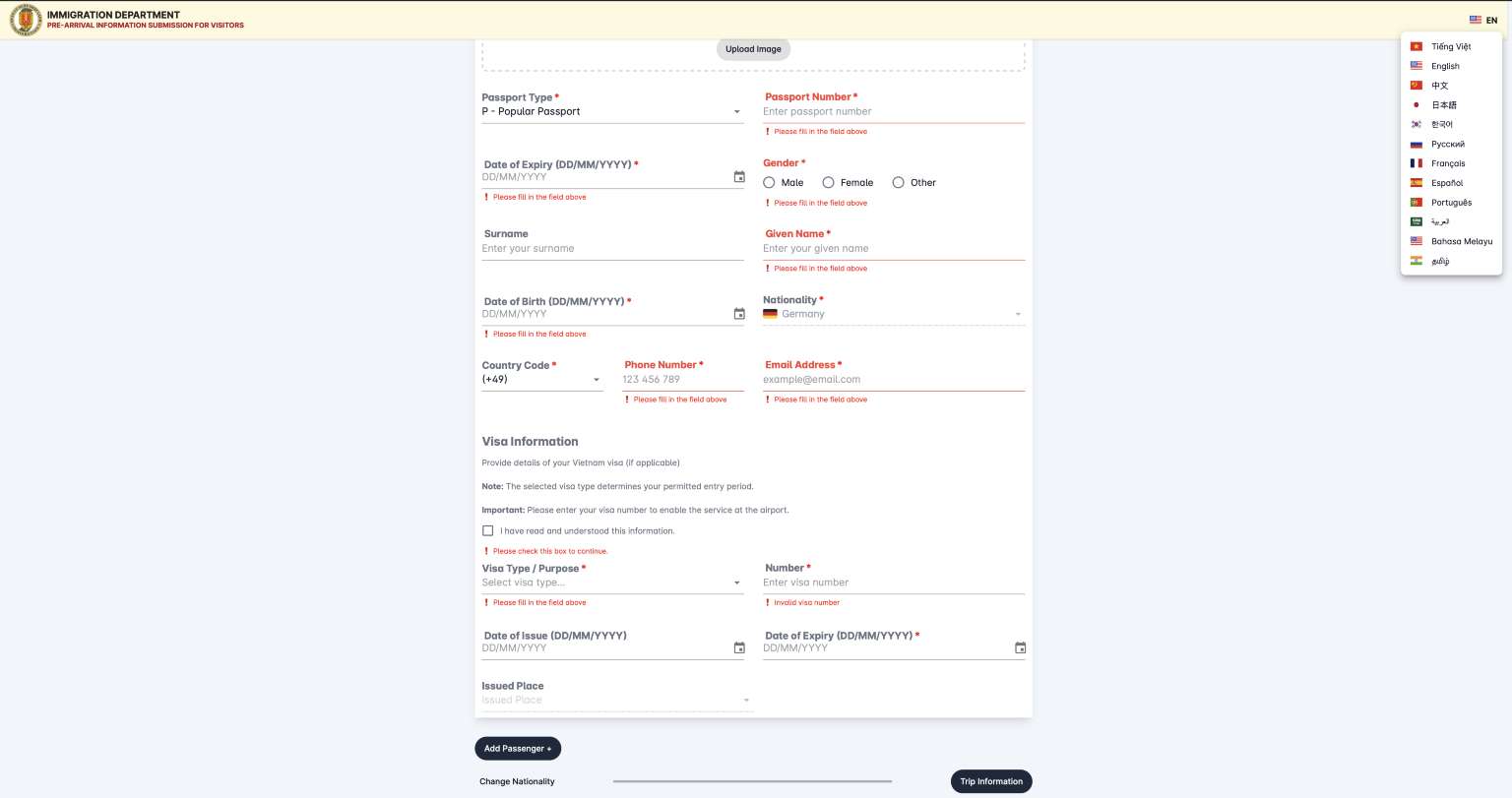
We’ll explain exactly what this all looks like in a step-by-step guide:
- Step 1: Open the official website of the Vietnamese immigration authority to create your Vietnam Arrival Card PAI
- Step 2: Click on the blue button in the middle of your screen labelled “Create & Submit Pre-Arrival Information”
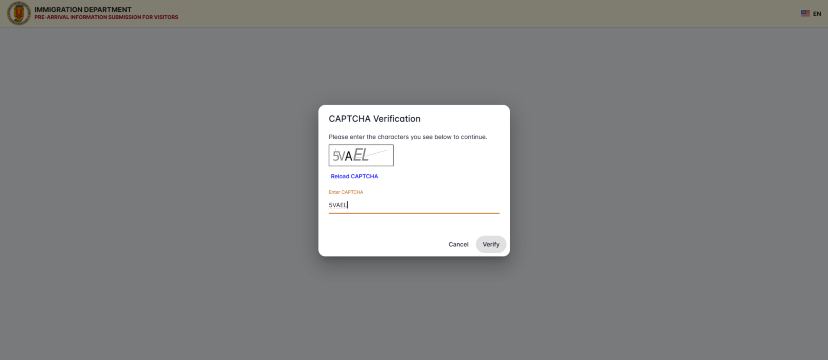
- Step 3: Next, enter the numbers and letters to complete the CAPTCHA (pay attention to upper and lower case)
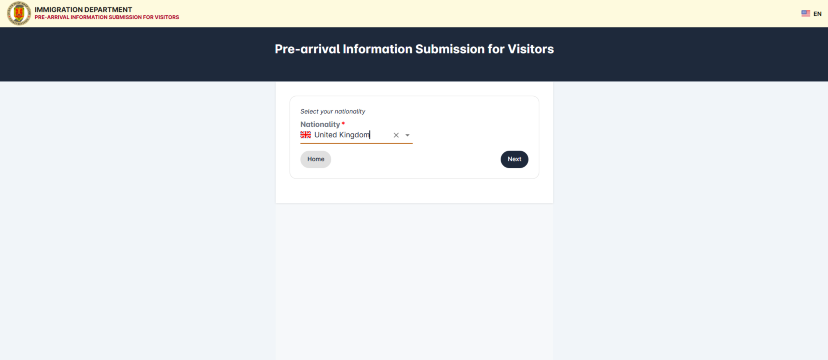
- Step 4: Select your nationality (e.g. United Kingdom, United States etc.)
- Step 5: Now start filling in the first page with the requested details. A particularly handy feature is the ability to upload a photo of your passport
- Step 6: Repeat step 5 on the 2nd page. This time, however, it’s about your travel details, including your travel plans, and confirm all the information you’ve provided in the next window
- Step 7: Now you will receive an email with a six-digit code. Enter this code on the website. A downloadable file containing your QR code will then be created.
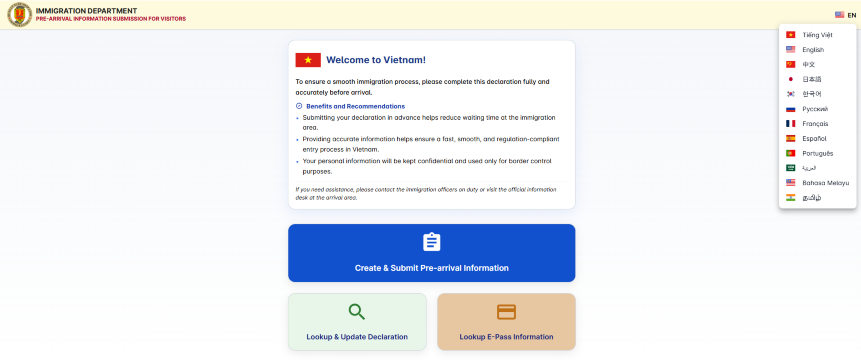
IMPORTANT: You can subsequently change the details you provided during the application process on the Vietnamese immigration authority's website. To do this, click on “Lookup & Update Declaration” at the bottom left. It is also very important that the application is completed within 3 days BEFORE arrival and that the QR code is therefore generated before arriving at the counter.
Hanoi
Ho Chi Minh City
Da Nang
Nha Trang
Phu Quoc
See all flights
📋 How to complete the Vietnam Arrival Card on a mobile device: A step-by-step guide by Trip.com
Since, unlike in the case of the Singapore Arrival Card, there is no app for Vietnam, you must also use the website of the Vietnamese immigration authorities on your smartphone or tablet. This means that regardless of whether you have an iOS or Android device, you always proceed as follows:
- Step 1: Load the Vietnamese immigration authority website by opening it with any browser app, such as Chrome or Safari
- Step 2: Next, tap “Create & Submit Pre-Arrival Information”
- Step 3: Continue by entering the CAPTCHA numbers and letters and selecting your nationality
- Step 4: Now, as described above, fill in the two pages required to create the PAI with your personal and travel details
- Step 5: Confirm your details again and you will receive the email with the six-digit code
- Step 6: Enter the code into the field on the website and download your confirmation with the QR code to your smartphone or tablet. You can also take a screenshot directly
Hanoi
Ho Chi Minh City
Da Nang
Nha Trang
Phu Quoc
See All Hotels









































When does the pre-arrival information QR code need to be created?
The 3-day time limit that applies to many Asian countries, such as South Korea, also applies to creating your Vietnam Arrival Card. This means that you can create your Pre-Arrival Information AT THE EARLIEST 3 days BEFORE your arrival. A practical feature here is that the currently available time window is displayed right at the top of the first page of the application. You therefore only need to select one of the 3 possible expected arrival days with a click.
🛃 Can I also complete my Vietnam Arrival Card shortly after arriving at a Vietnamese airport?
The Vietnamese immigration authority stipulates that the QR code must be presented to an immigration officer and that the PAI can be applied for no earlier than three days before arrival. Conversely, this means that you can actually complete your Vietnam Arrival Card at the last minute, i.e., on the way from the gate to reaching a Vietnamese immigration counter.
You will even find QR codes at many Vietnamese airports that you can simply scan with your smartphone or tablet. These QR codes take you directly to the website where the PAI is created. However, this is not a good idea, as it means you will waste unnecessary time at the airport.
Vietnam entry requirements for British citizens
In addition to the pre-arrival information, there are other standard regulations, such as the requirement to present a valid passport, which British citizens must observe. You can find information on the current entry requirements for British citizens on the Foreign, Commonwealth & Development Office (FCDO) website. At present (October 2026), the following points are listed there:
- British citizens require a passport (must be valid for at least six months from the date of entry)
- You can also enter the country with a temporary passport
- Tourists must be able to identify themselves at all times in Vietnam with their passport, including the entry stamp
- British citizens can stay in Vietnam for up to 45 days without a visa
- The e-visa allows British citizens to extend their stay for up to 90 days
Vietnam travel tips for your trip
To wrap up our Vietnam Arrival Card PAI guide, we’ve put together a few more tips and useful pieces of information for you:
- You should always have some cash on you, especially if you're exploring Vietnam's street food scene.
- Vietnam is known for its hot days and, depending on the region, high humidity. Sun protection and drinking plenty of water are therefore a must.
- Vaping and vaping products are banned in Vietnam, and this also applies to their import.
- Make sure you don't exceed your permitted length of stay. Penalties for so-called overstays were significantly increased by the Vietnamese government on 15 December 2025.
See all attractions








FAQ – Vietnam Arrival Card
-
Is the Vietnam Arrival Card free?
-
How long can I stay in Vietnam with the Pre-Arrival Information (PAI)?
-
Can I complete the Vietnam Arrival Card after I land?
-
What do I need to do at Vietnam immigration?
-
Do UK travellers need to complete the Vietnam Arrival Card?
More travel guides
Vietnam entry requirements for UK travellers: What visa or documents do you need?
Check Vietnam entry requirements, including visa rules, required documents, health regulations, and stay limits for UK and international travellers.
October 15, 2026
How to Get from Ho Chi Minh City Airport to City Center
Explore all transport options from Ho Chi Minh Airport to the city center, including buses, taxis, Grab, private transfers, car rentals, and travel tips.
October 15, 2026
Top Things to do in Vietnam: Best Activities & Must-Sees
Discover what to do in Vietnam: top activities, must-see sights, local culture and neighbourhoods to make the most of your trip.
October 15, 2026
Best eSIM for Vietnam from £0.43
Find the best Vietnam eSIM options for tourists. Compare prices, data plans, and coverage to stay connected with high-speed 4G/5G during your Vietnam trip.
October 15, 2026
Disclaimer: This article has been provided by an individual contributor or third party platform. If there is any discrepancy regarding the copyright, please contact us directly and we will delete the content immediately.
Trending Searches
-
Travel guides