 261939 booked



Hotels: Save up to 10% (Book online or on Mobile)
Homes & Apts: Save up to £39 (App-only deal)

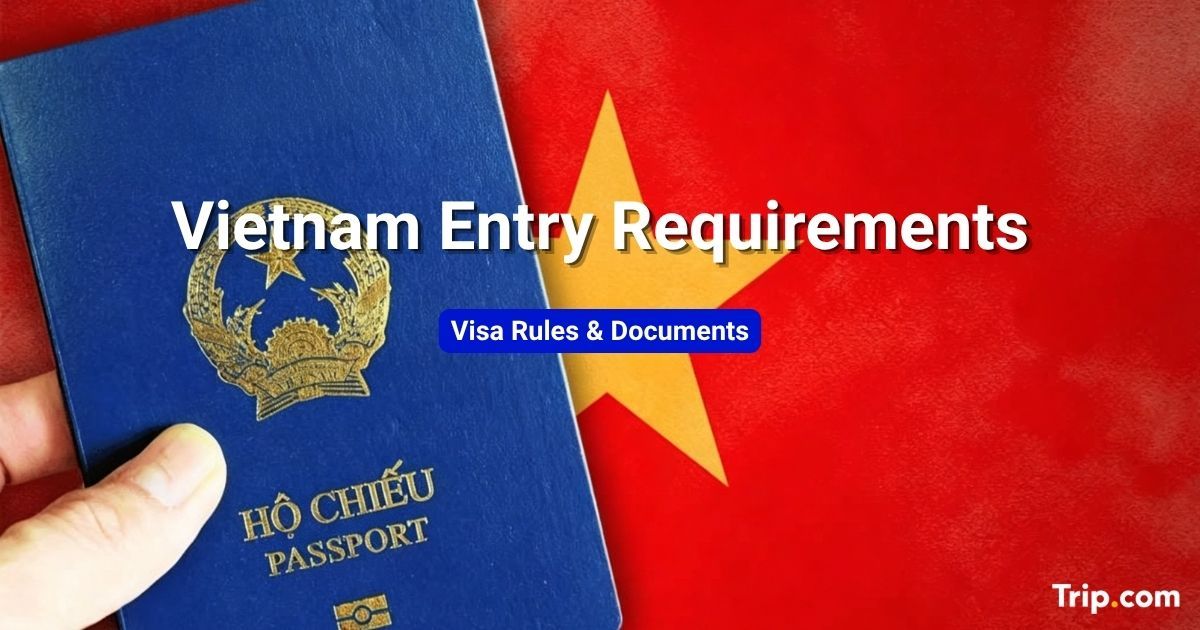
For years, Vietnam has been creeping onto the list of dream destinations in Southeast Asia. Between its cinematic landscapes, street food, and cities that never stop for a second, the curious thing is that every trip there feels different.
Given its popularity, many tourists wonder whether a visa is required for Vietnam and what the entry requirements are for visiting this fascinating country.
One thing you definitely need to keep in mind is that Vietnam has started requiring a Digital Arrival Card at certain airports—a new procedure that many travellers aren't yet aware of. That's why, here at Trip.com, we're breaking it down step-by-step so you can travel to Vietnam without any surprises.
Whether you need a visa to travel to Vietnam depends on your nationality and how long you plan to stay. While some travellers can enter visa-free for short tourist visits, most visitors now use the Vietnam e-Visa, which can be applied for online before travelling.
In general, there are three main ways to enter Vietnam as a tourist:
Some of the most common entry categories are listed below:
Category | Eligible Countries | Permitted Duration | Key Requirements |
Visa-Free (45 Days) | United Kingdom, France, Germany, Italy, Spain, Japan, South Korea, and several European countries | Up to 45 days | Passport valid 6+ months, 2 blank pages, onward ticket |
Visa-Free (ASEAN) | Thailand, Singapore, Malaysia, Indonesia, Cambodia, Laos | Up to 30 days (Philippines: 21 days; Brunei: 14 days) | Passport valid 6+ months, onward ticket |
E-Visa | All countries and territories globally (including US, Canada, Australia, India, etc.) | Up to 90 days | Apply online before travel, passport valid 6+ months |
Visa on Arrival | Emergency travellers, business visitors, approved tour groups | Usually 30–90 days | Pre-approved visa letter, passport photos, airport stamping fee |
Embassy Visa | Long-term workers, investors, selected nationalities | Varies | Embassy application, supporting documents, sponsor may be required |
Vietnam offers visa-free entry to travellers of various nationalities, particularly those from Europe and Asia, for short tourist stays. Simply put, if your country is on this list, you can head straight there without needing to apply for a visa, provided you stick to the maximum permitted duration:
Vietnam offers visa-free entry to citizens of several countries, although the permitted stay depends on your nationality. Here's a simple overview:
Visa-Free Stay | Countries / Regions |
Up to 90 days | Chile, Panama |
Up to 45 days | United Kingdom, France, Germany, Italy, Spain, Russia, Japan, South Korea, Denmark, Sweden, Norway, Finland, Belgium, Bulgaria, Croatia, Czech Republic, Hungary, Luxembourg, Netherlands, Poland, Romania, Slovakia, Slovenia, Switzerland |
Up to 30 days | Belarus, Cambodia, Indonesia, Kazakhstan, Kyrgyzstan, Laos, Malaysia, Mongolia, Singapore, Thailand |
Up to 21 days | Philippines |
Up to 14 days | Brunei, Myanmar |
These days are counted from the moment you enter the country and cannot be extended without leaving and re-entering or applying for a new visa. Plus, agreements can change, so it's always a good idea to check them before you travel.
On the other hand, there are quite a few countries whose citizens do need to arrange a visa for Vietnam before travelling. Here are a few examples:
Visa Requirement | Countries / Regions | Notes |
Visa required before travel | United States, Australia, Canada, India, New Zealand, China (including Hong Kong and Macau), South Africa | Most travellers apply for a Vietnam e-Visa online |
Visa required (most nationalities) | Most countries in Africa, the Middle East, South America (except Chile and Panama), and large parts of Asia (except ASEAN countries and selected visa-exempt nations) | Visa type and duration vary by nationality |

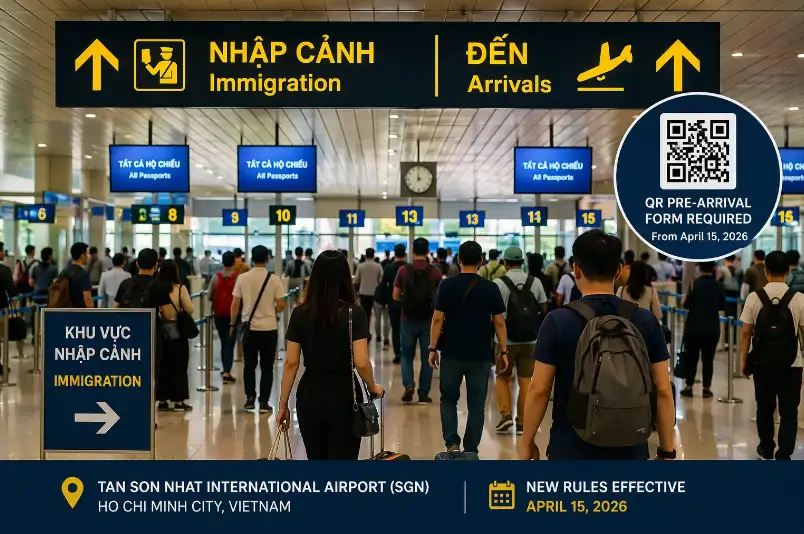
As of 15 April 2026, Vietnam has started implementing a new mandatory digital declaration for international travellers arriving at Tan Son Nhat International Airport (SGN) in Ho Chi Minh City.
This measure is part of the country's digitisation process for immigration controls and is expected to be gradually rolled out to more Vietnamese airports. The so-called Vietnam Digital Pre-Arrival Card must be completed online before you travel, generating a QR code that you'll need to show when you reach immigration control.
Aspect | Details |
Current airports | Tan Son Nhat (SGN) mandatory |
Planned expansion | Hanoi (HAN) and Da Nang (DAD) |
When to complete it | Within 72 hours before your flight |
Official website | prearrival.immigration.gov.vn |
Final result | QR code sent by email |
Cost | Free of charge |
Vietnam CK
Currently, almost all foreign travellers are required to complete this digital arrival card for Vietnam, including:
Vietnam CK
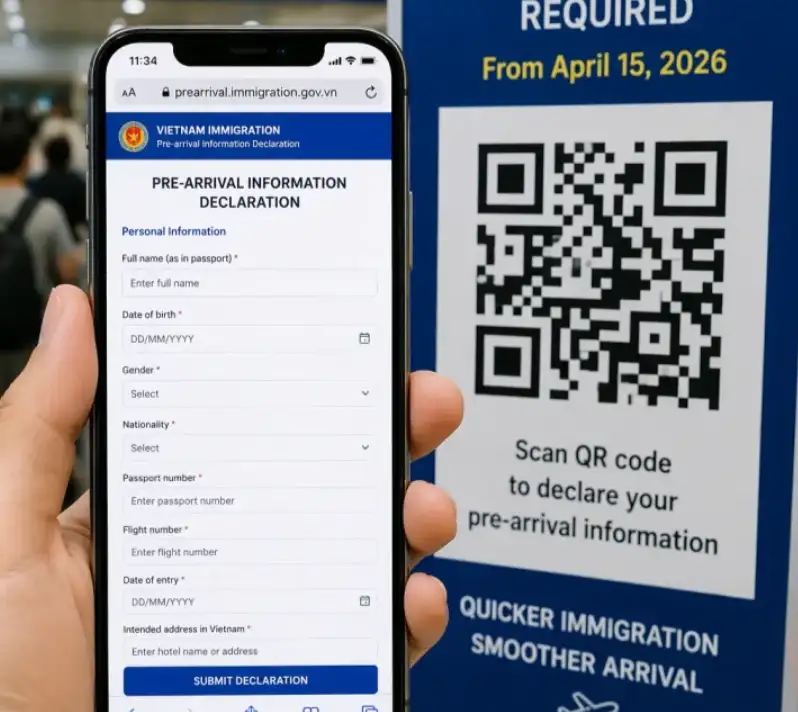
The digital entry card for Vietnam is completed entirely online, and the process usually takes just a few minutes. That said, it's a good idea to have a few documents ready before you start to make everything go a little faster.
Before you access the form, you'll usually need:
Next, head over to the official Vietnam immigration portal:
https://prearrival.immigration.gov.vn/
Once you're inside, you'll need to:
Once you've finished the form, you'll receive a QR code via email or directly on your screen.
Upon landing in Vietnam, you'll need to show:
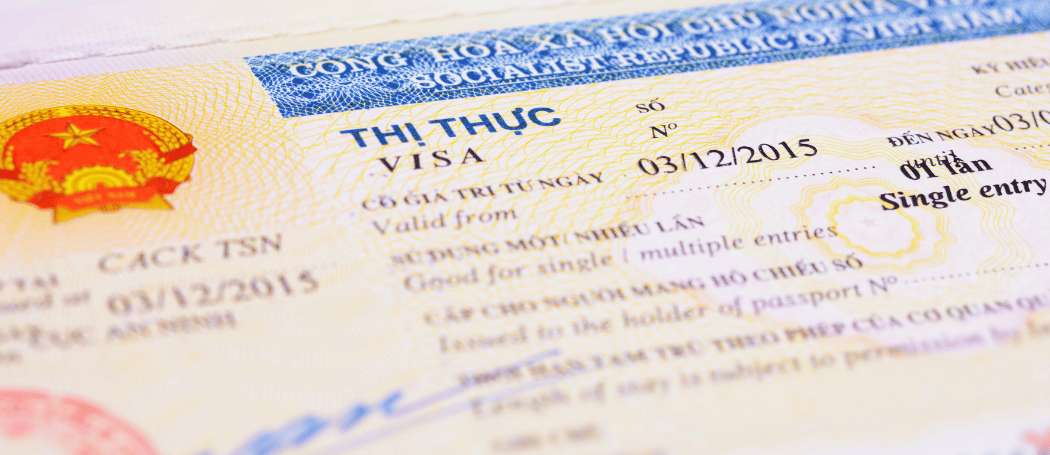
The Vietnam Visa on Arrival is a system that allows you to obtain your visa directly upon landing at the airport. However, there's an important detail to note: you can't just land and request the visa on the spot. Before you travel, you'll need a pre-approval letter issued online by an authorised agency.
The thing is, this system only works at certain international airports and is primarily designed for travellers who aren't using the Vietnam e-Visa or who require a specific type of entry.
To use the Vietnam visa on arrival, you'll typically need:
📌 Keep an eye on this, as the fee usually needs to be paid in cash and in US dollars. Also, you'll need to head to the VOA counter before going through standard immigration control.

The Vietnam NA1 form is the official entry and exit document used for the Visa on Arrival process. Simply put, it's the application you hand over at the airport along with your passport, photos, and approval letter so that immigration can issue your visa.
In this form, you'll need to include your personal details, passport information, travel dates, and basic entry details for the country. It's best to fill it out calmly and ensure everything matches your passport exactly to avoid any errors.
The NA1 form should primarily be completed by:
Who is exempt from the NA1 form?
Regardless of the type of visa you use, there are a few basic documents that the Vietnamese authorities may ask to see upon your arrival:
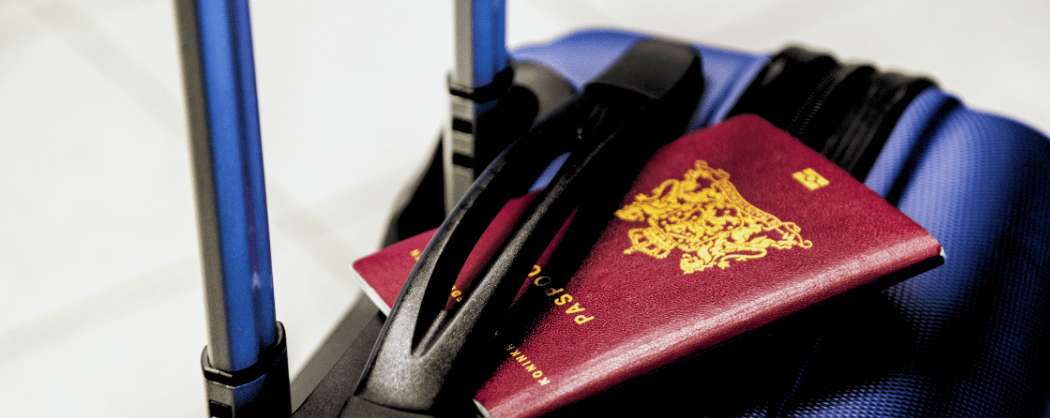
To get started, your passport is the most important thing. It must have at least 6 months' validity remaining from your date of entry and, what's more, include two blank pages for immigration stamps.
Remember that passports that are damaged, have torn pages, or are heavily worn can lead to extra questions at immigration. And that's no joke, especially when you're on long international connections.

Vietnam may also ask for proof of onward travel. Essentially, they want to ensure you won't be staying longer than permitted. This could be a return flight to your home country or a ticket to another destination in Southeast Asia.

Then there's accommodation. Usually, a hotel or Airbnb booking is enough, or even an invitation letter if you're staying with someone. To be honest, showing your booking on your phone is generally fine, though having an offline copy downloaded never hurts in case you don't have internet when you land.
If you're travelling with a Vietnam e-visa, it's highly recommended that you carry a printed copy. This is because some immigration checkpoints or airlines still prefer to check printed documents, especially on international flights with layovers.
At airports where the Vietnam Digital Pre-Arrival Card is already in operation, you'll need to show the QR code generated when you completed the online form. Having a screenshot or the QR code saved offline can save you a lot of time if the airport Wi-Fi is slow or not working at all.
👉 Pro tip: to avoid relying on WiFi, you can use an eSIM for Vietnam from just £0.27.
Documents you need to prepare before travelling to Vietnam
Document | Description |
Valid passport | At least 6 months' validity remaining and two blank pages |
Outbound ticket | Proof that you will leave Vietnam within the permitted timeframe |
Accommodation booking | Hotel, Airbnb, or an invitation letter |
Travel Itinerary | Planned dates and destinations |
Printed e-Visa | Mandatory if required by your nationality |
Pre-Arrival Digital QR Code | Mandatory at airports where it has already been implemented |
NA1 Form | For Visa on Arrival only |
Passport-sized photos | Required for some VOA procedures |
Travel insurance | Highly recommended for medical assistance |

Before travelling, many people wonder if mandatory vaccinations are required to enter Vietnam. The truth is that most travellers do not need any compulsory vaccinations to enter the country.
That said, there are several vaccinations for travelling to Vietnam that doctors often recommend, especially if you're planning to head into rural areas, go on long treks, or spend a significant amount of time travelling through different regions.
Recommended vaccinations for travelling to Vietnam
Vaccination | Recommended |
Hepatitis A | Yes |
Hepatitis B | Yes |
Tetanus | Yes |
Typhoid fever | Yes |
Rabies | By trip type |

One of the most common questions before travelling is how long you can stay in Vietnam without running into any immigration issues. And, of course, there isn't a single answer to this, as it all depends on the type of entry you use.
On one hand, some countries enjoy visa-free entry for short stays. Then there's the Vietnam e-Visa, which currently allows for a much longer stay in the country. And finally, there's the Visa on Arrival, although it's used far less frequently these days.
This is the typical duration for each type of authorisation:
Entry Type | Permitted Duration |
Visa exemption (UK passport holders) | Up to 45 days |
Vietnam e-Visa | Up to 90 days |
Visa on Arrival (VOA) | Depends on approval letter |
✈️ Book your flight + hotel in Vietnam at the best price on Trip.com.