China SIM Card 2026: eSIM vs Physical SIM vs WiFi Egg

Contents
- China SIM Card 2026 | Mainland Internet Options Compared
- Mainland Internet Options | Key Features at a Glance
- Mainland Internet Options | Pros, Cons and Real-World Experience
- Which China SIM Card? Quick Picks by Travel Scenario
- China SIM Card 2026 | Physical SIM Cards
- Prepaid SIM Cards | Short and Medium-Term Cross-Border Options
- Monthly Plans | Long-Term Contracts and One Card, Two Numbers
- China SIM Card 2026 | eSIM Data Plans
- eSIM Data Plans | Which Type Should You Buy?
- China SIM Card 2026 | Portable WiFi Egg
- China SIM Card 2026 | 10 Best Prepaid Cards for Hong Kong Travellers
- 1. China Unicom HK – 3-day China call and data card
- 2. China Mobile Hong Kong (CMHK) Duck Chat 5G 15GB/20GB 365-day China and Macau data card
- 3. 3 Hong Kong (3HK) – 365-day 18GB/33GB plan with unlimited data for China, Hong Kong and Macau
- 4. 3 Hong Kong (3HK) – International Universal Card (4 regions, 395 days, 20GB; bronze and silver versions)
- 5. China Mobile Hong Kong (CMHK) Duck Chat 5G 10GB/15-day China and Macau data card
- 6. CSL – 365-day China, Hong Kong and Macau prepaid card
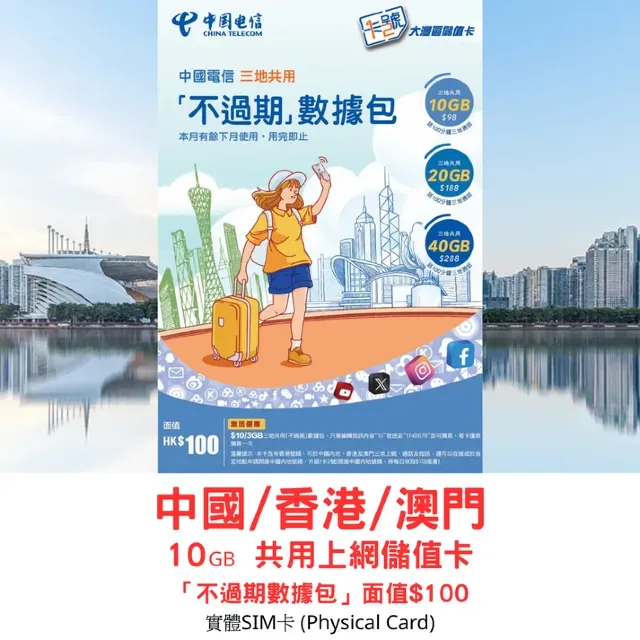
- 7. China Telecom – Greater Bay Area prepaid card
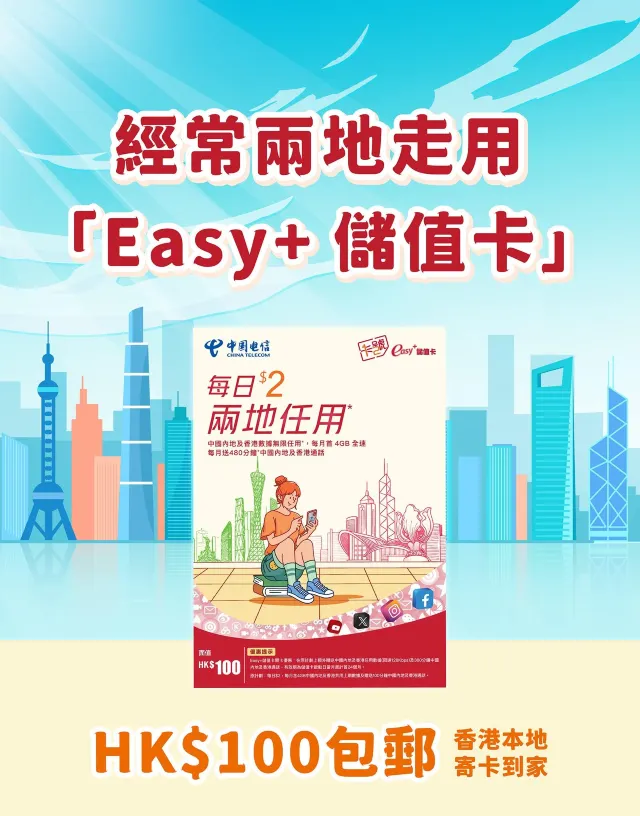
- 8. China Telecom – Easy+ prepaid card
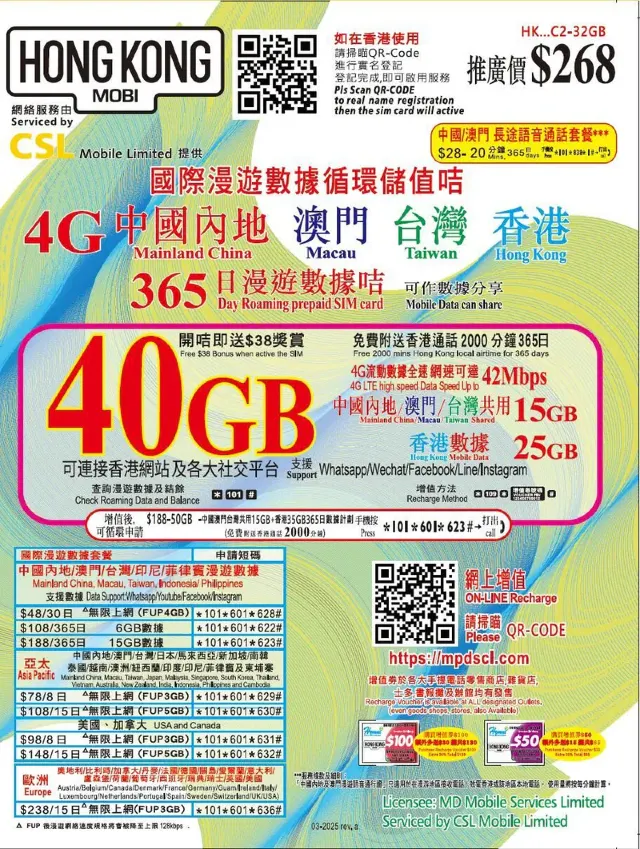
- 9. HK MOBILE (CSL network) – 40GB annual card for 4 regions: mainland China, Hong Kong, Macau and Taiwan
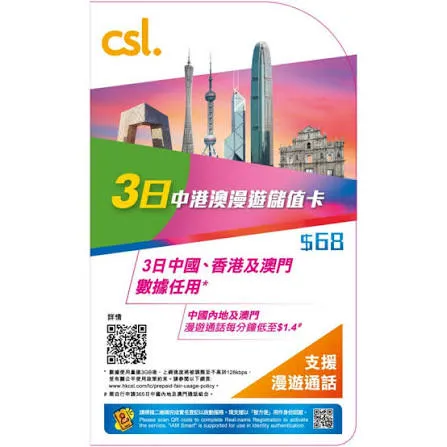
- 10. CSL – 3-day China, Hong Kong and Macau roaming prepaid card
- China SIM Card 2026 | How to Top Up
- China SIM Card 2026 | Frequently Asked Questions
- 1. Do I need real-name registration for a mainland China SIM card?
- 2. What are the new rules for activating a China Unicom CUniq prepaid card on the mainland?
- 3. For a trip of a few days, should I choose a physical SIM or an eSIM?
- 4. How does a Greater Bay Area card differ from a regular mainland card?
- 5. Why do mainland cards sometimes come with a one-year contract, and can I cancel early?
- 6. Is the mainland number on a one-card-two-numbers SIM a real, permanent number that can receive verification codes?
Show more
Travelling from Hong Kong to mainland China? A reliable data connection is now as essential as your Home Return Permit. With prepaid SIM cards, eSIMs and portable WiFi eggs all competing for attention, and prices, data limits and real-name rules varying so widely, choosing the right one can feel overwhelming.
Quick verdict: for a 3–7 day trip, buy an eSIM. It activates instantly and needs no real-name registration. If you cross the border often or need a mainland phone number, choose a Hong Kong prepaid SIM with a Greater Bay Area plan. Travelling in a group? A portable WiFi egg connects several devices at once. And if you rely on Google, WhatsApp or Instagram, pick a roaming card that routes through Hong Kong, because mainland-only cards block them.
| Option | Best for | Typical price | Coverage | Real-name & overseas apps |
| Physical SIM card | Long-term northbound travel, Greater Bay Area commuting, anyone who needs a local number | HK$25–200 | Mainland China, or China–Hong Kong–Macau roaming versions | Mainland-issued cards need real-name registration with your Home Return Permit or passport; Hong Kong roaming cards usually do not |
| eSIM (virtual SIM) | 3–7 day trips, data only, no calls needed | HK$30–80 | Mainland China, or China–Hong Kong–Macau roaming plans | Cards bought through Hong Kong channels need no real-name registration; roaming plans can still reach overseas apps |
| Portable WiFi egg | Families or groups travelling together, 3–5 devices | HK$50–150 | Mainland China nationwide | No real-name registration; roaming models work with overseas apps, local models have restrictions |
| Option | Data and calls | Pros | Cons |
| Physical SIM card | Unlimited or capped data, and most plans include local call minutes | Stable signal, hotspot sharing, and its own phone number | Swapping cards is a hassle, poor value for short trips, and a fixed expiry date |
| eSIM (virtual SIM) | Mostly 4G unlimited data, with speeds throttled after the cap | No card to insert: scan a QR code and you are online | Not supported on older phones, some plans block hotspot sharing, and long-term top-ups add up |
| Portable WiFi egg | Generous bandwidth shared across several devices | No phone settings to change, and one device connects the whole group | Bulky, needs charging, and some budget models overstate their data allowance |
| Travel scenario | Recommended option | Why it works |
| 3–5 day short sightseeing trip | eSIM | Activates in minutes and costs little, which is enough for maps, messaging and browsing |
| Several trips a month, with calls to make | Hong Kong prepaid SIM with long validity | Low long-term cost, with reliable calls and data |
| Daily cross-border commuting in the Greater Bay Area | Greater Bay Area data card | One card covers Guangdong, Hong Kong and Macau, with no city-by-city switching |
| Travelling with family or friends | Portable WiFi egg | Split the cost and connect everyone on a single device |
| You rely on Google, WhatsApp and Instagram | China–Hong Kong–Macau roaming card | Traffic routes through Hong Kong, so overseas apps work without a VPN |
Not sure where to start? Match your trip to one of these:
Pick your plan around three things: how long you are staying, how many people are travelling, and which apps you need. Get those right and you stay connected from the moment you arrive.
A physical SIM is still the default option for most travellers. You slot it into your phone's SIM tray and it handles both calls and data.
The main advantage is stability. Whether you are in a busy city centre or out in the suburbs, the connection holds up. Hotspot sharing is supported, so transferring files or streaming video will not stall. Each card also comes with its own phone number, which makes it easy for family, friends and business contacts on the mainland to reach you, and local call rates are reasonable.
The drawbacks are just as clear. Swapping cards is fiddly, because you will be pulling your everyday SIM in and out. Cards issued by mainland operators require real-name registration with your Home Return Permit or passport, which takes extra time. And because they carry a fixed expiry date, they are poor value for a trip of just a few days.
| Prepaid card | Validity | Data and speed limit | Price (HK$) | Coverage | Calls, SMS and notes |
| China Unicom HK CUniq Cross-Border King (Enhanced) | 30-day data package; card valid until you stop topping up | 10GB full-speed, shared across three regions. Data stops when used up, or you buy an add-on. | About 128–150 | Mainland China, Hong Kong, Macau | Local and mainland call minutes included. One SIM with two numbers, and it must be activated in Hong Kong before you travel. |
| China Mobile Hong Kong (CMHK) Greater Bay Area 4G/5G prepaid card | 10-day or 30-day prepaid card | 12GB shared across three regions. Buy a roaming data add-on once you hit the cap. | About 108–138 | Mainland China, Hong Kong, Macau | Roaming call minutes included. Runs on China Mobile's mainland network with 5G support. |
| 3 Hong Kong (3HK) China–Hong Kong–Macau roaming prepaid card | 30-day prepaid card | 15GB shared across three regions. Data stops when used up. | About 88–98 | Mainland China, Hong Kong, Macau | Basic calls and SMS receiving. Switches automatically between 4G and 5G and can be topped up repeatedly. |
| China Telecom International CTExcel China–HK–Macau prepaid card | 30-day prepaid card (HK$100 face value) | 15GB shared across three regions. Data stops when used up. | About 100 | Mainland China, Hong Kong, Macau | Calls and SMS included. A Hong Kong IP address means overseas apps work without a VPN, and you can apply for a mainland number. |
| China Unicom 15-day China–Hong Kong roaming card | 15-day prepaid card | 8GB shared across two regions. Data stops when used up. | About 88 | Mainland China, Hong Kong | Data only, with no calls. Suits two-week family visits or short business trips. |
| 7-day 4G mainland China data card (widely sold on Apliu Street) | 7 days | 5GB full-speed in total, then throttled to 128kbps | About 38–55 | Mainland China nationwide | Data only, with no calls or SMS. A budget card that runs on mainland operators' networks. |
| Birdie Asia and mainland roaming day pass | Charged per day and bought in the app | 500MB high-speed per day, then throttled to 128kbps | About 25–28 per day | Mainland China and several Asian destinations | Data only, with call packs available. Activate any day in the app without swapping your SIM. |
| Club SIM China and Macau roaming package | Per day, or 7-day and 30-day bundles | 3GB to 10GB, then throttled to 128kbps | About 68–128 | Mainland China, Hong Kong, Macau | Data only, with call packs sold separately. For HKT customers: buy and activate in the app. |
| China Mobile Hong Kong (CMHK) 30-day cross-border prepaid card | 30-day prepaid card | 20GB in total. Data stops when used up. | About 168 | Mainland China, Hong Kong | Includes a small allowance of call minutes. Good for frequent border crossers who do not want a contract. |
| Plan | Contract | Data and speed limit | Monthly fee (HK$) | Coverage | Calls, SMS and notes |
| China Mobile Hong Kong (CMHK) Greater Bay Area service plan | 24-month contract, monthly fee | 30GB to 200GB, then throttled but unlimited | About 228–428 | Guangdong, mainland China, Hong Kong, Macau | Greater Bay Area calls and SMS included. Comes with a mainland number, ideal for bank and app verification codes. |
| China Unicom HK CUniq Greater Bay Area 5G plan | 24-month contract, monthly fee | 20GB to 100GB, then throttled to around 128kbps | About 198–398 | Mainland China, Hong Kong, Macau | Three-region call minutes included. Built-in compliant roaming keeps overseas apps working smoothly. |
| CSL / 1O1O Greater Bay Area service plan | 24-month contract, monthly fee | 15GB to 50GB, with speed limits set by the contract | From about 288 | Mainland China, Hong Kong, Macau | Call minutes to Hong Kong and Macau included. Premium network priority for very stable calls and data. |
| 3 Hong Kong (3HK) Greater Bay Area monthly plan | 24-month contract, monthly fee | 20GB to 80GB, then throttled | About 188–358 | Mainland China, Hong Kong, Macau | Greater Bay Area calls included. A good-value long-term cross-border plan. |
| China Mobile Hong Kong (CMHK) One SIM, Multiple Numbers add-on | Add-on to an existing monthly plan | Shares your main SIM's data | About 29 plus fees | Mainland China | Receiving mainland SMS is free and sending is charged. Adds a mainland number to your Hong Kong number. |
| China Unicom HK CUniq One Card Two Numbers plan | 24-month contract, monthly fee | 15GB to 60GB, then throttled but unlimited | About 168–328 | Mainland China, Hong Kong | Three-region call minutes included. A budget monthly plan for regular cross-border travel. |
| Mainland operators' M-Zone and Shenzhouxing 5G plans | Mainland contract, monthly fee | 20GB to 50GB, throttled to mainland standard | About RMB 59–129 | Mainland China nationwide | Mainland call minutes included. You must apply in person at a mainland branch with your Home Return Permit. |
| Mainland operators' 5G Ice Cream and King Card plans | Mainland contract, monthly fee | 30GB to 100GB, throttled to mainland standard | About RMB 79–199 | Mainland China nationwide | Mainland call minutes included. Popular native-number plans for residents and long-term commuters. |
| China Telecom Tianyi Greater Bay Area One Card Two Numbers plan | 24-month contract, monthly fee | 20GB to 50GB, with speed limits set by the contract | About 198 | Mainland China, Hong Kong, Macau | Three-region call package included. China Telecom's network keeps Greater Bay Area coverage steady. |
An eSIM is a digital SIM, with no plastic card to lose. You install it by scanning a QR code, and it is ready to use. Over the past two years it has become the go-to choice for short trips.
The appeal is convenience. There is nothing extra to carry: buy online before you leave, install it in advance, and it works the moment you land. Most eSIM plans sold in Hong Kong skip real-name registration entirely, and validity periods are flexible, with 3, 5 and 7-day options that fit short itineraries exactly.
There are real limitations too. Older handsets do not support eSIM at all, so check your model first. Many plans block hotspot sharing, which is awkward when you travel with others. And if you cross the border often, stacking up monthly eSIM plans quickly costs more than one long-validity physical SIM.
Quick check: dial *#06# on your phone. If an EID number appears, your device supports eSIM.
Today's China, Hong Kong and Macau eSIMs route traffic through Hong Kong, so overseas social media and search apps work normally. That is a big reason they are popular with travellers.
eSIM plans fall into three broad groups. Match yours to the trip below.
3–7 day roaming eSIM (mainland China, Hong Kong and Macau)
Mainland-only short-term eSIM
Long-stay business eSIM (30 days or more)


A portable WiFi egg, or pocket WiFi, is a small battery-powered router. Switch it on and it broadcasts its own network, so phones, tablets and laptops can all connect. It is the easiest way to keep a group online.
Its strength is compatibility. It does not care about phone model or operating system, so anything with WiFi can join and there are no phone settings to change. One device can host several gadgets at once, and splitting the rental between a few people brings the per-person cost right down. You also do not hand over personal documents to rent one, which is better for privacy.
Day to day, though, there are annoyances. The device has real bulk and weight, so it takes up room in a daypack and is awkward to carry while shopping. It runs on battery, which means carrying a power bank for long days out. And some cheap models deliver noticeably less usable data than advertised.
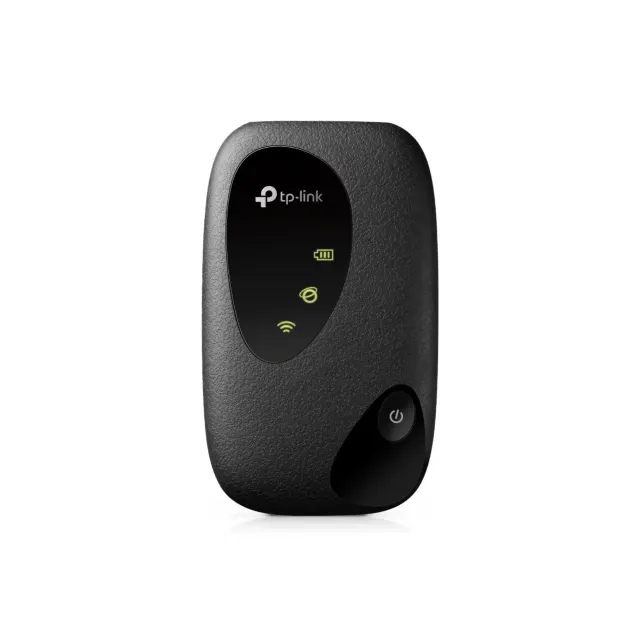
(Image: TP-Link M7000 4G LTE mobile WiFi)
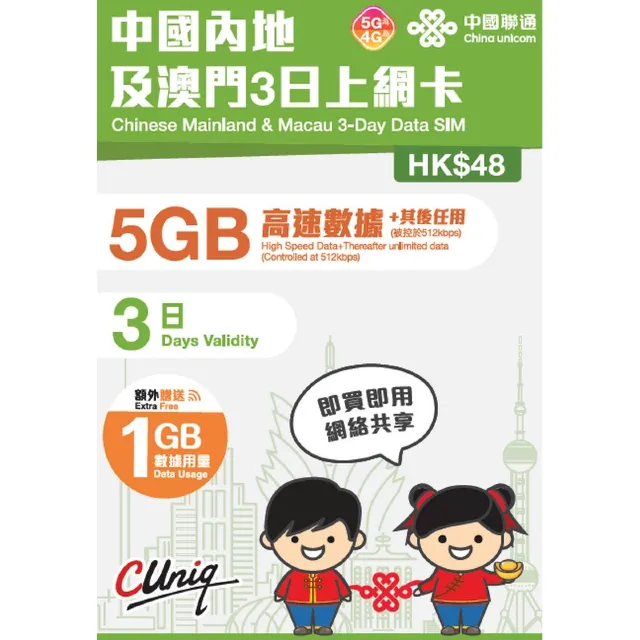
(Photo: Wellcome)
Price: HK$32 (includes 1GB free)
Coverage: mainland China and Macau
Data: 5G/4G service. After the 6GB fair-usage limit, data still works but slows down, never below 512kbps. Network sharing and peer-to-peer transfers are not supported.
Cards activated on or after 1 April 2026 receive bonus data.
Validity: 3 days, counted from activation until 23:59 Hong Kong time on day three.
SIM type: nano, micro or standard 3-in-1, fits any phone
Offer valid until 30/06/2027
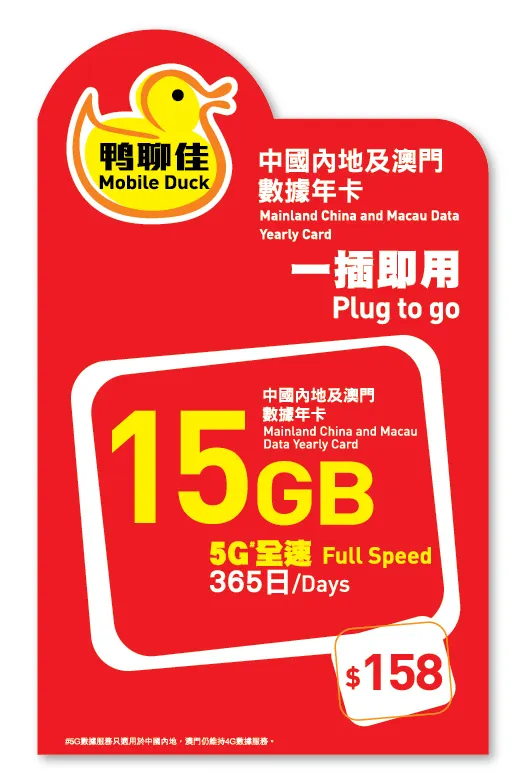

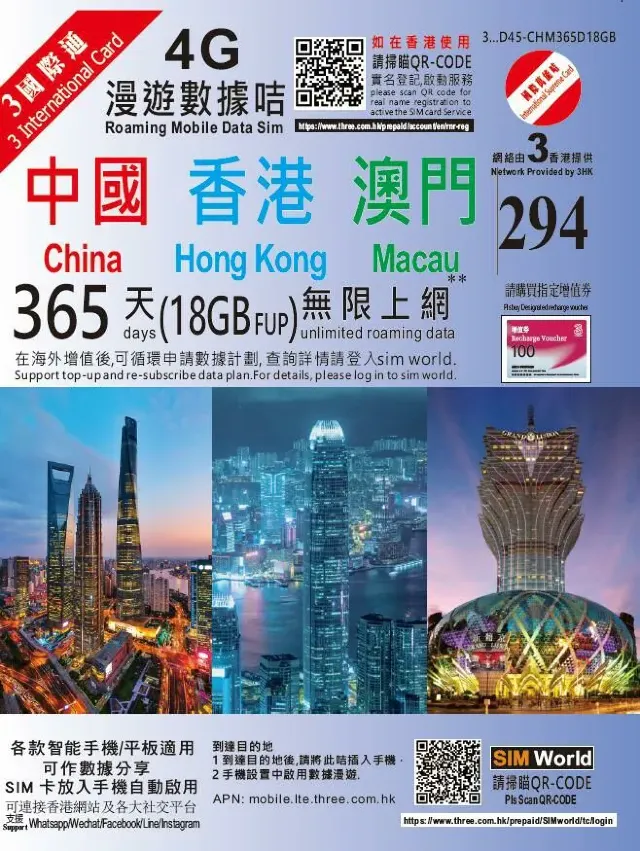
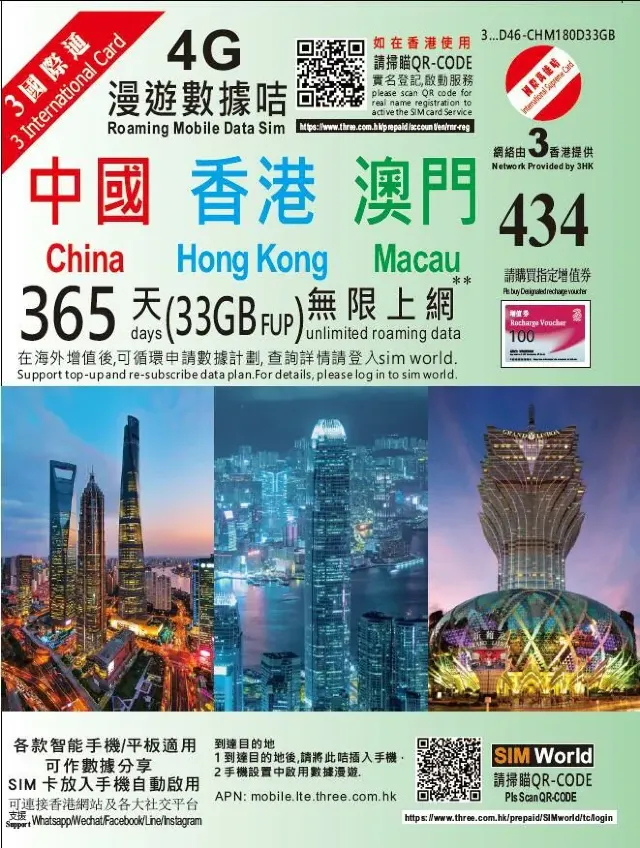
- Suggested retail price: about HK$150–220
- Data: 18GB or 33GB high-speed, then unlimited data at reduced speed
- Coverage: mainland China, Hong Kong and Macau
- Validity: 365 days
- Note: on the mainland this card runs on China Telecom's 4G network. No registration or setup is needed in the mainland or Macau, just turn data roaming on.
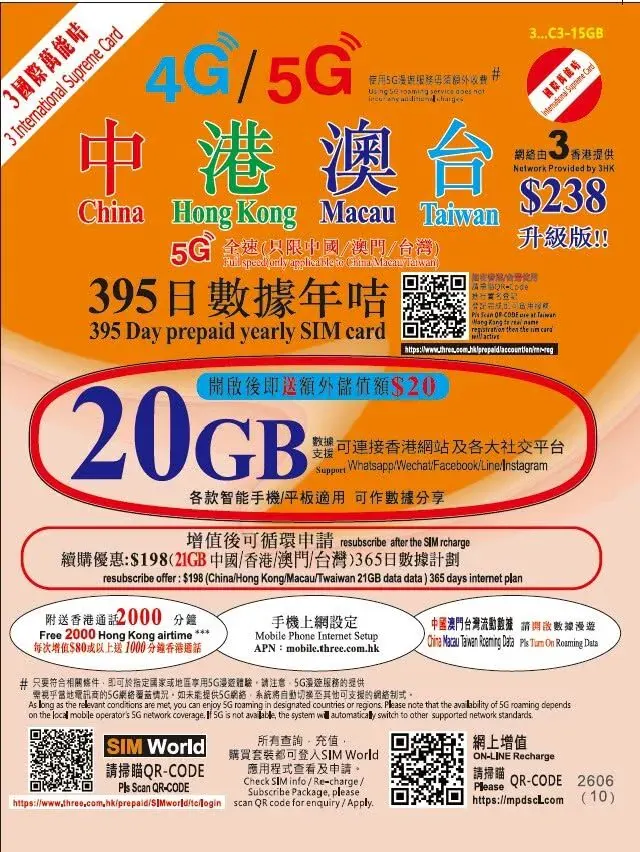
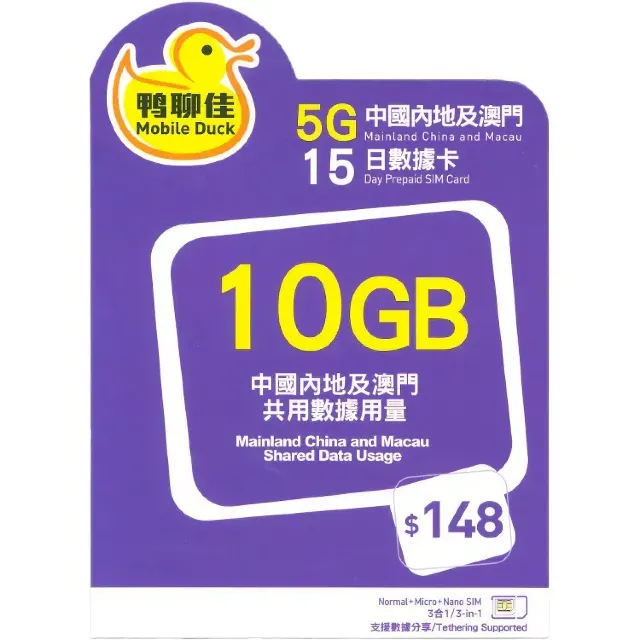
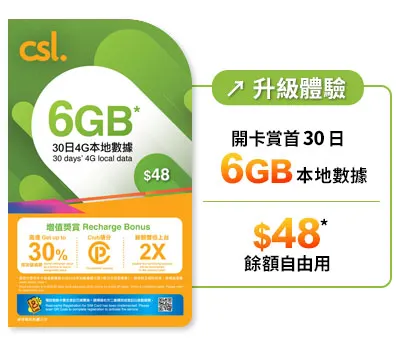
Prepaid cards usually come with top-up instructions on the packaging or on an insert. Follow the issuer's steps and your card's validity period is extended.
Major Hong Kong and mainland operators, including China Mobile, CSL and 3 Hong Kong, also run online top-up portals. Enter the card number and the amount on the provider's website and the credit is applied.
It depends on the issuer. Cards issued directly by mainland operators must be registered with a valid document such as your Home Return Permit or a passport, and without one they cannot be activated. Roaming and regional prepaid cards from Hong Kong operators are much more relaxed, and eSIMs bought through Hong Kong channels need no registration at all.
Since 1 August 2026, China Unicom's CUniq service no longer activates newly issued prepaid SIMs inside mainland China. Insert and activate the card in Hong Kong or another approved location outside the mainland before you cross the border, because a new card inserted after you arrive will not activate. The change follows the latest mainland rules on cross-border SIM activation.
Start with your phone and how you travel. iPhones and mainstream Android flagships released after 2018 generally support eSIM, and a virtual card means no swapping SIM trays, which makes it ideal for a short trip. If your handset is older and does not support eSIM, a physical SIM is your only option.
Coverage is the clearest difference. A Greater Bay Area card focuses on Guangdong, Hong Kong and Macau, giving steady signal for cross-city commuting without switching network modes, so it suits people who stay within the region. A regular mainland card covers every province, which makes it better for multi-province trips. On price, regional cards are usually cheaper, while national cards keep a single consistent rate.
In 2026 most mainland telecom stores offer a RMB 5 number-retention card with a one-year minimum contract, mainly to stop large numbers of users holding numbers they barely use. Cancelling early triggers a penalty fee, and in the first six months a ringback-tone service is often added automatically at extra cost, so ask the clerk to remove it before you buy.
Yes. It sits in an independent mainland number range and can receive verification SMS from Taobao, Alipay, food delivery apps, banks and social platforms, so it works for long-term number retention. As long as you keep the plan active, the number stays yours.
Popular recommendations

The Best Things to Do in Ho Chi Minh City
 _marialina___
Guide to Notting Hill Carnival 2023
_marialina___