2026 FIFA World Cup Travel Guide: Transport, Visa, Things to Do & Practical Tips

Contents
- How to Get to World Cup 2026: Transport Across the USA, Canada & Mexico?
- Flights, Trains, Buses or Car Rental: How to Travel Between the USA, Canada and Mexico?
- How to Get to the Stadium in Each World Cup 2026 Host City?
- Money-Saving Transport Tips and Matchday Transit Perks
- Matchday Payment Guide: How to Pay in the USA, Canada & Mexico
- Payment basics: USA vs Canada vs Mexico
- Stadium payments: many venues may be cashless
- What to prepare before matchday
- Practical payment tips for fans
- World Cup 2026 Visa Requirements: USA, Canada & Mexico
- Quick visa comparison
- USA: ESTA, B1/B2 visa and FIFA PASS
- USA visa checklist
- Canada: eTA or visitor visa
- Canada entry checklist
- Mexico: visa-free entry, Mexican visa or exemption
- Mexico entry checklist
- Multi-country visa planning example
- Things to Do During World Cup 2026: Landmarks, Fan Festivals & Sports Bars
- A practical plan is simple:
- Top Landmarks in World Cup 2026 Host Cities
- FIFA Fan Festival: Big-Screen Matches, Fan Activities and Live Entertainment
- Best Sports Bars in Host Cities for Watching World Cup 2026
- How to Choose the Best Area to Stay
- Best Stay Strategy by Host City
- Hotel Booking Tips for World Cup 2026
- Match Safety, Practical Checklist & Final Travel Tips
- Travel Safely To, Around and From Events
- Know the Venue Rules Before Matchday
- Stay Alert in Crowded Areas
- Follow Local Alerts and Emergency Updates
- Prepare for Local Weather
- Have an Emergency Plan
- Final Matchday Checklist
- Final Travel Tips
Show more
The 2026 FIFA World Cup is one of the biggest football events in the world — and the 2026 edition is especially important for travellers because it is hosted across three countries. Here is what fans need to know before planning a trip:
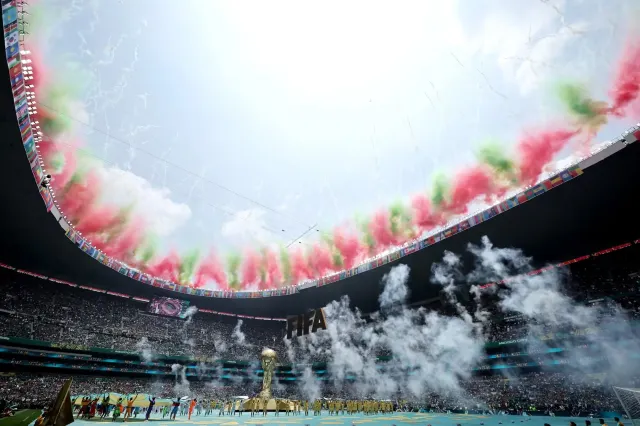
source:fifa.com
Host countries and cities
The most important planning rule: build your route around regions, not around random matches. North America is large, and moving between distant cities can take most of the day even by plane.
| Country | Host cities |
| USA | Atlanta, Boston, Dallas, Houston, Kansas City, Los Angeles, Miami, New York/New Jersey, Philadelphia, San Francisco Bay Area, Seattle |
| Canada | Toronto, Vancouver |
| Mexico | Guadalajara, Mexico City, Monterrey |
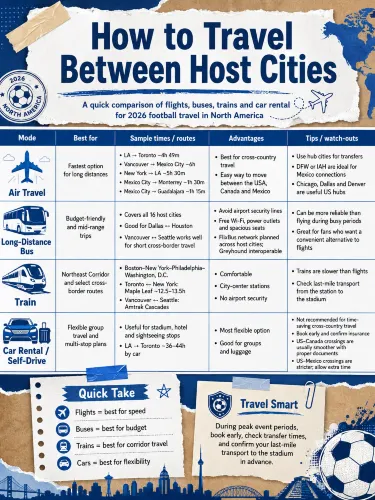
Transport planning depends on how many matches you want to attend and whether they are in the same region. For one match, choose the easiest route to the host city and focus on local transport. For several matches, check whether your route makes sense by flight time, border rules and recovery time between games.
| Route type | Best option | Why |
| Hotel to stadium | Public transport, shuttle, rideshare | Avoids parking and road closures |
| Same metro area | Metro, train, bus, rideshare | Usually cheaper and easier than driving |
| Nearby host cities | Train, bus or short flight | Depends on schedule and border control |
| Long-distance USA routes | Flight | Distances are too large for most buses/trains |
| USA ↔ Canada | Flight or selected land routes | Check visa/eTA rules and border time |
| USA ↔ Mexico | Flight | Usually faster and easier for match schedules |
| Within Mexico | Domestic flight or bus | Flights save time between major cities |
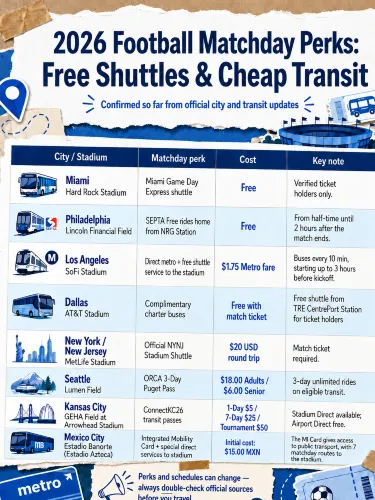
Local transport will vary by host city, so fans should check the matchday plan for their specific stadium before travelling. In some cities, the easiest option may be public transport; in others, official shuttles, special matchday buses or pre-booked parking may be more convenient.
Some host cities are already expected to offer useful matchday transport options, such as free shuttles, discounted transit passes or direct stadium services. These can help fans avoid traffic, reduce parking costs and get to the venue more smoothly.
Current examples of matchday transit options include:
| Host city / stadium | Matchday transport option | What fans should know |
| Miami — Hard Rock Stadium | Miami Game Day Express shuttle | Listed as free for verified ticket holders |
| Philadelphia — Lincoln Financial Field | SEPTA free rides home from NRG Station | Expected from half-time until around 2 hours after the match ends |
| Los Angeles — SoFi Stadium | Metro connection + free shuttle service | Metro fare applies; shuttle buses may run frequently before kick-off |
| Dallas — AT&T Stadium | Complimentary charter buses | Listed as free with a match ticket from TRE CentrePort Station |
| New York/New Jersey — MetLife Stadium | Official NYNJ Stadium Shuttle | Match ticket required; listed as a paid round-trip shuttle |
| Seattle — Lumen Field | ORCA 3-Day Puget Pass | Useful for unlimited eligible transit rides during a short stay |
| Kansas City — GEHA Field at Arrowhead Stadium | ConnectKC26 passes and Stadium Direct service | Transit passes and direct stadium service may help fans avoid driving |
| Mexico City — Estadio Banorte / Estadio Azteca | Integrated Mobility Card + special stadium routes | Useful for public transport access and direct matchday routes |
Before matchday, fans should check:
- the nearest metro, train, bus or light rail station;
- whether official matchday shuttles are available;
- where shuttle stops are located;
- whether the service is free or paid;
- whether a match ticket is required to use the service;
- how early buses or trains start before kick-off;
- how long services run after the match;
- whether parking must be booked in advance;
- road closures and security zones around the stadium.
For most fans, public transport or official shuttles will be easier than driving. Stadium parking can be limited, expensive or affected by road closures, while rideshare pick-up points may be moved farther from the stadium because of crowd control.
A good matchday plan should answer three questions in advance: how you will get to the stadium, how much extra time you need for crowds and security checks, and how you will return to your hotel after the match.
Transport can become one of the hidden costs of a World Cup trip, especially if you use rideshare apps before and after every match. The best way to save money is to plan your route around public transport, official shuttles, multi-day transit passes or matchday transport perks.
Some host cities may offer free or discounted transport options for fans. Based on current updates, examples may include free shuttle services, direct stadium buses, free post-match rides from selected stations, or multi-day transit passes. For example, some cities have listed options such as free shuttles for verified ticket holders, direct stadium services, discounted metro connections or city transit passes.
To reduce transport costs during World Cup 2026:
- choose a hotel near a metro, train, bus or shuttle stop, not just near the stadium;
- check whether your match ticket gives access to free or discounted transport;
- compare the cost of a transit pass with single rides or rideshare trips;
- avoid relying on rideshare immediately after the match, when prices may rise;
- check whether official shuttles are free or require a separate ticket;
- use multi-day passes if you are staying in one host city for several days;
- avoid booking a cheap hotel far from public transport, as taxi costs can cancel out the savings;
- check whether parking is paid, limited or requires advance booking.
For budget-conscious fans, the most useful strategy is to plan both directions in advance: how to get to the stadium and how to return after the match. Post-match transport can be more difficult because of crowds, road closures and high rideshare demand.
Before travelling, always double-check the latest city, stadium or transit updates. Matchday perks, shuttle schedules and prices may change closer to the tournament.
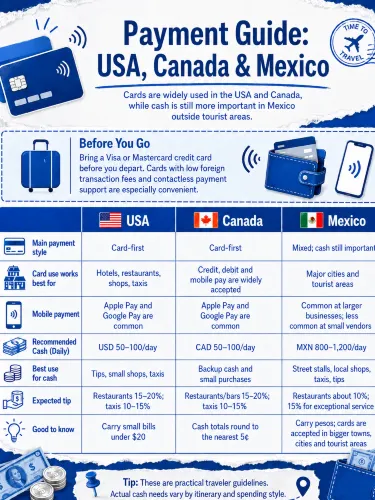
Payment habits are not the same across the three World Cup 2026 host countries. The USA and Canada are mostly card-first, while Mexico is more mixed: cards are common in major cities and tourist areas, but cash is still useful for smaller vendors, street food, taxis and tips.
Before travelling, bring at least one Visa or Mastercard credit/debit card, preferably with low foreign transaction fees and contactless payment support. It is also useful to have a mobile wallet such as Apple Pay or Google Pay, plus some local cash as a backup.
| Payment point | USA | Canada | Mexico |
| Main payment style | Card-first | Card-first | Mixed; cash still important |
| Cards work best for | Hotels, restaurants, shops, taxis/rideshare | Hotels, restaurants, shops, transport, taxis/rideshare | Major cities, hotels, restaurants and tourist areas |
| Mobile payments | Apple Pay and Google Pay are common | Apple Pay and Google Pay are common | Common at larger businesses; less common at small vendors |
| Suggested cash to carry | USD 50–100 per day | CAD 50–100 per day | MXN 800–1,200 per day |
| Best use for cash | Tips, small shops, taxis | Backup cash, small purchases | Street stalls, local shops, taxis, tips |
| Common tipping guide | Restaurants 15–20%; taxis 10–15% | Restaurants/bars 15–20%; taxis 10–15% | Restaurants around 10%; 15% for exceptional service |
| Good to know | Carry small bills under USD 20 | Cash totals may round to the nearest 5 cents | Carry pesos; cards are easier in bigger cities and tourist areas |
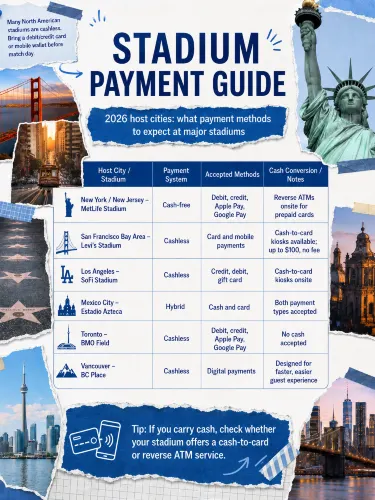
Many North American stadiums use cashless or cash-free payment systems. This means you may need a debit card, credit card, prepaid card or mobile wallet to buy food, drinks or merchandise inside the venue.
Based on current venue payment information, fans can expect different systems depending on the stadium:
| Payment system | Accepted methods | Cash notes |
| Cash-free | Debit card, credit card, Apple Pay, Google Pay | Reverse ATMs may be available for prepaid cards |
| Cashless | Card and mobile payments | Cash-to-card kiosks may be available |
| Cashless | Credit card, debit card, gift card | Cash-to-card kiosks may be available onsite |
| Hybrid | Cash and card | Both payment types may be accepted |
| Cashless | Debit card, credit card, Apple Pay, Google Pay | No cash accepted |
| Cashless | Digital payments | Designed for faster, easier purchases |
If you plan to carry cash, check whether your stadium offers a cash-to-card kiosk or reverse ATM. These machines allow fans to convert cash into a prepaid card that can be used inside the venue.
Before going to the stadium, prepare:
- one main international card;
- one backup card;
- mobile wallet if available;
- some local cash for transport, tips or small purchases outside the stadium;
- small bills for tips;
- a portable charger;
- offline hotel address and return route.
Do not rely on only one payment method. Your phone battery may run out, mobile payment may not work, or your bank may block an overseas transaction. A backup card and a small amount of cash can help avoid problems.
- Use cards for hotels, restaurants, stadium purchases and major transport apps.
- Carry local currency for small shops, tips, markets and taxis.
- In Mexico, keep more cash than you would in the USA or Canada, especially outside tourist areas.
- Check your card’s foreign transaction fees before departure.
- Save your bank’s emergency contact number in case your card is blocked.
- At cashless stadiums, check whether cash-to-card kiosks are available before entering.
- Keep some cash separate from your wallet as backup.
Because stadium payment systems and cash policies can change, always check the latest official stadium rules before matchday.
Visa planning is the most important part of a multi-country World Cup trip. There is no single “World Cup visa” that covers the USA, Canada and Mexico. Entry requirements depend on your passport, route, visa history, travel method and length of stay.
Check visa rules before booking non-refundable flights or hotels. If your trip includes more than one country, check each country separately.
| Country | You may need | Key point |
| USA | ESTA or B1/B2 visitor visa | FIFA PASS helps with appointment access only; it is not a visa |
| Canada | eTA or visitor visa | Requirements can depend on whether you fly or enter by land/sea |
| Mexico | Visa-free entry, Mexican visa or visa exemption | Some travellers can enter with valid visas/residence from selected countries |
For World Cup matches in the United States, most international visitors will need one of the following:
- ESTA if they are eligible under the Visa Waiver Program;
- B1/B2 visitor visa if they are not eligible for ESTA or prefer/need a visa;
- valid existing U.S. visa if they already have one and it matches the purpose of travel.
ESTA is for eligible travellers visiting the U.S. for tourism or business for short stays. It must be approved before boarding a U.S.-bound flight or sea carrier. However, ESTA approval does not guarantee entry; the final decision is made at the U.S. port of entry.
If you are not eligible for ESTA, you normally need a B1/B2 visitor visa. This requires a DS-160 application, visa fee and usually an interview appointment.
FIFA PASS: If you purchased FIFA World Cup 2026 tickets directly through FIFA and need a U.S. visa, you may be able to use FIFA PASS, the FIFA Priority Appointment Scheduling System. It can help eligible ticket holders access a priority visa interview appointment. It does not guarantee visa approval.
- Before applying or travelling, check:
- Is your passport eligible for ESTA?
- Do you need a B1/B2 visa instead?
- Do you already have a valid U.S. visa?
- Does your travel purpose match tourism/event attendance?
- Have you completed DS-160 if applying for a visa?
- Have you checked appointment availability?
- If using FIFA PASS, did you buy tickets directly through FIFA?
- Do your FIFA account details match your visa application details?
- Do you have hotel and return/onward travel information?
Practical tip: if the USA is part of your route, solve the U.S. entry question first. It is often the most time-sensitive part because interview appointments can be limited.
For matches in Canada, travellers may need either an eTA or a visitor visa. The rule depends on nationality and travel method.
In many cases:
- visa-exempt travellers flying to Canada need an eTA;
- travellers from visa-required countries need a visitor visa;
- some travellers may be eligible for an eTA only if flying, but need a visitor visa if entering by land, bus, train or boat.
This matters for World Cup routes. For example, flying into Toronto may have a different document requirement from entering Canada by bus or car from the United States.
Check before booking:
- Do you need an eTA or visitor visa?
- Are you flying to Canada or entering by land/sea?
- Is your passport valid for the trip?
- If you already have a Canadian visitor visa, is it still valid?
- Do you need biometrics for a visitor visa?
- Are you entering Canada only once or multiple times?
- Do you have proof of hotel booking and return/onward travel?
Practical tip: if you plan to visit both the U.S. and Canada, check whether you need separate documents for each country. Having permission to enter one does not automatically allow entry into the other.
Mexico has separate entry rules. Depending on your nationality, you may be able to enter visa-free, need a Mexican visa, or use a visa exemption.
A common exemption: travellers who hold a valid visa or permanent residence from the United States, Canada, Japan, the United Kingdom or a Schengen country may be able to enter Mexico without a separate Mexican visa, regardless of nationality.
However, the document must be valid, and rules can change. Always check with the nearest Mexican embassy or consulate before travelling.
Before travelling to Mexico, check:
- Does your nationality require a Mexican visa?
- Are you eligible for visa-free entry?
- Do you hold a valid U.S., Canadian, Japanese, UK or Schengen visa/residence permit?
- Is your document valid for the entire trip?
- Do you have hotel details and return/onward travel?
- Are you entering by air or land?
- Do you need to complete any immigration form or online requirement before arrival?
Practical tip: if Mexico is your first entry point before travelling to the U.S. or Canada, make sure you also have the documents required for the next country.
| Route | What to check |
| Mexico City → Dallas → Toronto | Mexico entry + U.S. ESTA/visa + Canada eTA/visa |
| Vancouver → Seattle → Los Angeles | Canada entry + U.S. ESTA/visa |
| New York/New Jersey → Philadelphia only | U.S. entry only |
| Guadalajara → Monterrey → Mexico City | Mexico entry only |
| Toronto → New York/New Jersey → Mexico City | Canada entry + U.S. ESTA/visa + Mexico entry |
Do not schedule border crossings on the same day as a match unless there is no alternative. Immigration queues, flight delays, baggage problems or traffic can easily affect timing.

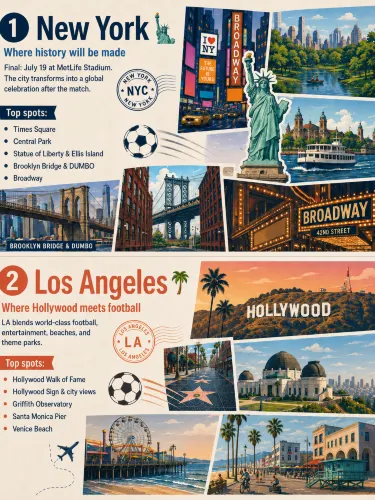
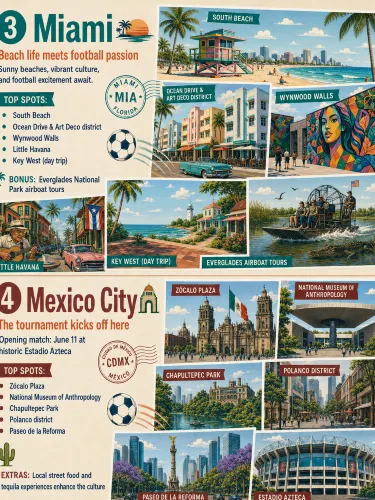
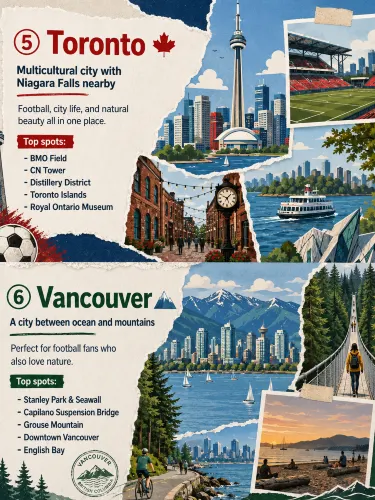
World Cup 2026 is also a chance to explore the host cities beyond the stadium. If your schedule allows, add at least one extra day before or after the match for sightseeing, food, fan events or a sports bar experience.
- on matchday: choose one nearby attraction, then leave early for the stadium;
- on non-match days: visit major landmarks, museums or neighbourhoods;
- without a stadium ticket: watch matches at a FIFA Fan Festival, fan zone or sports bar;
- with 2–3 extra days: add a short day trip, such as Niagara Falls from Toronto or Key West / Everglades from Miami.
Each host city has a different travel style. Some are better for classic sightseeing, some for beaches and nightlife, and others for nature or food.
| Host city | Best for | Top spots to consider |
| New York / New Jersey | First-time visitors, skyline views, final-match atmosphere | Times Square, Central Park, Statue of Liberty & Ellis Island, Brooklyn Bridge & DUMBO, Broadway |
| Los Angeles | Entertainment, beaches, city views | Hollywood Walk of Fame, Hollywood Sign viewpoints, Griffith Observatory, Santa Monica Pier, Venice Beach |
| Miami | Beaches, nightlife, Latin culture | South Beach, Ocean Drive & Art Deco District, Wynwood Walls, Little Havana, Key West day trip |
| Mexico City | History, museums, food, culture | Zócalo Plaza, National Museum of Anthropology, Chapultepec Park, Polanco, Paseo de la Reforma |
| Toronto | City life, multicultural food, Niagara Falls access | BMO Field area, CN Tower, Distillery District, Toronto Islands, Royal Ontario Museum |
| Vancouver | Nature, ocean views, outdoor activities | Stanley Park & Seawall, Capilano Suspension Bridge, Grouse Mountain, Downtown Vancouver, English Bay |
For matchdays, avoid attractions far from the stadium or far from your hotel. It is better to plan one simple activity in the morning, have an early meal, and leave for the stadium with extra time for crowds and security checks.
For non-match days, choose your itinerary by travel style:
| Travel style | Best idea |
| First-time visitor | Main landmarks and viewpoints |
| Family trip | Parks, museums, waterfront areas |
| Budget trip | Free landmarks, public spaces, local food |
| Friends trip | Food halls, nightlife, sports bars |
| Extra full day | Short side trip outside the city |
The FIFA Fan Festival is the official fan destination during the tournament. It is designed for fans who want to watch matches on big screens, enjoy live entertainment, join football-themed activities and experience the World Cup atmosphere without being inside the stadium.
Fan Festivals are especially useful if:
- you do not have a stadium ticket;
- you want to watch several matches in one place;
- you are travelling with friends or family;
- you want a more affordable matchday atmosphere;
- you prefer a public viewing experience with food, music and entertainment.
Typical Fan Festival features may include:
- big-screen match broadcasts;
- live music and entertainment;
- food and drink vendors;
- football activities and sponsor experiences;
- family-friendly areas;
- fan merchandise;
- public gathering spaces for supporters.
Entry rules may differ by city. In many locations, entry may be free or low-cost, but fans may still need advance registration, an online ticket, a QR code or a pass. Capacity limits, bag policies, age rules and opening hours can also vary.
Before going to a FIFA Fan Festival, check:
- whether entry is free, paid or registration-based;
- whether you need to reserve a pass online;
- opening dates and match broadcast schedule;
- bag policy and prohibited items;
- food and drink rules;
- whether the event is suitable for children;
- public transport options after evening matches.
A Fan Festival can be a good alternative to the stadium if you want the atmosphere without buying a match ticket. It can also be a useful backup plan for rest days between matches.

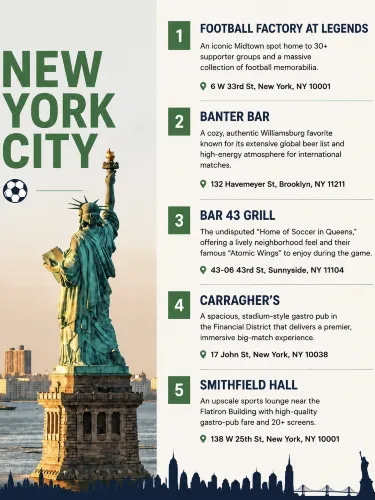
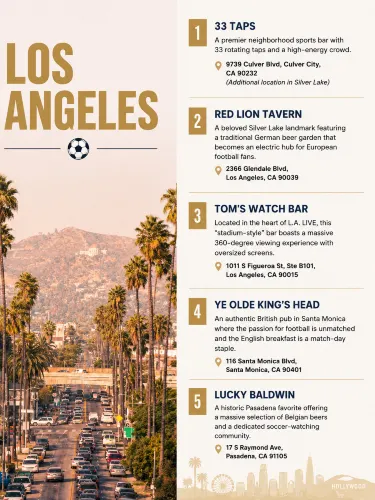
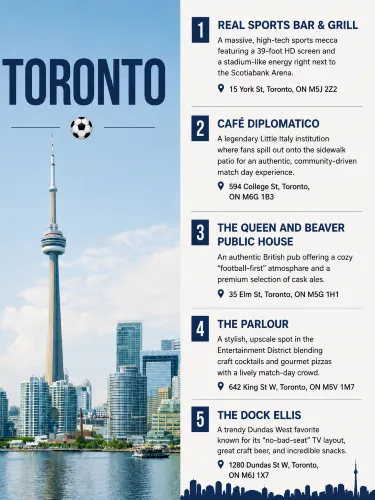
Sports bars are a good option if you want a more comfortable place to watch the match with food, drinks and multiple screens. They are especially useful for evening matches, group travel or games you cannot attend in person.
For popular matches, book early or arrive well before kick-off. Check whether the bar will show the match with sound, whether reservations are required, and whether there is a minimum spend.
Examples of sports bars from the host city guide include:
| City | Sports bars to consider | Best for |
| New York City | Football Factory at Legends, Banter Bar, Bar 43 Grill, Carragher’s, Smithfield Hall | Large football crowds, international supporter groups, classic sports bar atmosphere |
| Los Angeles | 33 Taps, Red Lion Tavern, Tom’s Watch Bar, Ye Olde King’s Head, Lucky Baldwin | Big screens, European football fans, beach-area or downtown viewing |
| Toronto | Real Sports Bar & Grill, Café Diplomatico, The Queen and Beaver Public House, The Parlour, The Dock Ellis | Stadium-style viewing, local crowd, downtown matchday atmosphere |
| Vancouver | Shark Club Sports Bar & Grill, The Park Pub, The Pint Public House, Red Card Sports Bar + Eatery, Score on Davie | High-energy viewing, downtown access, group watching |
| Mexico City | Cantina Salón Ríos, Cantina El Centenario, Salón Corona, Twin Peaks, Pinche Gringo BBQ | Local cantina atmosphere, tacos, large-screen viewing, group crowds |
Before choosing a sports bar, check:
- if the match will be shown live;
- whether the bar will play match sound;
- reservation policy;
- minimum spend;
- age restrictions;
- food and drink menu;
- distance from your hotel;
- late-night transport options.
Sports bars can be a better choice than a fan zone if you want a seat, table service and a more predictable viewing experience. Fan zones are better if you want a bigger outdoor crowd and festival atmosphere.
Where to Stay Near Stadiums and Host Cities
Choosing where to stay during World Cup 2026 is not only about finding a hotel close to the stadium. In many host cities, the better choice may be a hotel near public transport, a shuttle stop, the city centre or the airport.
A hotel near the stadium can be convenient on matchday, but it may not always be the best option for sightseeing, restaurants or airport transfers. Before booking, compare the stadium route, transport options, cancellation policy and how easy it will be to return after an evening match.
| Stay area | Best for | Watch out for |
| Near the stadium | One-match trips, walking distance, simple matchday plan | Fewer sightseeing options, higher prices, limited hotel choice |
| City centre | First-time visitors, food, nightlife, sightseeing | Longer stadium commute, crowded transport after matches |
| Near public transport | Most fans, especially without a car | Check late-night service after evening matches |
| Near the airport | Early flights, short stopovers, multi-city routes | Less atmosphere, longer trip to city attractions |
| Near fan zones / sports bars | Fans without tickets or watching several matches | Can be noisy and busy during major games |
| Host city | Stadium area | Best stay strategy |
| New York / New Jersey | MetLife Stadium, East Rutherford | Stay in Manhattan for sightseeing and transport options, or in Secaucus / Meadowlands for easier stadium access. |
| Los Angeles | SoFi Stadium, Inglewood | Stay near Inglewood or LAX for stadium access; choose Santa Monica, West Hollywood or Downtown LA for sightseeing. |
| Miami | Hard Rock Stadium, Miami Gardens | Stay in Miami Beach, Downtown or Brickell for the city experience; consider Aventura, Hollywood or Fort Lauderdale for easier access to the stadium area. |
| Mexico City | Estadio Azteca / Estadio Banorte area | Roma, Condesa, Polanco and Reforma are better for first-time visitors; stay farther south only if stadium access is your top priority. |
| Toronto | BMO Field / Exhibition Place | Downtown, Entertainment District, Waterfront and King West are convenient for sightseeing and stadium access. |
| Vancouver | BC Place | Downtown Vancouver, Yaletown, Gastown and Coal Harbour are practical because the stadium is close to the city centre. |
| Seattle | Lumen Field | Downtown, Pioneer Square, Waterfront and Capitol Hill work well for fans who want easy stadium access and city activities. |
| San Francisco Bay Area | Levi’s Stadium, Santa Clara | Stay in Santa Clara, San Jose, Sunnyvale or Mountain View for easier stadium access; stay in San Francisco only if sightseeing is the main priority. |
| Dallas | AT&T Stadium, Arlington | Arlington is best for stadium access; Dallas or Fort Worth may be better for nightlife, restaurants and airport connections. |
| Houston | NRG Stadium | Downtown, Museum District, Medical Center and areas near the METRORail Red Line can be practical for matchday. |
| Kansas City | GEHA Field at Arrowhead Stadium | Stay Downtown, Crossroads or Power & Light District for restaurants and fan atmosphere; check shuttle or driving options to the stadium. |
| Atlanta | Mercedes-Benz Stadium | Downtown and Midtown are practical for stadium access, restaurants and transport. |
| Boston | Gillette Stadium, Foxborough | Stay in Boston for sightseeing, or closer to Foxborough / nearby suburbs if matchday convenience is more important. |
| Philadelphia | Lincoln Financial Field, South Philadelphia | Center City, Old City and Rittenhouse are good for sightseeing; South Philadelphia is better for stadium-focused stays. |
| Guadalajara | Estadio Akron, Zapopan | Zapopan, Andares and Providencia are practical upscale areas; the historic centre is better for culture and sightseeing. |
| Monterrey | Estadio BBVA, Guadalupe | San Pedro Garza García and central Monterrey are better for restaurants and city stays; Guadalupe is closer to the stadium. |
Before booking a hotel, check:
- travel time from the hotel to the stadium;
- whether public transport or official shuttles are available;
- how you will return after an evening match;
- distance to the airport or train/bus station;
- cancellation policy;
- recent reviews;
- nearby restaurants and shops;
- whether prices are higher on match dates;
- whether the area is convenient for sightseeing or only for the match.
If you are attending only one match, staying near the stadium can save time. If you are staying for several days, a central area with good transport may be a better choice.
For multi-city trips, choose hotels that make airport transfers easy. A cheaper hotel far from transport can become more expensive once you add taxis, rideshare costs and extra travel time.
Large football matches can be crowded, loud and busy, especially during an international tournament. To make matchday smoother, prepare your route, documents, weather essentials and emergency plan before leaving your hotel.
Plan to arrive early. For major matches, it is safer to arrive 90 minutes to 2 hours before kick-off to avoid transport congestion, fan zone crowds and long security lines.
Before leaving for the stadium:
- check your route to the venue and your return route;
- save your ticket, hotel address and stadium map offline;
- be ready to show ID at different entry points;
- expect airport-style security, including metal detectors and bag checks;
- use only reputable taxi services or official ride-share apps;
- avoid unofficial drivers or people offering “special” transport near the stadium.
If you travel in a group, agree on a meeting point before entering the venue. Mobile networks may be slow around the stadium, so do not rely only on messaging apps.
Each stadium may have different rules for bags, food, drinks, cameras, power banks, flags and other personal items. Check the official venue rules before you go.
Important things to review:
- bag size limits;
- prohibited items;
- digital ticket rules;
- accepted payment methods;
- entry gate information;
- stadium opening time;
- medical tent locations;
- exits and emergency routes.
Bring only what you need. Large bags, outside alcohol, sharp objects, professional camera equipment or items that block other fans’ view may not be allowed.
Crowded public spaces can increase the risk of petty theft, lost items or confusion after the match. Stay aware of your surroundings, especially in queues, public transport, fan zones and busy streets near the stadium.
Practical safety tips:
- keep your passport in a secure place, not in an easy-to-access pocket;
- carry a copy of your passport instead of taking the original everywhere, if local rules allow;
- keep your phone and wallet close in crowded areas;
- avoid carrying too much cash;
- report unattended bags or suspicious behaviour to event staff or police;
- follow instructions from security staff, police and stadium workers.
A simple rule: if something feels unsafe, move to a busier, well-lit area or ask official staff for help.
Before and during your trip, monitor local news, weather updates and official event information. Host cities may send alerts about severe weather, road closures, transport changes or emergency situations.
You can also:
- sign up for local emergency notifications where available;
- download official city or transit apps;
- check weather alerts before leaving the hotel;
- follow stadium or host city updates on official channels;
- keep your phone charged throughout the day.
In the USA, Canada and Mexico, 911 is the main emergency number for police, fire and ambulance services.
World Cup 2026 takes place in summer, so weather can vary a lot depending on the host city. Some places may be hot and humid, while others may have cooler evenings or rain.
| Region / country | Typical summer conditions | What to prepare |
| USA host cities | Around 70–85°F / 21–29°C, often warm and sunny | Light clothing, sunscreen, water, hat |
| Canada host cities | Around 65–80°F / 18–27°C, generally mild | Light layers, rain jacket, comfortable shoes |
| Mexico City | Around 60–80°F / 16–27°C, possible afternoon showers | Light jacket, umbrella or raincoat |
Weather risks can include heat, summer storms, heavy rain, flooding, wildfires, hurricanes or earthquakes depending on the region. Always check the forecast for your exact host city before travelling.
For hot weather:
- drink water regularly;
- wear loose, lightweight clothing;
- use sunscreen;
- bring a hat;
- avoid standing in direct sun for too long.
Watch for signs of heat-related illness, such as dizziness, confusion, rapid pulse, very hot skin or feeling faint. If this happens, move to a cooler place and seek medical help.
Before entering the stadium or fan zone, take a few minutes to understand the area.
Check:
- where the exits are;
- where medical tents are located;
- where security staff are stationed;
- where your group will meet if separated;
- how to leave the area after the match;
- where the nearest public transport stop or ride-share zone is.
If travelling with family or friends, make sure everyone knows the hotel address and has a way to contact the group.
Before leaving your hotel, check that you have:
- match ticket saved offline;
- passport or ID if required;
- phone with enough battery;
- portable charger;
- accepted payment card;
- small amount of local cash;
- hotel address saved offline;
- stadium route and return route;
- weather-appropriate clothing;
- sunscreen, hat or rain jacket depending on the forecast;
- emergency contacts;
- travel insurance information;
- any required medication.
- Arrive earlier than you normally would for a regular sports event.
- Do not bring items that may be rejected at security.
- Keep your passport, wallet and phone secure in crowded areas.
- Use public transport, official shuttles or reputable ride-share apps.
- Check weather and local alerts before leaving the hotel.
- Have a plan for getting back after the match.
- Follow instructions from event staff and local authorities.
Good planning will help you avoid the most common matchday problems: long queues, blocked roads, phone battery issues, payment problems, bad weather and difficulty getting back to your hotel after the final whistle.
Popular recommendations

Top 14 Hotels with Villas in Phuket
 _marialina___