 2081786 booked







Hotels: Save up to 10% (Book online or on Mobile)
Homes & Apts: Save up to £39 (App-only deal)

By Tina
October 16, 2026
Travelling to China today holds a surprise for first-timers: you can go for days without ever touching a banknote, as almost everything is paid for via QR codes. This is where Alipay and WeChat Pay come in—two apps that pretty much run everything. If you don't have them set up beforehand, things can get trickier than you might expect.
If you're wondering how to handle payments in China without losing your mind, at Trip.com we'll help you understand what each one offers, their real benefits, and which one you should have ready before you touch down.
China is almost entirely cashless, so understanding how to pay before you travel is more important than you might think. Here are some of the top payment methods to get you started:
The most popular payment methods in China
Method | Acceptance |
Alipay | ⭐⭐⭐⭐⭐ |
WeChat Pay | ⭐⭐⭐⭐⭐ |
Cash | ⭐⭐ |
Visa / Mastercard | ⭐⭐ |
UnionPay | ⭐⭐⭐⭐ |

Alipay is one of the most popular payment apps in China. In fact, if you're planning a trip to the country, it's highly likely you'll end up using it for almost everything: from paying in restaurants and supermarkets to catching a taxi or buying train tickets.
To put it simply, Alipay works via QR codes. You scan or get scanned, confirm the amount… and you’re done. No cash, no fuss. The beauty of Alipay is that it’s a quick method, works almost everywhere, and is also really well-adapted for tourists.
With Alipay, you can pay at:
What makes Alipay for tourists so useful isn't just that it works, but how it works.
This is where most people get a bit stuck… but honestly, if you follow the steps, you’ll have it sorted in just a few minutes.
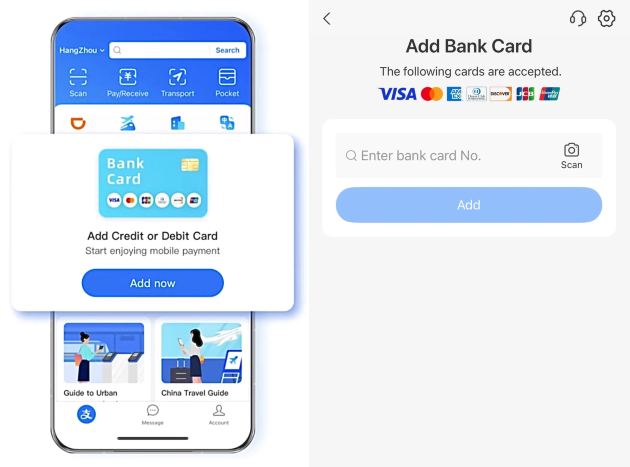
▶️ Download Alipay from the Play Store ▶️ Download Alipay from the App Store
👉 If you'd like to get a better handle on how it works, take a look at our full article on how to use Alipay in China as a foreigner.

WeChat Pay is the payment system integrated into WeChat, the most popular messaging app in China. While many people compare it to WhatsApp, it actually goes much further, allowing you to make payments, order services, book transport, and handle a whole host of other tasks, all from one single app.
As for how it works, it’s very similar to Alipay. You simply need to link a compatible card and pay by scanning a QR code or by showing your own for the merchant to scan. Payments are processed instantly, and you can use it at millions of establishments across the country.
The big difference is that WeChat Pay is part of the WeChat ecosystem. This means you can chat with friends, follow accounts, book services, and pay without ever leaving the app. That’s why, for many people living in China, it’s an essential part of their daily routine that they use constantly.
WeChat Pay might not be the easiest option to start with, but it’s certainly one of the most comprehensive once you’re up and running.
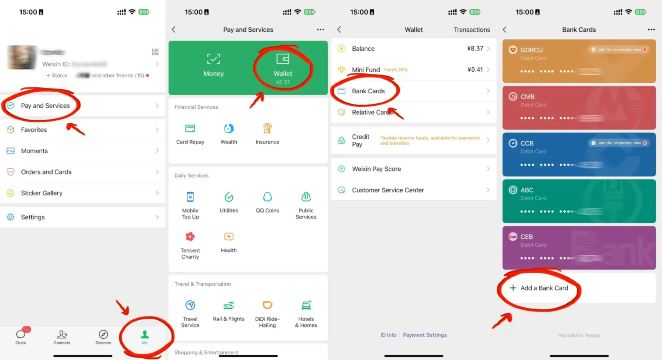
Now for the practical part. And yes, you can use WeChat Pay as a foreigner, but you need to make sure it’s set up correctly.
To get started, open the app and head to the ‘Me’ tab (bottom right). From there, go to ‘Services’ and then ‘Wallet’.
Once you're in, head to ‘Bank cards’ and tap ‘Add a bank card’.
From there:
▶️ Download WeChat from the Play Store ▶️ Download WeChat from the App Store
👉 And if you want to take it a step further, you can also check out our full article on how to pay with WeChat in China: a step-by-step guide.
When you're planning your trip, it's natural to think you have to choose one of these payment platforms, but the reality is a little more nuanced. To put it simply, both work, both can be used to pay, and both are everywhere.
The difference lies in how they adapt to you as a traveller.
Feature | 🔵 Alipay | 🟢 WeChat Pay |
QR payments | ✅ | ✅ |
International cards | ✅ | ✅ |
Didi | ✅ | ✅ |
Underground and transport | ✅ | ✅ |
Taobao | ✅ | ✅ |
Mini Apps | ✅ | ✅ |
P2P transfers for travellers | Limited | Very limited |
Tourist-friendly | ⭐⭐⭐⭐⭐ | ⭐⭐⭐ |
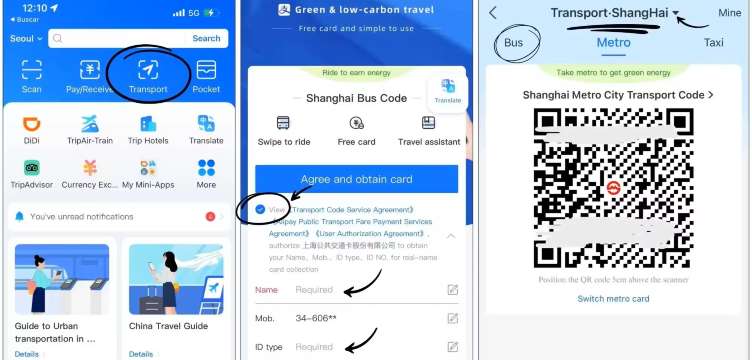
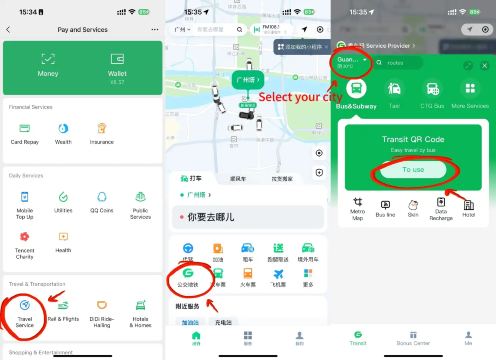
Getting around China is easier than you might think... as long as your phone is set up correctly. This is where Alipay and WeChat Pay really make a difference. The thing is, you can pay for almost all transport using QR codes or directly through the apps, so you can forget about the hassle of buying physical tickets every five minutes.

If you're planning to spend a few hours out and about, sooner or later you'll likely find yourself using one of the shared power banks dotted all over China. They’re incredibly handy, available to rent by the hour, and you’ll spot them in restaurants, shopping centres, metro stations, airports, and tourist attractions.
The yellow Jiedian power banks are, by far, the easiest to find. They’re practically everywhere, making them the most convenient choice when you’re running low on battery. To rent one, simply scan the QR code via Alipay or WeChat Pay and complete the payment. Within seconds, the power bank will unlock automatically.
📌 A quick heads-up for travellers: in many cases, you'll need a Chinese phone number or an active Chinese eSIM to complete the verification process.
The blue Xiaodian power banks work in much the same way. Just scan the QR code, make your payment, and take the battery from the station.
The upside is that they’re usually much easier for tourists to use, as you typically don’t need a Chinese phone number to complete the rental. The downside is the exact opposite of Jiedian: there are fewer stations available, so they can be a little trickier to track down depending on which city or area you’re exploring.
There’s no mystery here, but it’s worth being clear about it:

If there’s one thing you can’t do without on a trip to China, it’s a stable internet connection. That’s why we’re showing you how to get one:
When it comes to staying connected in China, the two most popular options are the eSIM and the physical SIM.
An eSIM is often the most convenient option for travellers. You can purchase yours before you jet off, install it in a matter of minutes, and land with your connection ready to go. It’s the perfect way to skip the hassle of hunting for a local shop or wasting precious time setting up a SIM card the moment you arrive.
A physical SIM remains a great alternative, especially for those who prefer a more traditional approach. Just keep in mind that you’ll usually need to pick one up at the airport or a local shop once you’ve arrived in China.
📶📱 Stay connected in China with a 5G eSIM from just £0.41. Activate it in seconds with a QR code and start using Alipay and WeChat Pay as soon as you land.
It depends on the apps you're planning to use. You won't need a VPN for Alipay, WeChat Pay, DiDi, local maps, or most other Chinese services. These apps work perfectly fine within the country.
However, if you're planning to use services like Google, Gmail, WhatsApp, Instagram, Facebook, or YouTube, it's highly recommended to have a VPN installed before you travel. China maintains restrictions on many Western platforms, and once you're in the country, downloading or setting up a VPN can be quite a bit trickier.
App | Works Without VPN? |
Alipay | ✅ |
✅ | |
Didi | ✅ |
Trip.com | ✅ |
Google Maps | ❌ |
❌ | |
❌ |
The best app for navigating travel in China
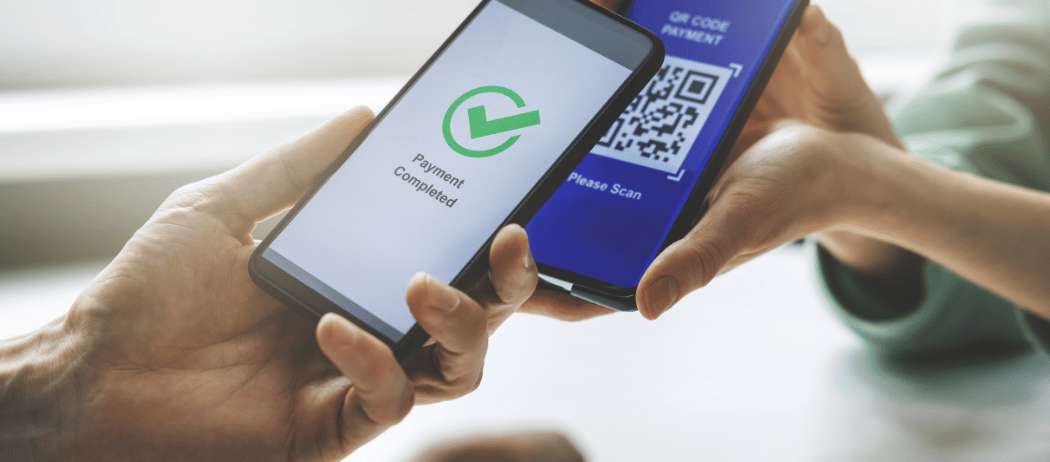
Once you’ve mastered payments, there’s another temptation: shopping. China is truly in a league of its own when it comes to online retail. In this Asian powerhouse, there are some clear differences between the apps, and it’s well worth knowing them.
To kick things off, Taobao and Tmall are the e-commerce giants in China. And here, Alipay reigns supreme. It’s seamlessly integrated, making payments instant.
Mind you, the interface is in Chinese, so it can be a bit chaotic if you're not used to it.
Next up is JD.com, which operates in a similar way but with a different approach.
Here, the integration with WeChat is even stronger. In fact, you can access JD directly from mini-apps within WeChat.

✈️ Book your flight + hotel in China at the best price on Trip.com.